
6. Registration Processes
- 6 Mins to read
-
DarkLight
6. Registration Processes
- 6 Mins to read
-
DarkLight
Article summary
Did you find this summary helpful?
Thank you for your feedback
Infant Formula
USA

This section provides information on any product notification or registration and manufacturing site registration processes.
6.1 Product Notification
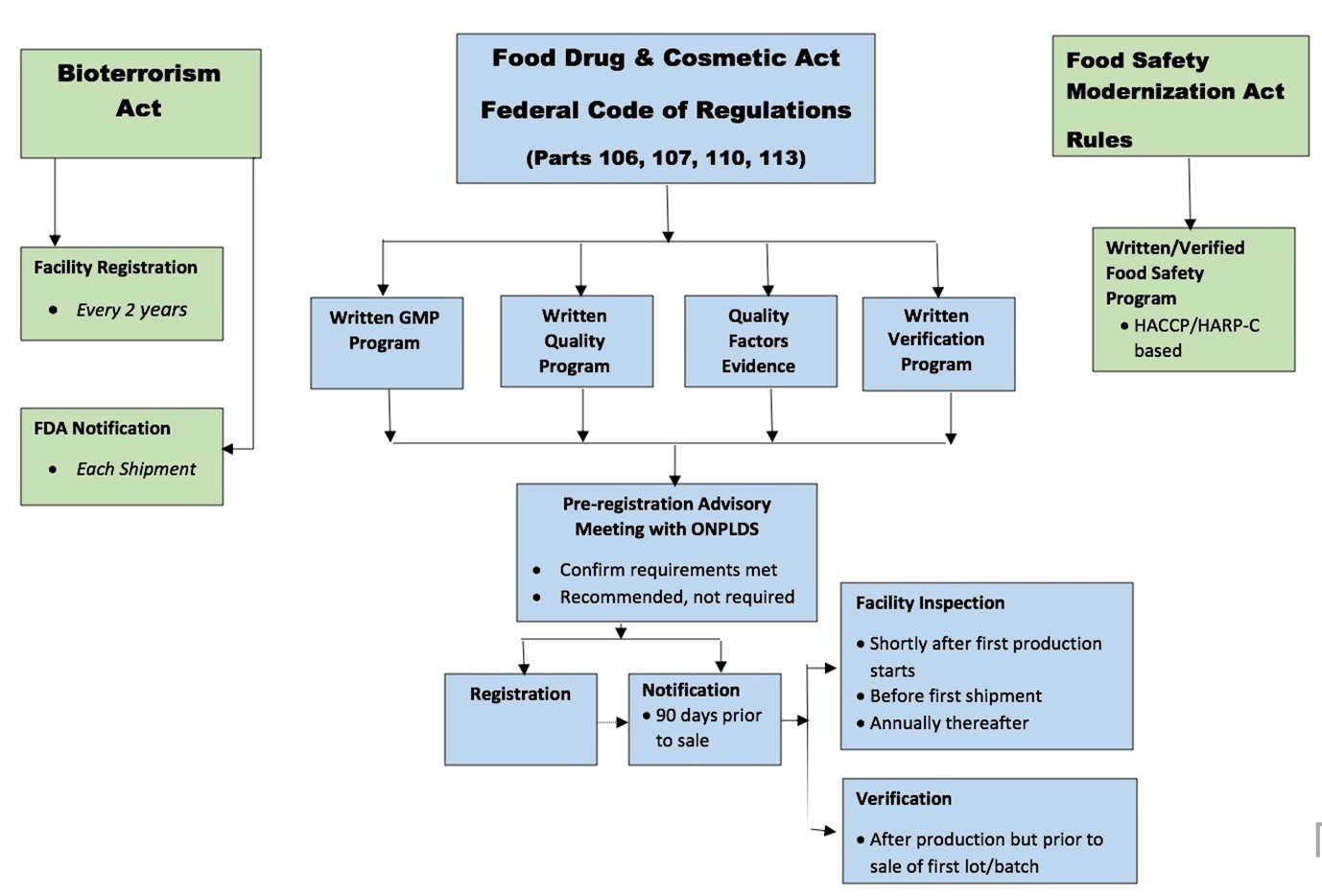
The Bioterrorism Act includes a requirement to notify the FDA prior to entry (prior notification). In other words, product notification to the FDA is required 90 days prior to sale (90-day notification requirement after registration).
6.2 Product Registration
Product registration is required, but the pre-market review is voluntary. The FDA does not approve infant formulas before they can be marketed.
US FDA, and in particular the Office of Nutritional Products, Labeling, and Dietary Supplements (ONPLDS) has program responsibility for infant formula. [1]
List of mandatory documents for product registration [2]:
"§106.110 New infant formula registration shall include:
- The name of the new infant formula;
- The name of the manufacturer;
- The street address of the place of business of the manufacturer; and
- The name and street address of each establishment at which the manufacturer intends to manufacture such new infant formula."
"§106.120 New infant formula submission:
A. At least 90 days before a new infant formula is introduced or delivered for introduction into interstate commerce, a manufacturer shall submit a notice of its intent to do so to the Food and Drug Administration at the address given in §106.110(a). An original and two paper copies of such notice of intent shall be submitted unless the notice is submitted in conformance with part 11 of this chapter, in which case a single copy shall be sufficient.
B. The new infant formula submission shall include:
- The name and description of the physical form (e.g., powder, ready-to-feed, or concentrate) of the infant formula;
- An explanation of why the formula is a new infant formula;
- The quantitative formulation of each form of the infant formula that is the subject of the notice in units per volume or units per weight for liquid formulas, specified either as sold or as fed, and units per dry weight for powdered formulas, and the weight of powder to be reconstituted with a specified volume of water, and, when applicable, a description of any reformulation of the infant formula, including a listing of each new or changed ingredient and a discussion of the effect of such changes on the nutrient levels in the formulation;
- A description, when applicable, of any change in the processing of the infant formula. Such description shall identify the specific change in processing, including side-by-side, detailed schematic diagrams comparing the new processing to the previous processing and processing times and temperatures;
- Assurance that the infant formula will not be marketed unless the formula meets the requirements for quality factors of section 412(b)(1) of the Federal Food, Drug, and Cosmetic Act (21 U.S.C. 350a(b)(1)) and the nutrient content requirements of section 412(i) of the Federal Food, Drug, and Cosmetic Act.
- Assurance that the formula meets the requirements for quality factors, which are set forth in §106.96, shall be provided by a submission that complies with §106.121;
- Assurance that the formula complies with the nutrient content requirements, which are set forth in §107.100 of this chapter, shall be provided by a statement that the formula will not be marketed unless it meets the nutrient requirements of §107.100 of this chapter, as demonstrated by testing required under subpart C of this part; and
- Assurance that the processing of the infant formula complies with section 412(b)(2) of the Federal Food, Drug, and Cosmetic Act. Such assurance shall include:
- A statement that the formula will be produced in accordance with subparts B and C of this part; and
- The basis on which each ingredient meets the requirements of §106.40(a), e.g. that it is an approved food additive, that it is authorized by a prior sanction, or that it is generally recognized as safe (GRAS) for its intended use. Any claim that an ingredient is GRAS shall be supported by a citation to the Agency's regulations or by an explanation, including a list of published studies and a copy of those publications, for why, based on the published studies, there is general recognition of the safety of the use of the ingredient in infant formula.
- If the manufacturer is requesting an exemption under §106.91(b)(1)(ii), the manufacturer shall include the scientific evidence that the manufacturer is relying on to demonstrate that the stability of the new infant formula will likely not differ from the stability of formulas with similar composition, processing, and packaging for which there are extensive stability data."
Estimated cost and duration for product registration [1]:
Costs - Ultimately the costs associated with registration will be dictated by the amount of data/information already available in a format that is acceptable to the FDA. The FDA strongly recommends pre-notification and pre-registration consultations to ensure requirements have been met to avoid the risk of recall due to adulteration. The most significant costs could be related to the evidence needed for the Quality Factors requirement. This could entail clinical trials.
Duration - it is not necessary to conduct pre-market reviews with the FDA so the only prescribed timetable is the 90-day notification requirement after registration. Once again, the time needed to complete this process is highly dependent on the quantity and quality of existing information and programs.
Infant Formula Registration flow
6.3 Other Notes or Requirements
Product Notification
N/A
Product Registration
It is important to note that Infant Formula requires TWO types of registration - like all foods entering the US (facility registration is required as part of the US Bioterrorism Act requirements). The Bioterrorism Act also includes a requirement to notify the FDA prior to entry (prior notification). Details of these requirements can be found in [3]. This is a separate requirement from the registration process required for infant formula specifically.
6.4 Manufacturing Site Registration
As part of the registration requirements, the manufacturing site must be identified. The same rule applies to imported products. FDA is the authority handling manufacturing site registration. [1]
6.4.1 Standard/Rules for Manufacturing Site
Facilities that manufacture, process, pack, or hold food that is intended for human or animal consumption in the United States must register with FDA before beginning these activities. The manufacturing site is required to comply with FDA Food Safety Modernization Act (FSMA) and fulfill Good Manufacturing Practice Requirements and Hazard Analysis & Critical Control Points (HACCP) needs to be in place. [4,5,6,7]
6.4.2 Other Notes or Requirements for Manufacturing Site Registration
FDA also inspects new facilities during early production runs and before introduction for sale in the US. As part of the inspection, FDA collects and analyzes samples of infant formula. In addition, the FFDCA authorizes the agency to initiate an FDA-mandatory recall if the agency determines that an adulterated or misbranded infant formula presents a risk to human health. After the initial inspection, the FDA conducts yearly inspections of all facilities that manufacture infant formula.
The US FDA Food Safety Modernization Act (FSMA) shifts the focus from responding to foodborne illness to preventing it, recognizing the importance of preventing foodborne illness. It is important to note that Australia and New Zealand have been identified as countries whose food safety programs are comparable to those in the US. This means that certain requirements for importers are reduced in scope. [5,8,9,10]
Estimated cost and duration for manufacturing site registration
There is no cost associated with manufacturing site inspection. However, there may be costs associated with re-inspections should they be deemed necessary. It is also important to note that with the Covid-19 pandemic in place, current in-person on-site inspections have been suspended, although virtual inspections are possible. [8]
6.5 References
1. U.S. Food & Drug Administration (FDA) - Questions & Answers for Consumers Concerning Infant Formula
2. Code of Federal Regulations (CFR) - §106.110 New infant formula registration
3. U.S. Food & Drug Administration (FDA) - Questions and Answers Regarding Food Facility Registration (Seventh Edition): Guidance for Industry
https://www.fda.gov/media/85043/download
4. U.S. Food & Drug Administration (FDA) - How to Start a Food Business
https://www.fda.gov/food/food-industry/how-start-food-business
5. U.S. Food & Drug Administration (FDA) - Food Safety Modernization Act (FSMA)
6. Part 117 - Current Good Manufacturing Practice, Hazard Analysis, And Risk-Based Preventive Controls For Human Food
https://www.accessdata.fda.gov/scripts/cdrh/cfdocs/cfcfr/CFRSearch.cfm?CFRPart=117
7. U.S. Food & Drug Administration (FDA) - Hazard Analysis Critical Control Point (HACCP)
8. U.S. Food & Drug Administration (FDA) - Foreign Food Facility Inspection Program Questions & Answers
9. U.S. Food & Drug Administration (FDA) - FDA Recognizes Australia as Having a Comparable Food Safety System to the U.S.
10. U.S. Food & Drug Administration (FDA) - Frequently Asked Questions on Systems Recognition for Foreign Governments
Was this article helpful?