
7. Importation Requirements
- 4 Mins to read
- DarkLight
7. Importation Requirements
- 4 Mins to read
- DarkLight
Article summary
Did you find this summary helpful?
Thank you for your feedback
Infant Formula
USA

This section provides information on the importation process (shipment, customs, licenses required, and test requirements).
7.1 Shipment Declaration
An import license is not required. However, most importers choose to hire licensed representatives when offering the products for entry. These representatives are known as customs brokers or entry filers. The entry filers can assist the importer by submitting necessary entry information and appropriate payments to U.S. Customs and Border Protection (CBP) on behalf of the importer. CBP’s website has a clickable US map that will provide a list of specific ports, and under each port, you will find a list of brokers.
US Food Safety Modernization Act and Rules - while not a license, under these rules and in particular the foreign supplier verification program (FSVP), the US Importer is required to have demonstrable proof that the products being imported meet US regulatory requirements. The final FSVP rule requires that an importer provide its name, electronic mail address, and unique facility identifier (UFI) recognized as acceptable by the FDA for each line entry of food product offered for importation into the United States.
The FDA has recognized the Data Universal Numbering System (DUNS) number as an acceptable UFI for FSVP. [1,2,3,4]
7.2 Customs Procedure
US CBP provides detailed information on what is needed to import food into the US. CBP has specialists who can help provide detailed information on this process.
Depending on the country of origin, the list of required documents may vary somewhat:
- Commercial invoice,
- Importer ID Number,
- Prior Notice (PN) Satisfied Number
- Bill of Lading or Air waybill,
- Entry Manifest,
- Harmonized System Tariff Classification (HS Code), and
- Documents such as certificate of origin and facility registration numbers.
In the case of infant formula, documents verifying the lot/batch meet requirements are needed for new or modified infant formulas, and will likely be requested for each lot/batch by the importer resident in the US as part of the US FSMA requirements. It is recommended that a company work with a qualified customs broker to ensure documentation requirements are met. [5,6,7]
7.3 Manufacturing License
7.4 Test for Importation
The FFDCA requires infant formula manufacturers to test product composition during production and shelf-life, to keep records on the production, testing, and distribution of each batch of infant formula, and to use good manufacturing practices and use quality control procedures. In addition, the FFDCA requires infant formula manufacturers to maintain records of all complaints, some of which are reviewed to reveal the possible existence of a hazard to health. The final product is required for the Nutritional and Microbiological Test.
Mandatory Testing Parameters [8,9,10]:
A. Nutritional Tests
- Vitamin A
- Vitamin C
- Vitamin E
- Thiamine
B. Microbiological Tests:
- Cronobacter spp.
- Salmonella spp.
Please refer to Section 8 for more info on safety parameters.
7.5 Other Notes or Requirements for Importation
A. In order to clear customs, the infant formula must have been made in a registered facility, and the FDA must have been notified a) 90 days in advance of entering interstate commerce, and b) prior notice under the Bioterrorism Act. Once registration and notification are complete, verification documents are required to demonstrate the product meets US requirements for new infant formulas or those that have been changed. Most US resident importers will request certificates of analysis for each lot that demonstrate compliance with nutritional and microbiological requirements (quality and safety). [11,12]
B. It is important to recognize that in addition to US FDC requirements, US FSMA requirements also exist, including supporting rules [13,14,15,16,17,18]. Some rules of interest include:
- Accredited Third-Party Certification may be used by importers to help establish eligibility for participation in the Voluntary Qualified Importer Program (VQIP), which offers expedited review entry of food.
- Preventive Controls for Human Food - All food processors/importers must have a written food safety plan that the processor/manufacturer can clearly demonstrate adherence to the plan. The Food Safety Plan includes the following essential elements:
- Hazard analysis
- Preventive controls
- Process controls
- Food allergen controls
- Sanitation controls
- Other Controls
- Oversight and management of preventive controls
- Monitoring
- Corrections
- Corrective actions
- Verification
- Supply chain program
- Recall plan
- Foreign Supplier Verification Programs (FSVP) for Importers of Food for Humans and Animals - This rule requires that importers perform certain risk-based activities to verify that food imported into the US has been produced in a manner that meets applicable US safety standards.
- Voluntary Qualified Importer Program (VQIP) - The Voluntary Qualified Importer Program (VQIP) is a voluntary fee-based program that provides expedited review and import entry of human and animal foods into the US for participating importers.
7.6 Overview Flowchart for Importation Process
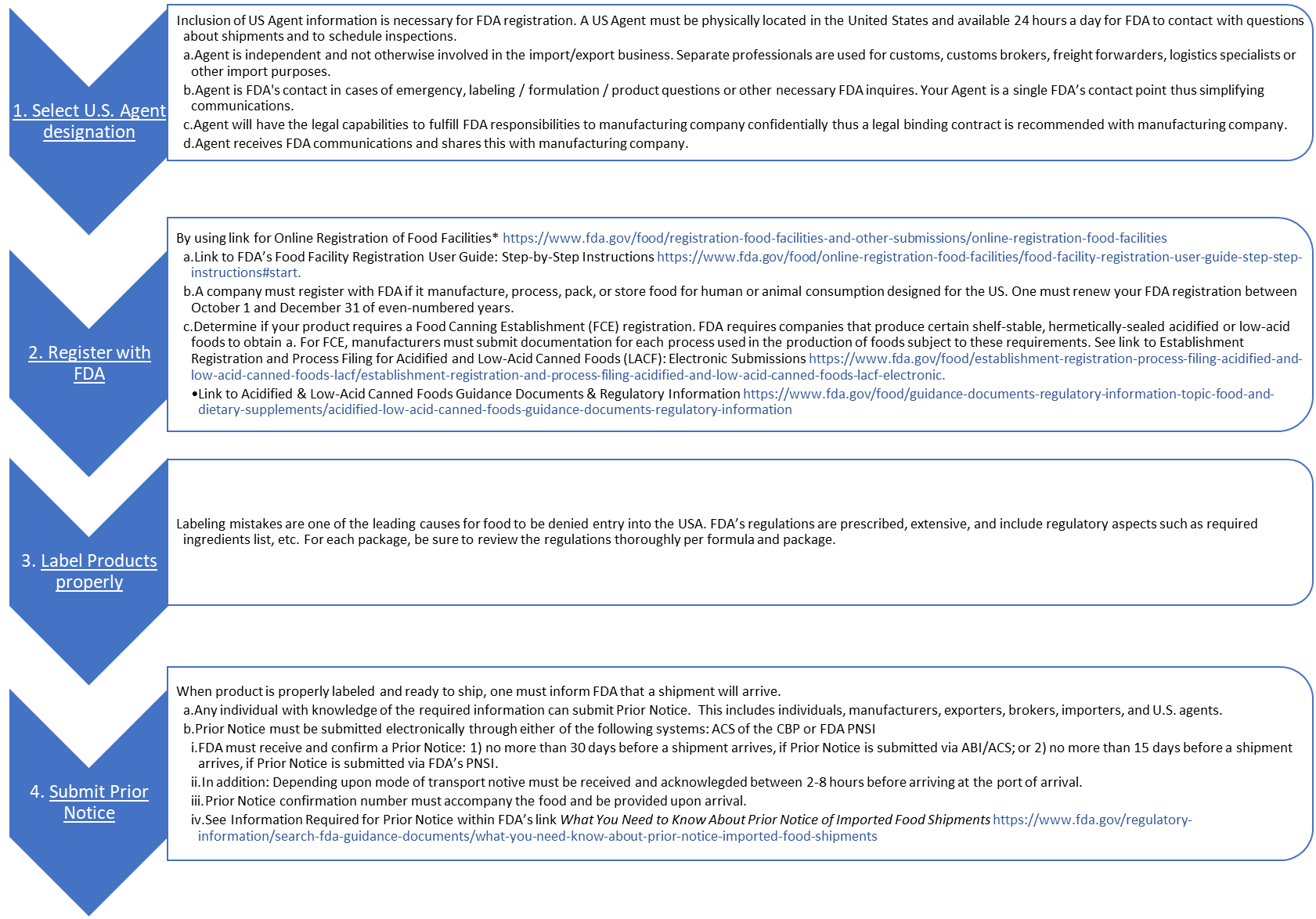
7.7 References
1. U.S. Food & Drug Administration (FDA) - Entry Process
https://www.fda.gov/industry/import-program-food-and-drug-administration-fda/entry-process
2. U.S. Customs & Border Protection - Locate a Port of Entry
https://www.cbp.gov/contact/ports/
3. U.S. Food & Drug Administration (FDA) - Entry Submission Process
https://www.fda.gov/industry/entry-process/entry-submission-process
4. FSMA Final Rule on Foreign Supplier Verification Programs (FSVP) for Importers of Food for Humans and Animals
5. How do I import food (canned goods, meat, vegetables, fruits, bulk foods, etc.) for resale?
https://help.cbp.gov/s/article/Article-83?language=en_US
6. U.S. Customs & Border Protection - Find a Broker by Port
https://www.cbp.gov/contact/find-broker-by-port
7. U.S. Food & Drug Administration (FDA) - Documents Required Status
https://www.fda.gov/industry/entry-submission-process/documents-required-status
8. U.S. Food & Drug Administration (FDA) - Sec. 106.6 Production and in-process control system.
https://www.accessdata.fda.gov/scripts/cdrh/cfdocs/cfcfr/CFRSearch.cfm?fr=106.6
9. U.S. Food & Drug Administration (FDA) - Sec. 106.91 General quality control
https://www.accessdata.fda.gov/scripts/cdrh/cfdocs/cfcfr/CFRSearch.cfm?fr=106.91
10. U.S. Food & Drug Administration (FDA) - Sec. 106.55 Controls to prevent adulteration from microorganisms.
https://www.accessdata.fda.gov/scripts/cdrh/cfdocs/cfcfr/CFRSearch.cfm?fr=106.55
11. U.S. Food & Drug Administration (FDA) - Guidance for Industry: Frequently Asked Questions about FDA's Regulation of Infant Formula
12. Infant Formula- Recent Issues and Regulatory Changes- SGS
https://www.sgs.com/en/news/2015/12/infant-formula-recent-issues-and-regulatory-changes
13. Importing into the United States- A Guide for Commercial Importers
https://www.cbp.gov/sites/default/files/documents/Importing%20into%20the%20U.S.pdf
14. U.S. Food & Drug Administration (FDA) - FSMA General Information for Industry
15. U.S. Food & Drug Administration (FDA) - FSMA Final Rule on Accredited Third-Party Certification
16. U.S. Food & Drug Administration (FDA) - FSMA Final Rule for Preventive Controls for Human Food
17. U.S. Food & Drug Administration (FDA) - FSMA Final Rule on Foreign Supplier Verification Programs (FSVP) for Importers of Food for Humans and Animals
18. U.S. Food & Drug Administration (FDA) - Voluntary Qualified Importer Program (VQIP)
Was this article helpful?