
6. Registration Processes
- 3 Mins to read
-
DarkLight
6. Registration Processes
- 3 Mins to read
-
DarkLight
Article summary
Did you find this summary helpful?
Thank you for your feedback
General Foods
Australia

This section provides information on any product notification or registration and manufacturing site registration processes.
6.1 Product Notification
Miscellaneous/General Foods
1. Packaged food (B2B)
Product notification is not required.
2. Packaged food (B2C)
Product notification is not required.
3. Non-packaged food (i.e., “Pick-and-choose”) (B2C)
Product notification is not required.
6.2 Product Registration
Miscellaneous/General Foods
1. Packaged food (B2B)
Product registration is not required.
2. Packaged food (B2C)
Product registration is not required.
3. Non-packaged food (i.e., “Pick-and-choose”) (B2C)
Product registration is not required.
6.3 Other Notes or Requirements
Product Notification
N/A
Product Registration
N/A
6.4 Manufacturing Site Registration
Miscellaneous/General Foods
1. Packaged food & Non-packaged food (i.e., “Pick-and-choose”)
Overseas manufacturing sites producing food products that are imported do not require site registration or food service authorization in order for the products to be sold in Australia. There are some quality system requirements for overseas sites, which are checked in the import processes, and these will be described in Section 7.3 of this guidebook. In addition, B2B customers have their own checks when accepting products from overseas suppliers (‘vendor approval’).
However, local manufacturing sites or food services stores need to notify an appropriate enforcement agency before commencing any food operation business. The authorities and steps vary depending upon the location of the food business, as described in detail below.
Australian food businesses must meet the requirements under Chapter 3: Food Safety Standards of the FSC [1]. A ‘food business’ and ‘handling of food’ are defined in Clause 3.1.1-1 under Chapter 3 of the FSC [2] in Figures 1 and 2.

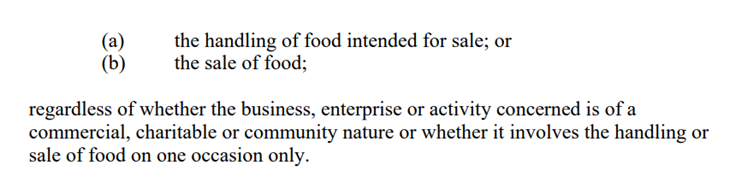
Figure 1. Screenshot from Standard 3.1.1-1 [2]: Definition of a food business

Figure 2. Screenshot from Standard 3.1.1-1 [2]: Definition of ‘handling of food’
Before commencing food handling operations, a food business must notify an appropriate enforcement agency, as described in Clause 3.2.2-4 [4] (Figure 3). The appropriate enforcement agency is a local municipal or State/Territory government agency which depends upon the geographic location of the food business site. FSANZ has a list of these agencies [5].
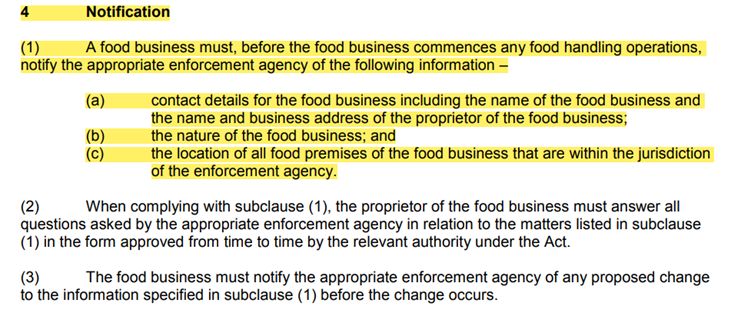
Figure 3. Screenshot from Standard 3.2.2-4 [4]: Notification of enforcement agency
As an example, a food business based in Box Hill, Melbourne, Victoria, would fall under the jurisdiction of the local Council which is the Monash City Council. This was determined using the Victorian government search tool [6]. A food business located in Box Hill would contact an Environmental Health Officer at the Monash City Council to discuss registration of their food business (if required) and other relevant issues (refer to Figure 4 below for examples).
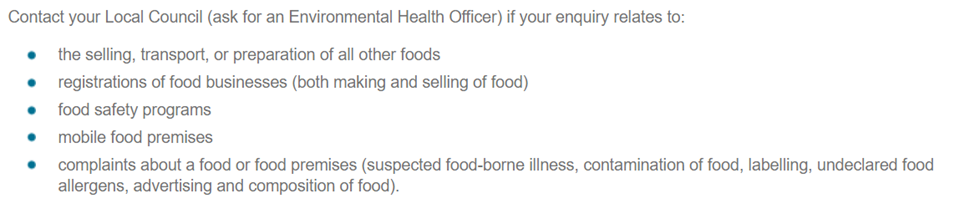
Figure 4. Screenshot from ref [7]: Food business inquiry topics for local councils
A new food business in Box Hill would also find useful information on the Victorian requirements on the Department of Health website [8]. In Victoria, food premises are classified (classes 1, 2, 3, or 4) based on risk [9] and different regulatory processes apply (registration versus notification) based on the class. Each state has different rules and may not follow the same system as Victoria. Therefore, this information is offered as an example only. There is an online guide to the Food Safety Standards [10].
2. Food Preparations
Same as "1. Packaged food & Non-packaged food (i.e., “Pick-and-choose”)" above.
6.4.1 Standard/Rules for Manufacturing Site
Miscellaneous/General Foods
1. Packaged food & Non-packaged food (i.e., “Pick-and-choose”)
Proprietors of food businesses must ensure the business complies with the requirements of the Food Safety Standards:
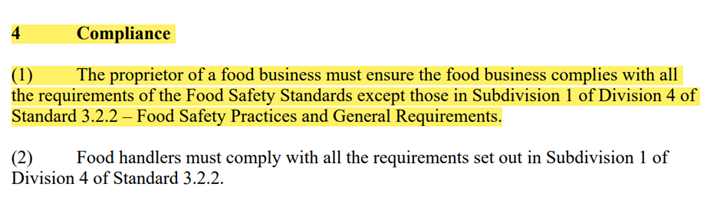
Figure 5. Screenshot from Standard 3.1.1-4 (1) [2]: Compliance with Food Safety Standards
Food businesses should implement a Food Safety Program as described in the Hazard Analysis and Critical Control Point (HACCP) system, adopted by the joint WHO/FAO Codex Alimentarius Commission [3]. Clause 3.2.1-5 [3] (Figure 6) describes the requirements.
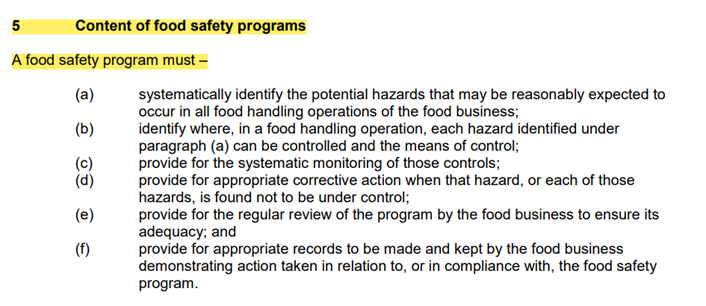
Figure 6. Screenshot from Standard 3.2.1-5 [3]: Contents of food safety programs
2. Food Preparations
Same as "1. Packaged food & Non-packaged food (i.e., “Pick-and-choose”)" above.
6.4.2 Other Notes or Requirements for Manufacturing Site Registration and Food Services Authorization
Miscellaneous/General Foods
1. Packaged food & Non-packaged food (i.e., “Pick-and-choose”)
N/A
2. Food Preparations
N/A
6.5 References
1. Chapter 3 (Food Safety Standards) from the FSC. Available on tab 3 of the landing page:
https://www.foodstandards.gov.au/code/Pages/default.aspx
2. Standard 3.1.1 – Interpretation and application
https://www.legislation.gov.au/Details/F2009C00816/Download
3. Standard 3.2.1 – Food safety programs
https://www.legislation.gov.au/Details/F2011C00551/Download
4. Standard 3.2.2 – Food safety practices and general requirements
https://www.legislation.gov.au/Details/F2023C00751/Download
5. FSANZ list of food enforcement contacts
https://www.foodstandards.gov.au/about/foodenforcementcontacts/Pages/default.aspx
6. Victorian Government ‘Know your council. Search tool
https://www.vic.gov.au/know-your-council
7. FSANZ webpage ‘Victorian contacts’
https://www.foodstandards.gov.au/about/foodenforcementcontacts/pages/victoria.aspx
8. Victoria Department of Health ‘Food business’ page
https://www.health.vic.gov.au/food-safety/food-businesses
9. Victoria Department of Health ‘Food business classifications’ page
https://www.health.vic.gov.au/food-safety/changes-to-food-business-classifications-and-regulations
10. Safe Food Australia – A Guide to the Food Safety Standards
https://www.foodstandards.gov.au/publications/Pages/safefoodaustralia3rd16.aspx
Was this article helpful?