
5. Claim Requirements
- 10 Mins to read
-
DarkLight
5. Claim Requirements
- 10 Mins to read
-
DarkLight
Article summary
Did you find this summary helpful?
Thank you for your feedback
General Foods
Malaysia

This section provides information on the definition of different types of claims and any restrictions or allowance of claims as well as claim registration processes.
5.1 Overview of Claims
5.1.1 Types & Definitions
Regulation 18A defines the claims as below [1]:
- Nutrient Content Claim: a nutrition claim that describes the level of a nutrient contained in a food.
- Nutrient Comparative Claim: a claim that compares the nutrient levels or energy value of two or more foods.
- Nutrient Function Claim: a nutrition claim that describes the physiological role of the nutrient in the growth, development, and normal functions of the body.
5.1.2 List of Prohibited Claims
Prohibited claims for food are described in Regulation 18 [1]:
- No descriptive matter appearing on or attached to or supplied with any package of food shall include any comment on, reference to, or explanation of any statement or label required by these Regulations to be borne on any package of food if such comment, reference, or explanation either directly or by implication, contradicts, qualifies or modifies the statement or the content of that label.
- Words to indicate grading, quality, or superiority or any other words of similar meaning shall not appear on the label of any package of food unless such a description of quality grading conforms to those established by the relevant authorities responsible for such grading; and where such words appear on the label it shall be presumed that the food is in compliance with the requirements established by the relevant authorities in respect of that quality grading.
- No label that describes any food shall include the word "pure" or any other words of the same significance unless:
- the food is of the strength, purity, or quality prescribed by these Regulations and is free from any other added substance apart from those essential in the processing of such food; and
- there is no expressed stipulation in these Regulations prohibiting the inclusion of such word in the label in respect of that food.
- Except as otherwise provided in these Regulations, no label which describes any food shall include the word "compounded", "medicated", "tonic" or "health" or any other words of the same significance.
- No label which describes any food shall include any claim on the absence of:
- beef or pork or its derivatives, or lard or added alcohol if the food does not contain such ingredients; or
- any food additive or nutrient supplement the addition of which is prohibited in these Regulations.
- Where a pictorial representation or design included in the label for the purpose of illustrating recipes involving the use of the food or suggestions on how to serve the food such inclusion, of the words "RECIPE" or "SERVING SUGGESTION" or other words of similar meaning must be immediately preceded or followed or otherwise closely accompanied, in not less than 6-point lettering.
- No label which describes any food shall include any claim:
- stating that any given food will provide an adequate source of all essential nutrients, except as otherwise permitted in these Regulations;
- implying that consuming a balanced diet or combination of a variety of foods cannot supply adequate amounts of all nutrients;
- which cannot be substantiated;
- as to the suitability of a food for use in the prevention, alleviation, treatment, or cure of a disease, disorder, or particular physiological condition, except as otherwise permitted in Malaysia Food Regulations; or
- which could give rise to doubt about the safety of similar food or arouse or exploit fear in the consumer.
- No label that describes any food shall include the word “organic”, “biological”, “ecological”, “biodynamic” or any other words or descriptive matter of the same significance unless the food conforms to the requirements established or recognized by the Food Safety and Quality Division.
- No label that describes any food shall include the words “special dietary” or any other equivalent term except as otherwise provided in these Regulations [1].
- 100% of wholegrain or wholemeal for wheat flour, rice flour, rice or grains;
- 60% or more of wholegrain or wholemeal for bread; and
- (25% or 8 g or more of wholegrain or wholemeal per serving for other products.
There shall be written on the label the word “wholegrain” or “wholemeal” and the percentage of the whole grain or wholemeal in not less than 4-point lettering.
“Wholegrain” or “wholemeal” refers to cereal grains that consist of intact, ground, milled, cracked, or flaked kernels after the removal of the inedible parts.
5.2 Nutritional Claims
5.2.1 Permitted Claims
1) Nutrient content claim
- Conditions for making nutrient content claims are specified in Table I and Table II of the Fifth A Schedule Malaysia Food Regulations.
- Where a food is by its nature low in or free of the nutrient that is the subject of the claim, the term describing the level of the nutrient shall not immediately precede the name of the food but shall be in the following form, that is, “a low (naming the nutrient) food” or “a (naming the nutrient)-free food”.
- Claims which highlight the absence or non-addition of one or more nutrients in or to food shall be regarded as nutrition claims and the conditions for nutrient content claims would apply. Such claims are permitted if the substance is one which consumers would normally expect to find in the food, has not been substituted by another substance giving the food equivalent characteristics unless the nature of the substitution is clearly stated with equal prominence; and the presence or addition is permitted in the food.
- Claims which highlight the non-addition of sodium salts, including "no added salt" may be included in the label if the food contains no added sodium salts; the food contains no ingredients that contain added sodium salts; and the ingredients that contain sodium salt that is functioning as a substitute for added salts are not used in the food.
- No label on a package containing any food shall bear a nutrient content claim except those permitted in these Regulations or with prior written approval of the Director.
2) Nutrient comparative claim
- "Nutrient comparative claim" can be expressed by comparing the level of a nutrient in the food with the level of a nutrient in a reference food through the following words or any other words of the same significance, that is, “reduced”, “less than” “fewer”, “increased”, “more than”, “light” or “extra”.
- Nutrient comparative claims may only be used on the label based on the food as sold, taking into account further preparation required for consumption if relevant, according to the instructions for use on the label and subject to the following conditions:
- The reference food shall be different versions of the same or similar food and the reference food should be clearly identified.
- A statement of the amount of difference in the energy value or nutrient content shall be given and the following information shall appear in close proximity to the nutrient comparative claim:
- The amount of difference related to the same quantity, expressed as a percentage, fraction, or an absolute amount, and full details of the comparison shall be given; and
- The reference food shall be described in such a manner that it can be readily identified by consumers;
- The comparison should be based on a relative difference of at least 25 percent in the energy value or nutrient content, except for micronutrients where a 10 percent difference in the Nutrient Reference Values (NRV) would be acceptable. The minimum absolute difference in the energy value or nutrient content shall be equal to or more than the value required for a claim as “low” or a “source” in Tables I and II to the Fifth A Schedule.
3) Nutrient function claim
- A nutrient function claim shall not imply or include any statement to the effect that the nutrient would afford a cure or treatment for or protection from disease.
- No label that describes any food shall include any claims relating to the function of a nutrient in the body unless the food for which the nutrient function claim is made shall contain at least the minimum amount required of that nutrient per reference amount as specified in Table III to the Fifth A Schedule.
- Only the nutrient function claims or any other words of similar meaning as specified in Table III to the Fifth A Schedule shall be permitted to be specified on a label (Figure 2a, 2b).
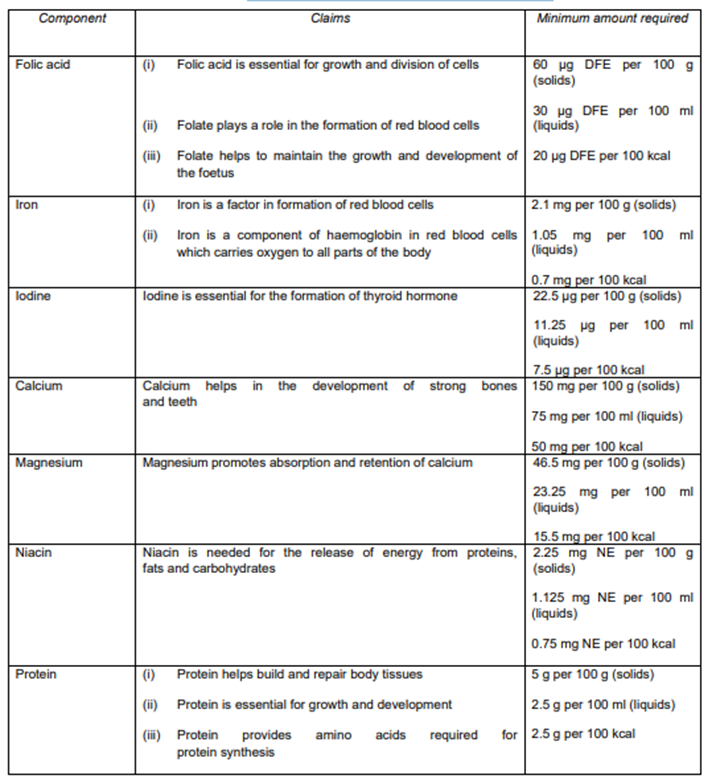
Figure 2a. Table III to the Fifth A Schedule – Condition for nutrient function claims (1)
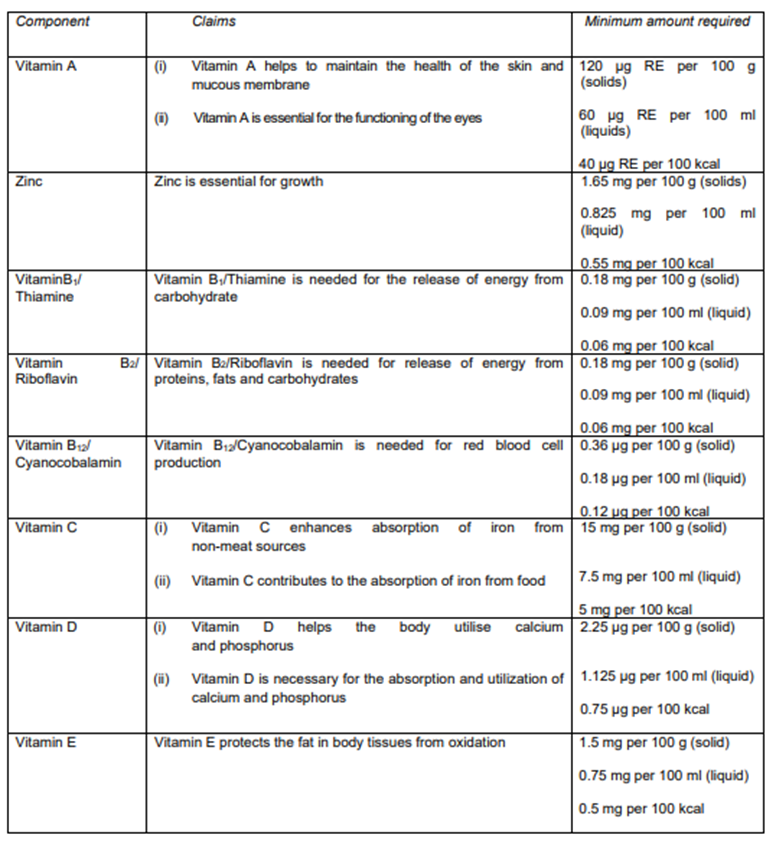
Figure 2b. Table III to the Fifth A Schedule – Condition for nutrient function claims (2)
- No label on a package containing any food shall bear a nutrient function claim except these permitted claims or with the prior written approval of the Director.
4) “Nutritious” claim
Food can have a description on the label that includes the word “nutritious” or any other words of the same significance provided that:
- The food contains a range of nutrients including carbohydrates, fat, protein, vitamins, and minerals;
- The food contains a substantial amount of energy of more than 40 kcal per 100 g or 20 kcal per 100 ml;
- The food contains a source of protein not less than 5 g per 100 g or 2.5 g per 100 ml;
- The food contains at least four vitamins of an amount that meets the criteria for claim as a source and two minerals (excluding sodium) of an amount that meets the criteria for claim as a source, and the amount of the nutrients mentioned in paragraphs is declared.
5) "Other function" claim
This claim describes a specific beneficial effect of other food components in the food that gives a positive contribution to health or improvement of a function of the body. It shall not imply or include any statement to the effect that the nutrient would afford a cure or treatment for a disease or protection from disease. No label that describes any food shall include any claims relating to the function of other food components in the body unless the food for which the function claim is made complies with the minimum amount of the other food component and other conditions specified in Table IV to the Fifth A Schedule.
6) Claim on probiotics
There may be written on the label of a package of food to which probiotic cultures have been added, the words “Probiotic cultures help in improving intestinal or gut function” or any other words of similar meaning.
In addition, no label on a package containing any food shall bear any permitted claims as specified in column (1) of Table V of the Fifth A Schedule unless the food in the package meets the conditions as specified in column (3) of Table V to the Schedule [1,2].
5.2.2 Nutritional Claim Registration
1. For nutritional claims that are already permitted for use:
There is no need to register or get approval from the Food Quality Control Division for nutritional claims that are already permitted for use.
2. For nutritional claims that are not currently permitted for use:
If the food company wishes to apply for a new nutrient function claim, i.e. a nutrition claim that describes the physiological role of the nutrients in the growth, development, and normal functions of the body, they may submit an application to the Director of Food Quality Control Division, Department of Public Health, for written approval of the Director.
“Application for nutrition claims” template [2]:
- Name, address, email, etc. of the applicant
- Proposed claim and food
- Limit of probable daily intake of the nutrient
- Chemical structure and formula of the nutrient
- Information on the physiological role of the nutrient
- For “nutrient content claim” or “comparative claim”, proposed criteria for making these claims and provide scientific justification
- For the "nutrient function claim", the level of “source” of nutrient per 100 g or ml with the scientific justification of the proposed level if it is not already in Table (II) in the Fifth A Schedule
- Evidence or benefit from 5 clinical trials (studies should be published in the refereed journal)
- Epidemiological and experimental studies and review papers may be included as supportive evidence
- Information regarding stability and bioavailability of the nutrient in raw, processed, and/or finished food
- Analytical method
- Data on safety evaluation derived from both chronic and acute studies
- Approval by other countries or recognized international agencies
- Other relevant information
The cost and timeline of the approval process are not mentioned by the regulations.
Amendment process [3]:
- Step I Secretariat will present a proposal to regulate or amend to related Expert Working Group
- Step II Consultation with industry and stakeholders involved
- Step III Food Regulations 1985 Advisory Committee will deliberate the proposal from the expert working group
- Step IV Proposed amendment draft will be published for public consultation
- Step V The draft amendment for gazettement will be prepared after comments
- Step VI Draft regulation will be forwarded to the legal advisor of the Ministry of Health, Attorney General Chambers for approval and to the Minister of Health for signature
- Step VII Regulations gazetted and printed
5.3 Health Claims
5.3.1 Permitted Claims
Health Claims are NOT permitted by the Malaysia Food Regulations. Please see the nutrient function claim in Section 5.2 above.
5.3.2 Health Claim Registration
Not applicable.
5.4 Other Notes or Requirements for Claims
None.
5.5 References
1. The Malaysian Food Regulations 1985 and its Schedules
https://hq.moh.gov.my/fsq/peraturanperaturan-makanan-1985
2. Application for nutrition claims – Malaysia MOH
http://www.moh.gov.my/moh/resources/food%20pdf/2/Application_for_Nutrition_Claims_(pdf).pdf
3. Updates on Nutrition Labeling and Claims Regulations in Malaysia by Norrani Eksan, Food Safety and Quality Division, Ministry of Health Malaysia Presented at the 9th Seminar on Nutrition Labeling, Claims and Communication Strategies, August 2015, Manila, Philippines
https://ilsisea-region.org/wp-content/uploads/sites/21/2016/06/Session-1-3_Norrani-Eksan.pdf
Was this article helpful?