
9. Advertising Aspects
- 11 Mins to read
- DarkLight
9. Advertising Aspects
- 11 Mins to read
- DarkLight
Article summary
Did you find this summary helpful?
Thank you for your feedback
Beers, RTDs, Whisky
Thailand

This section provides information on regulations on advertising and if there are any restrictions or approval processes.
9.1 Applicable Advertising Regulation
General Food
In Thailand, the advertising of food and alcoholic beverages is governed by strict regulations to ensure accurate, truthful, and non-misleading information. For food advertising, the “Criteria for Food Advertisement B.E. 2564” prohibits false or misleading claims and mandates that efficacy claims be supported by scientific evidence and approved by relevant authorities. Advertisements must follow specific formatting guidelines to ensure clarity and truthfulness [1].
Food advertising in Thailand is also regulated under the Food Act B.E. 2522 (1979). Section 41 stipulates that anyone intending to advertise the qualities, benefits, or indications of a food product through radio, television, film, newspapers, printed materials, or other media for commercial purposes must submit the advertisement's content, including sound, images, films, or text, to the relevant authority for review. Advertising is permitted only after receiving official approval [2].
In regulations relating to advertising, the following concepts are defined [1, 3, 4]:
- Advertising: Any act intended to inform the public by enabling them to see, hear, or gain knowledge of information for commercial purposes, including all forms of marketing communication.
- Food advertising: Any action that causes the public to see or know information about food, or food ingredients for commercial purposes.
- Marketing Communication: Any activity undertaken to promote the sale of goods or services, enhance brand image, or disseminate information. This includes public relations, sales promotions, product exhibitions, event sponsorships, and direct marketing efforts.
- Message: Any form of communication used to convey information, such as letters, illustrations, films, lights, sounds, symbols, or any action that effectively communicates meaning to individuals.
Category
Alcoholic beverages
For alcoholic beverages, Section 32 of the Alcoholic Beverage Control Act, B.E. 2551 specifies prohibitions and certain restrictions on the advertising of alcoholic beverages [3].
Product
1) Beer
Same as "Category" (alcoholic beverages).
2) Alcoholic ready-to-drink beverages (such as Chuhai)
Same as "Category" (alcoholic beverages) above.
3) Whisky
Same as "Category" (alcoholic beverages) above.
9.2 Specific Restrictions on Advertising
General Food
Food advertisements must not include messages that are misleading, unfair to consumers, or detrimental to society. Prohibited Advertising Practices under the Food Advertising Criteria 2021 include [1]:
- Claiming the presence of nonexistent food components or misrepresenting their quantity.
- Misleading consumers regarding the characteristics, benefits, or methods of consuming food.
- Using messages that may incite division or disrupt societal harmony.
- Promoting illegal, immoral behavior, or actions that degrade cultural traditions.
- Encouraging dangerous, violent, or imitative behavior.
- Featuring endorsements by individuals posing as or claiming to represent medical or public health professionals.
- Making comparisons or criticisms of other products.
Advertising in the following forms does not require prior permission, provided it adheres to specified criteria:
- Academic information not intended for commercial purposes, with reliable references.
- Corporate image advertisements.
- Factual advertisements using pre-approved text as specified in Appendix 2 of the Food Advertising Criteria 2021 [1].
Advertising applications must be submitted for approval before advertising the following:
- Benefits, qualities, or properties not included on approved labels.
- Nutritional claims or promotions based on nutritional value.
- Heath claims require evaluation.
- Advertisements include additional claims about food benefits, quality, or properties [1].
Specific Advertising Guidelines [1]
- Infant formula, follow-on formula, and supplements for infants: Advertising is prohibited.
- Food for young children: Must not imply suitability for infants or sufficient nutritional value.
- Supplements for children aged 12 months to 3 years: Must not target infants or mislead consumers.
- Milk and related products: Must include the message, "You should eat a variety of food from all five food groups in appropriate proportions regularly."
- Ready-to-eat jelly: Must display the message, "Children should consume in small amounts."
- Jelly desserts with glucomannan or konjac flour: Must include the warning, "Children should not consume. Be careful of choking."
Advertised food must meet legal quality standards, ingredient requirements, and labeling regulations.
Messages and warnings must comply with Appendix 4 of the Food Advertising Criteria 2021 [1].
- Printed media: Warning text must be clear, with a minimum height of 1/25 of the advertisement's height.
- Audio media: Warnings must be clearly audible.
- Visual and audio media: Warnings must appear for at least five seconds with readable font sizes
Category
Alcoholic beverages
For alcoholic beverages, any information provided shall be in accordance with the criteria and conditions set out in the Beverage Control Act [3].
- Advertising or displaying, directly or indirectly, the name or trademark of any alcoholic beverage in a manner that emphasizes its properties or encourages consumption is prohibited.
- Manufacturers of alcoholic beverages may only engage in advertising or public relations activities that:
- Provide factual information.
- Promote socially constructive knowledge.
- Such activities must not include illustrations of the alcoholic beverage or its packaging.
- Only symbols representing the beverage or its manufacturer may be displayed, in compliance with the specifications outlined in Ministerial Regulations.
The restrictions mentioned above do not apply to advertisements broadcast from outside the Kingdom of Thailand [3].
Requirements for Displaying Symbols of alcoholic beverage [5]
Criteria for Displaying Symbols by Media Type Criteria for Displaying Symbols by Media Type
- In television, film, and digital media, the display of alcoholic beverage symbols must adhere to specific size and timing restrictions. The symbol size must not exceed 5% of the total advertising space, and its display time must be limited to 5% of the advertisement duration, with a maximum of 2 seconds. Advertisements featuring symbols are allowed only between 10:00 PM and 5:00 AM. Furthermore, symbols must appear exclusively at the end of the advertisement to ensure compliance.
- For printed media, the size of the symbols is similarly restricted to a maximum of 5% of the total advertising space. Additionally, symbols are prohibited from appearing on the front, back cover, center pages, or wrapping of the printed material, ensuring their placement is consistent with the regulations.
- In other media types, the size of the symbols must not exceed 3% of the total advertising space. These stricter size limitations reflect the broader application of symbol-related restrictions in unconventional formats.
Requirements for Warning Messages
- In television, projection, film, video, or electronic media, warning messages must be presented in both audio and written formats. Audio warning messages must be clearly audible with a volume equivalent to the main advertisement message and have a minimum duration of 2 seconds. Written warning messages must follow the approved template provided by the Alcoholic Beverage Control Board as per Table 8. These messages must be displayed prominently at the top of the advertisement, covering at least half of the advertising space, and must remain visible for at least 2 seconds.
- For printed media, warning messages must adhere to the approved Alcoholic Beverage Control Board template. These messages must be placed at the top of the advertisement and occupy no less than one-third of the advertising space, ensuring prominent visibility to the audience.
- In other media types, warning messages must also comply with the approved template as described in Table 8. They must be displayed at the top of the advertisement, covering the entire advertising space, ensuring maximum clarity and visibility in these less conventional formats.
Mandatory Warning Messages:
All displays of alcoholic beverage symbols or manufacturer logos must include a warning message per Table 8 below [5].
| Type | Product | Warning message in Thai | English translation |
| 1 | Alcohol |  |  |
| 2 | 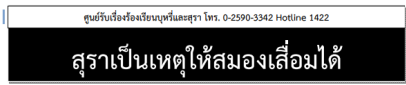 | 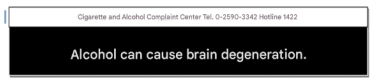 | |
| 3 |  | 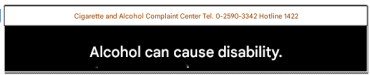 | |
| 4 | Beer | 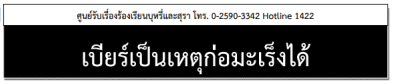 | 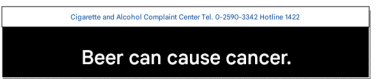 |
| 5 | 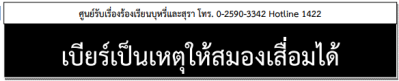 | 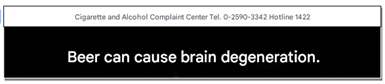 | |
| 6 | 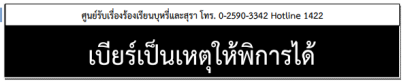 | 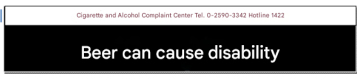 | |
| 7 | Wine |  | 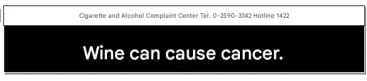 |
| 8 |  | 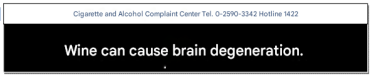 | |
| 9 |  |  | |
| 10 | Alcohol | 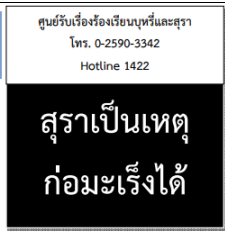 | 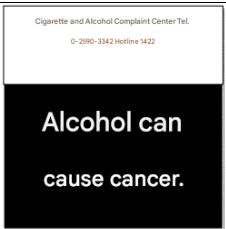 |
| 11 | 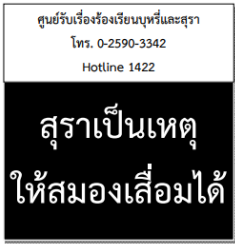 | 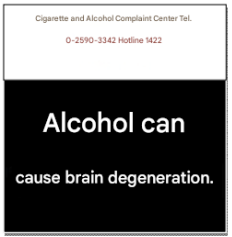 | |
| 12 | 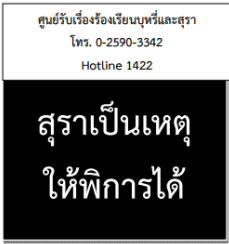 | 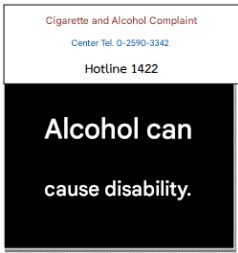 | |
| 13 | Beer | 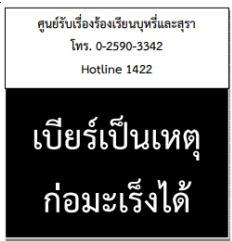 | 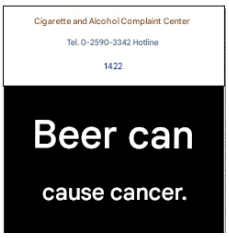 |
| 14 | 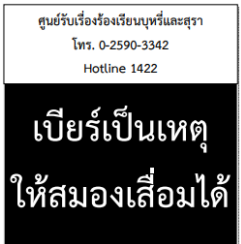 | 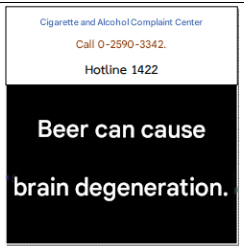 | |
| 15 | 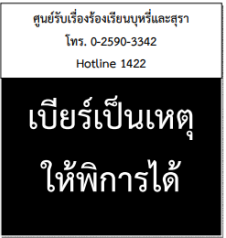 | 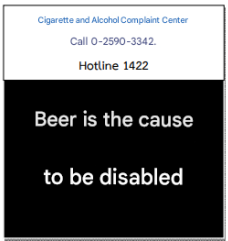 | |
| 16 | Wine | 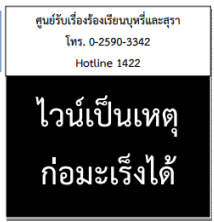 | 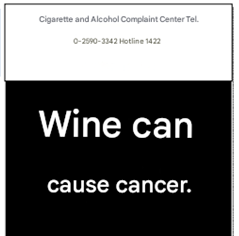 |
| 17 | 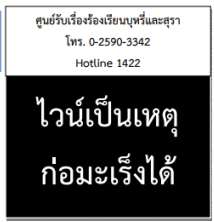 | 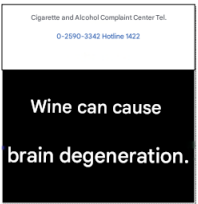 | |
| 18 | 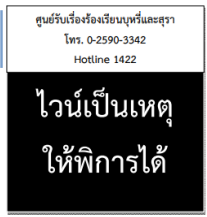 | 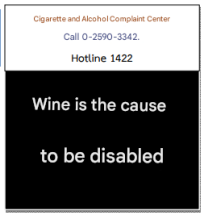 |
Table 8. A prototype warning message included at the end of the Alcoholic Beverage Control Board's announcement on the format of warning messages featuring an alcoholic beverage symbol or an image of an alcoholic beverage manufacturing company 2014 [5].
Product
1) Beer
Same as "Category" (alcoholic beverages) above.
2) Alcoholic ready-to-drink beverages (such as Chuhai)
Same as "Category" (alcoholic beverages) above.
3) Whisky
Same as "Category" (alcoholic beverages) above.
9.3 Advertising Approval
General Food
Anyone intending to advertise the benefits, qualities, or properties of food through radio, television, film, newspapers, printed materials, or other means for commercial purposes must obtain prior approval. For nationwide food advertisements, applications must be submitted to the Food and Drug Administration (FDA) via the e-submission system [6,7].
For advertisements intended only within a specific province—such as those disseminated via radio, loudspeakers, or print media, excluding television and the Internet—applications can be submitted to the Provincial Public Health Office. These applications should comply with the guidelines outlined in the Public Health Office’s Guide for Citizens in Requesting Permission to Advertise Food. All advertisements must adhere to the food advertising regulations established by law [1,8].
Step-by-step guide on how to apply for advertising permission [6]
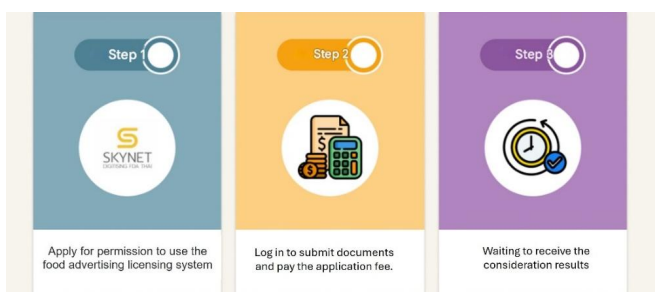 Figure 5. Step-by-step guide on how to apply for advertising permission
Step 1: Apply for permission to use the food advertising licensing system - https://food.fda.moph.go.th/e-submission-system/regis-ad 
Figure 6. Illustration of steps to prepare documents of food advertisement permission application
1. Prepare Documents
The following documents are required for system access:
- Business Operator Appointment Form
- Must be stamped with the company seal and affixed with a 30-baht revenue stamp.
- Download from the Food Division website https://food.fda.moph.go.th/download/ >> Section 1.5 Power of Attorney and Business Operator Appointment Form for Advertising Permission.
- Power of Attorney Form for System Use
- Must be stamped with the company seal and affixed with a 30-baht revenue stamp.
- Download from the Food Division website https://food.fda.moph.go.th/download/ >> Section 1.1 Power of Attorney Form.
- Copy of Commercial Registration
- A certified true copy required if filing in the name of an individual.
- Authorization Card of the Grantor
- A certified true copy required if the person granting the power of attorney does not appear in person.
- Attorney’s ID Card Authority: Food and Drug Administration
- A certified true copy required if the attorney does not appear in person.
- Work Permit Copy
- Required if the business operator is a foreigner applying for permission.
Note:
- The legal entity's information and authorized signatories will be verified with the Department of Business Development's database.
- The national ID card and house registration details will be checked against the population registration database.
2. Verify Documents
Ensure all documents are accurate and complete as per the checklist in Section 1. Arrange the documents in order, with this document placed on top.
3. Submit Documents
Submit the completed documents to: Ministry of Public Health, Food and Drug Administration Building 8, 4th Floor, One Stop Service Center, 88/24 Tiwanon Road, Mueang District, Nonthaburi Province 11000. Contact Number: 02-590-7000 ext. 79929 Service Hours: Monday to Friday (except government holidays), 8:30 AM - 4:30 PM.
4. Create a User Account and Verify Applicant’s Identity
Visit the website https://connect.egov.go.th/ to create a user account and complete the identity verification process.
Step 2: Apply for food advertising licenses through the E-submission system
Guide to applying for food advertising licenses through the E-submission system:
- Guide to log in to submit documents and pay the application fee (In the case of no more than 5 products per request) - https://food.fda.moph.go.th/media.php?id=511958899566452736&name=STEP2_Esub100-Ads_manual.pdf
- Guide to log in to submit documents and pay the application fee (In the case of more than 5 products per request) - https://food.fda.moph.go.th/media.php?id=511958899167993856&name=STEP2_semi-Esub-Ads_manual.pdf
- Guide to applying for permission to advertise food on the Internet, where the advertising content does not include the benefits, quality, or properties of food - https://food.fda.moph.go.th/media.php?id=511958899360931840&name=manual_step2_3.pdf
- Guide to requesting permission to advertise food in the event that the status "Official requests clarification" appears -https://food.fda.moph.go.th/media.php?id=511958898899558400&name=E-ads_problem.pdf
Checklist for Required Documents
- Application for Food Advertising Permission (Form Kho.Or.1) - 2 copies, printed from the E-Submission system.
- Advertisement Images and Text (Form Kho.Or.3) - 2 copies, printed from the E-Submission system.
- Supporting Documents for Claims (as applicable):
- New product: Permission valid for no more than 1 year or certification of the product's initial market release.
- Globally recognized product: Evidence of availability in at least 15 countries across 3 continents.
- Manufacturing Site Certification: Valid certification of quality assurance or inspection.
- Awards: Documents or letters confirming awards received.
- Production Process: Evidence showing production steps or methodology.
- Top Sales Ranking: Evidence from a credible source confirming the product is a top seller.
- Promotions: Certification of promotional campaigns.
- Contests or Giveaways: License for conducting lotteries or prize giveaways.
- Health Claims: Supporting documents for health-related claims.
Step 3: Receive an answer to the application
The results of the application review or additional requirements, if any, will be sent to the applicant's email.
Summary of the Application Process:
- Document Upload - Applicants must click to view and upload the required documents for their request.
- Payment Process - A payment slip will be available for printing after the request is submitted. Once payment is made, the process proceeds.
- Document Submission to OSSC - For applications involving more than five product advertisements per request, documents must be submitted to the OSSC. Applications and supporting documents will be sent to an officer for content review.
- Request for Additional Documents - If needed, the applicant will be notified to submit additional supporting documents within 10 days.
- License Payment - Once approval is granted, applicants can print the payment form for the license fee. After payment, the license must be downloaded and printed by the applicant.
- Approval or Rejection:
- Approval: The advertisement is permitted, and the applicant can proceed.
- Request for Clarifications: Additional details may be required for document or content clarification.
- Rejection: The request may be returned or rejected if it does not meet requirements.
The fees to be paid include an application fee of 2,000 baht and a permit fee of 5,000 baht, in accordance with the Ministry's announcement [10]. Approved advertisements must adhere to permitted content, display license numbers, and comply with specified conditions. Advertising permissions are valid for up to five years [7].
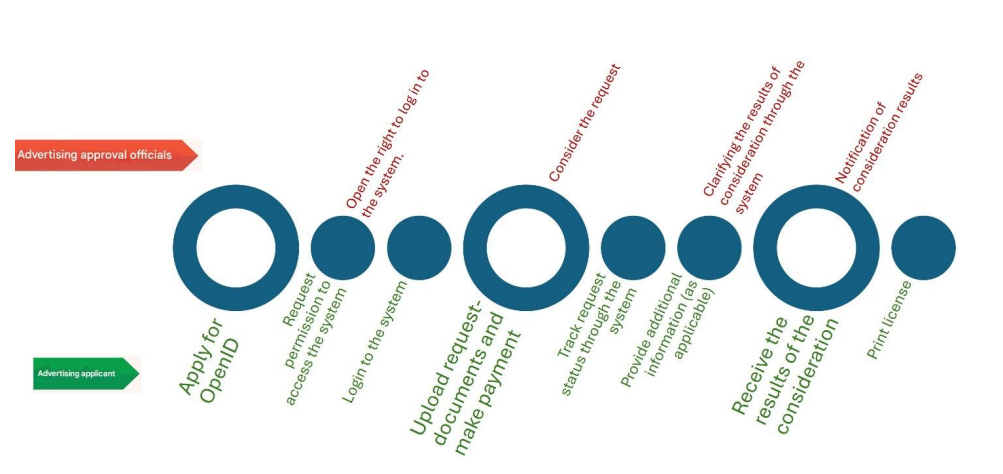 Figure 7. Illustration of the steps of the application process for food advertising
Category
Alcoholic beverages
The formal process for businesses to apply for a license to advertise alcoholic beverages has not been explicitly stated by the Excise Department, the Food and Drug Administration, or the Department of Disease Control. Alcohol advertising in Thailand is highly regulated. It is advised to consult a legal expert or contact the Excise Department directly to ensure your application and advertising content comply with all applicable laws and regulations. Advertising materials and supporting documents submitted to the Excise Department must strictly adhere to the restrictions on alcoholic beverage advertising outlined in Section 9.2 above.
Product
1) Beer
Same as "Category" (alcoholic beverages) above.
2) Alcoholic ready-to-drink beverages (such as Chuhai)
Same as "Category" (alcoholic beverages) above.
3) Whisky
Same as "Category" (alcoholic beverages) above.
9.4 Other Notes or Requirements for Advertising
N/A.
9.5 References
1. Announcement of the Food and Drug Administration on Food Advertising Criteria B.E. 2564
https://www.ratchakitcha.soc.go.th/DATA/PDF/2564/E/073/T_0014.PDF
2. Food Act B.E. 2522 (1979)
https://food.fda.moph.go.th/media.php?id=536782813802930176&name=law_act_EN.pdf
3. Alcoholic Beverage Control Act B.E. 2551 (2008)
https://ddc.moph.go.th/uploads/files/14020220209072300.pdf
4. Thailand Liquor Act B.E. 2493
https://www.excise.go.th/cs/groups/public/documents/document/dwnt/mzkz/~edisp/uatucm393165.pdf
5. Announcement from the Alcoholic Beverage Control Committee - Subject: Format of Warning Messages with Symbols of Alcoholic Beverages or Symbols of Alcoholic Beverage Manufacturing Companies, 2014
https://ddc.moph.go.th/uploads/ckeditor/c74d97b01eae257e44aa9d5bade97baf/files/lawalc/004_2alc.PDF
6. Application for food advertising permission via the e-submission system where the advertising content does not reflect the benefits, quality, or properties of food
https://food.fda.moph.go.th/e-submission-system/esub-002/
7. Guidelines for requesting permission to advertise food through the e-submission system
https://food.fda.moph.go.th/e-submission-system/%20esub-2
8. Checklist for food advertising permit application and record of defects
https://food.fda.moph.go.th/media.php?id=511957897287180288&name=6.1_F-F2-01C.pdf
9. Infographics - Food Advertising Permission Request
https://food.fda.moph.go.th/media.php?id=512632157538230272&name=960_InfoFoodAd.jpg

10. Fee rates as announced by the Ministry of Public Health
https://www.ratchakitcha.soc.go.th/DATA/PDF/2560/E/199/23.PDF
Was this article helpful?