
7. Importation Requirements
- 6 Mins to read
- DarkLight
7. Importation Requirements
- 6 Mins to read
- DarkLight
Article summary
Did you find this summary helpful?
Thank you for your feedback
Beers, RTDs, Whisky
Singapore

This section provides information on the importation process (shipment, customs, licenses required, and test requirements).
7.1 Shipment Declaration
General Food
The Singapore Food Agency (SFA) classifies food into the following categories:
- Meat and meat products
- Fish and fish products
- Fresh fruits and vegetables
- Fresh eggs
- Processed eggs
- Processed food
- Food Appliances
For processed food (including alcoholic drinks):
Upon meeting SFA’s conditions for processed food and complying with the SFA’s food legislation (details are in Section 7.2 on Customs Procedure below), an import permit application needs to be submitted to Singapore Customs via TradeNet for shipment declaration [1].
The import permit application should include:
- SFA (Processed Food) Registration Number (in the Licence/Certificate No. field)
- Product Information (required for all food products and food appliances under SFA (Processed Food)’s control). You need to declare all relevant information in the:
- CA/SC Product Code field
- CA/SC Product Quantity field
- CA/SC Product Unit of Quantity field, Brand Name field (e.g., brand name, name of the manufacturer of the food product, or the intended brand name of the food product)
- Please select the most relevant product codes for the declaration of import permits
Upon approval, you will be issued a Cargo Clearance Permit (CCP) which also serves as an SFA import permit. Print out the CCP, which will be used for clearance of foods at the border checkpoint, inspection, etc. Check the conditional approval message stated in the import permit and contact SFA if the message states that inspection of your products is required.
* The Singapore Food Safety and Security Act (FSSA) [11] was passed in Singapore Parliament in January 2025. While the FSSA has not yet come into effect, it would consolidate and amend food safety legislation in Singapore, including the eventual repeal of the Sale of Food Act. The implementation of the FSSA would be in phases, with a full transition expected in 2028.
Proper Record-Keeping and Traceability for Effective Recall
When Sections 87 and 88 of the FSSA come into operation, all licensed importers of import-controlled items (applies to any other food imported) will be required to keep proper records of items to facilitate traceability and timely recalls. Information to be kept includes data to identify, locate and trace from supplier to licensed importer, and from the licensed importer to the next party involved, unless transaction is to final consumers.
Section 88 of the FSSA will allow SFA to request industry to conduct simulations to test recall procedures when required. If a licensed importer initiates a voluntary recall on the grounds that the food might be unsafe or unsuitable, it must notify SFA within 24 hours. A licensed importer must have procedures for identifying and locating imported import‑controlled items that must be accurate and sufficient for effective recall.
Requirement to Provide Records to the Singapore Food Agency
Section 89 of the FSSA will require all licensed importers of import-controlled items to provide records within 24 hours or within any reasonable shorter period specified by the authorized officer or food inspector of the Singapore Food Agency (SFA).
Category
Alcoholic drinks
Same as "General Food" above.
Product
1) Beer
Same as "Category" (alcoholic drinks) above.
2) Ready-to-drink beverages (mainly Chuhai)
Same as "Category" (alcoholic drinks) above.
3) Whisky
Same as "Category" (alcoholic drinks) above.
7.2 Customs Procedure
General Food
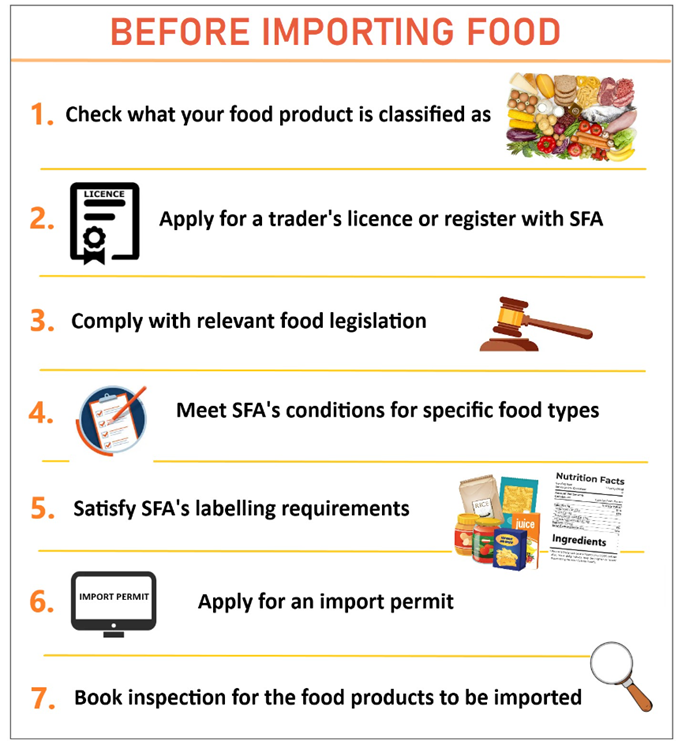
- Check what your product is classified as [2]
- Meat and meat products
- Fish and fish products
- Fresh fruits and vegetables
- Fresh eggs
- Processed eggs
- Processed food
- Food Appliances
- Apply for a trader’s license or register with the Singapore Food Agency (SFA) via GoBusiness [3]
- The trading company or business is to register with the Accounting and Corporate Regulatory Authority (ACRA) before conducting business in Singapore. ACRA issues a Unique Entity Number (UEN) to all Singapore-registered companies.
- Register and activate UEN with Singapore Customs.
- Open and maintain a GIRO account with Singapore Customs for the payment of permits.
- Check additional requirements from SFA (none for alcoholic drinks).
- Comply with relevant food legislation governed by SFA
- Meet SFA’s conditions for specific types of food
- Different conditions and requirements apply to specific types of food. The conditions would depend on the type of food, source country or region, etc.
- For processed food, they can be imported from any country or region as long as the imports meet SFA’s conditions. For non-high-risk processed food (including alcoholic drinks), they must be obtained from establishments regulated by overseas competent authorities [4].
- Comply with SFA’s labeling requirements
- Refer to Section 4 on labeling requirements.
- Apply for an import permit with Singapore Customs via TradeNet [5]
- Prepare your SFA license/registration number, product / HS code [6], and establishment code [7].
- Apply for an import permit via TradeNet.
- Completed applications submitted will be processed within one working day if submitted before 5.30 pm (Mon to Thu) or 5 pm (Fri).
- Additional documents may be required for specific food products (alcoholic drinks not included). Submit them online as attachments through TradeNet.
- Upon approval, you will be issued a Cargo Clearance Permit (CCP), which also serves as an SFA import permit.
- Print out the CCP, which will be used for clearance of foods at the border checkpoint, inspection, etc.
- Upon import / before products are released from customs, payment of goods and services tax and customs duty (for dutiable goods – including intoxicating liquor) will be deducted via GIRO.
- Book inspection for the imported food products via iFAST [8]
- Imported food may be subject to SFA’s routine food safety inspection upon arrival in Singapore. Samples may also be taken for laboratory analysis.
- Check the CCP to determine if the imported consignments require inspection by SFA.
Category
Alcoholic drinks
The import procedure is the same as the one outlined under "General Food" above except that an additional payment of customs duty needs to be made (on top of Goods and Services Tax) as "intoxicating liquors" are considered dutiable in Singapore.
Product
1) Beer
Same as "Category" (alcoholic drinks) above.
2) Ready-to-drink beverages (mainly Chuhai)
Same as "Category" (alcoholic drinks) above.
3) Whisky
Same as "Category" (alcoholic drinks) above.
7.3 Manufacturing License
N/A
7.4 Test for Importation
General Food
Other than specified foods, submission of laboratory test reports to SFA is currently not required for imported food items not specified. However, such products may be subjected to inspection and sampling by SFA. The specific parameters to be tested for each food product will be dependent on the risks and hazards associated with the food. This list is not exhaustive and SFA may test for additional parameters that are not stated in the list below [9].
Examples of chemical tests
Pesticide residues
- Organochlorines
- Pyrethroids
- N-methyl carbamates
- Dithiocarbamates
- Organophosphates
Preservatives
- Benzoic acid
- Boric acid
- Sorbic acid
- Sulfur dioxide
- Methyl paraben
- Methyl-p-benzoate
- Propyl paraben
- Propyl-p-benzoate
- Formaldehyde
Metals
- Arsenic
- Antimony
- Cadmium
- Copper
- Lead
- Mercury
- Tin
- Selenium
- Inorganic arsenic
Mycotoxins
- Aflatoxins (B1&2, G1&2)
- Ochratoxin A
- Fumonisins
- Deoxynivalenol
- Zearalenone
Colors
- Para Red
- Sudan I, II, III & V
- Chrysoidine
- Basic yellow
Sweetening agents
- Acesulfame-K
- Sucralose
- Stevioside
- Saccharin
- Cyclamate
- Rebaudioside
Others
- Bromate
Examples of microbiological tests
- Enterobacteriaceae
- Escherichia coli
- Escherichia coli O157
- Salmonella
- Bacillus cereus
- Bacillus enterotoxins
- Clostridium perfringens
- Listeria monocytogenes
- Staphylococcus aureus
- Staphylococcus enterotoxins
- Clostridium botulinum
Category
Alcoholic drinks
Testing for importation of alcoholic drinks (except Absinthe) is not mandatory. However, companies are encouraged to send products to accredited laboratories for analysis. The list of accredited laboratories can be searched on the website of the Singapore Accreditation Council-Singapore Laboratory Accreditation Scheme [10].
Product
1) Beer
Same as "Category" (alcoholic drinks) above.
2) Ready-to-drink beverages (mainly Chuhai)
Same as "Category" (alcoholic drinks) above.
3) Whisky
Same as "Category" (alcoholic drinks) above.
7.5 Other Notes or Requirements for Importation
None.
7.6 Overview Flowchart for Importation Process
General Food [4]
Category
Alcoholic drinks
Same as "General Food" above.
Product
1) Beer
Same as "Category" (alcoholic drinks) above.
2) Ready-to-drink beverages (mainly Chuhai)
Same as "Category" (alcoholic drinks) above.
3) Whisky
Same as "Category" (alcoholic drinks) above.
7.7 References
1. Singapore Customs’ website on “Competent Authorities Requirements - Singapore Food Agency (Processed Food)"
2. Singapore Food Agency’s website on “General Classification of Food and Food Products"
https://www.sfa.gov.sg/food-import-export/general-classification-of-food-food-products
3. Singapore Food Agency’s website on “Licensing and Registration of Traders"
https://www.sfa.gov.sg/food-information/novel-food/licensing-registration-of-traders
4. Singapore Food Agency’s website on “Conditions to Import Processed Food & Food Appliances” and “Commercial food imports"
https://www.sfa.gov.sg/food-import-export/conditions-for-specific-types-of-food-for-import#Conditions-to-Import-Processed-Food--Food-Appliances
https://www.sfa.gov.sg/food-import-export/commercial-food-imports
5. Singapore Customs’ TradeNet
https://www.tradenet.gov.sg/tradenet/login.jsp
6. Singapore Food Agency’s website on “Product Codes for Processed Food Products"
https://www.sfa.gov.sg/docs/default-source/tools-and-resources/product-codes-for-tradenet/product-code-for-processed-food-and-food-appliances.pdf?sfvrsn=745c661_22
7. Singapore Food Agency’s website on “List of Japan Prefectural Codes"
listofjapanprefecturalcodes.pdf
8. Singapore Food Agency’s iFAST for booking inspections for imported food products
https://ifast.sfa.gov.sg/eserviceweb
9. Singapore Food Agency’s document on “Import Requirements of Specific Food Products
https://www.sfa.gov.sg/docs/default-source/tools-and-resources/import-requirements-of-specific-food-products.pdf
10. Singapore Accreditation Council, search database of accredited organisations
https://sacinet2.enterprisesg.gov.sg/sacsearch/search
11. Food Safety and Security Act (Uncommenced)
https://sso.agc.gov.sg/Act/FSSA2025/Uncommenced/20250504225421?DocDate=20250206&WholeDoc=1#
Was this article helpful?