
7. Importation Requirements
- 3 Mins to read
- DarkLight
7. Importation Requirements
- 3 Mins to read
- DarkLight
Article summary
Did you find this summary helpful?
Thank you for your feedback
Mixture of Food Additives
Sri Lanka

This section provides information on the importation process (shipment, customs, licenses required, and tests requirements).
7.1 Shipment Declaration
Category
Food Additives
Importers declare imports through the ASYCUDA system’s CUSDEC (customs declaration) [1]. After payment of duties and levies, submission of hard copies of the following documents occurs for shipment release:
- Copy of the CUSDEC
- Bill of lading
- Original commercial invoice
- Certificate of origin (varies by product)
- Export/health certificate (varies by product)
- Packing lists
- Certificate of Insurance
- Payment guarantees from a local bank advising of payment transfer to the supplier
- Import permit (issued to Sri Lankan importer for licensed products)
The calculation of duties follows the transaction value as per the commercial invoice.
Product
Mixture of Food Additives/Additive Premix
Same as "Category" above.
7.2 Customs Procedure
Category
Food Additives
Although there is no registration for the product of interest (as mentioned in Section 6.2 of this guidebook), all food items imported should comply with the following regulations [2]:
- Food (labeling and advertising) Regulations 2011 [3]
- Food (shelf life for imported food items) Regulations 2012 [4]
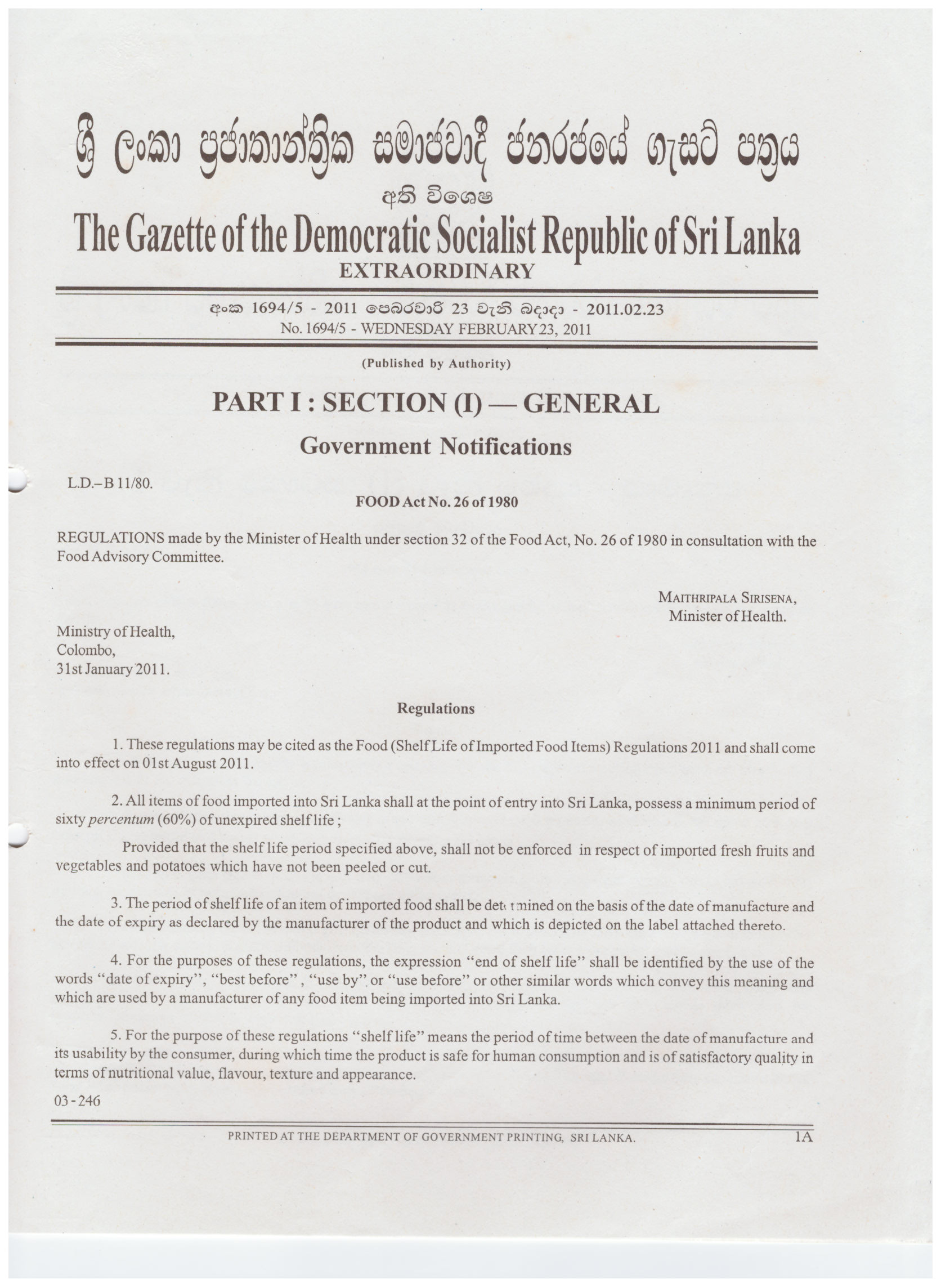
Under the Food (shelf life for imported food items) Regulations 2012 [4], the Food Control Administration Unit regulates the shelf life of imported food products. At the point of entry into Sri Lanka, the food should still have a minimum of 60 percent of its shelf life.
The regulation states that the shelf life of imported food is determined from the date of manufacture and the date of expiry declared by the manufacturer. During this time, the product is considered safe for human consumption and of satisfactory quality in terms of nutritional value, flavor, texture, and appearance.
[Exemptions: On August 14, 2015, amendment exempted imported sugar, cereals, and pulses in wholesale packs, fresh fruits and vegetables, bulbs, roots, and tubers that have not been peeled or cut from this regulation].
The above two regulations apply in addition to the specific regulation(s) governing the product if any such regulation(s) exist for the product. For example, common salt should comply with “Food (Oxidization of salt) regulations in addition to the above 2 regulations.
Further, if a standard has been adopted under the Food (adoption of standards) Regulations for a specific food product, that product shall comply with the adopted Sri Lankan standards. There are 101 food products currently regulated by their regulation.
This means that food additives should also comply with the Food (Additives – General) Regulations 2019 [5] in addition to the above 2 regulations.
Food additives are not subjected to the mandatory SLSI import inspection scheme [6] and are not described in specific product standards [7], hence no detailed inclusion of the documents is stated and required. Products are sampled and tested. Once the results are out and admissible, customs are cleared and the importer can ship the product to Sri Lanka.
Product
Mixture of Food Additives/Additive Premix
Same as "Category" above.
7.3 Manufacturing License
Category
Food Additives
A Manufacturing License is not required for importation.
Product
Mixture of Food Additives/Additive Premix
Same as "Category" above.
7.4 Test for Importation
Category
Food Additives
Since the food additives are not in the inspection scheme (as mentioned in Section 7.2 above), specific testing is not specified for the food additives. They are subject to be sampled and tested by SLSI-accredited testing laboratories or SLSI-recognized accredited laboratories depending on the events and the authority to test.
Product
Mixture of Food Additives/Additive Premix
Same as "Category" above.
7.5 Other Notes or Requirements for Importation
Category
Food Additives
Sri Lankan regulations require prior registration of all importers. Registration for a tax identification number and payment of related value-added tax, in compliance with the Customs Ordinance are mandatory. The importer signs the "Importers Proxy", while a licensed customs house agent signs the "Acceptance Proxy". Except for the licensed products, which require an import license from the Department of Imports and Exports Control of Sri Lanka and that are not subject to specific sanitary and phytosanitary requirements, other products can proceed with the importation by submitting a declaration to Sri Lanka Customs. Importers often rely on customs brokers or their own staff to check on shipments and to clear products through customs.
There is no requirement for the translation of documents into the local language as English is the preferred language.
Product
Mixture of Food Additives/Additive Premix
Same as "Category" above.
7.6 Overview Flowchart for Importation Process
Category
Food Additives
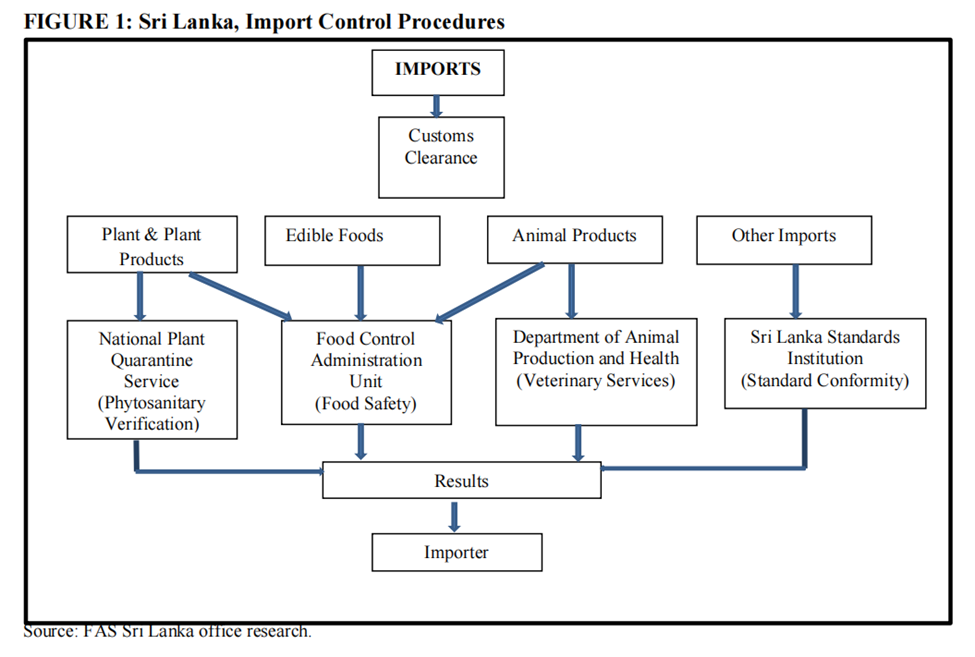
Food additives will be categorized under “Other Imports”. The importer needs to clear customs by SLSI before importing this product into Sri Lanka.
Product
Mixture of Food Additives/Additive Premix
Same as "Category" above.
7.7 References
1. Sri Lanka Customs
https://www.customs.gov.lk/business/importing-goods/
2. Import Control Procedure
http://eohfs.health.gov.lk/food/index.php?option=com_content&view=article&id=2&Itemid=136&lang=en
3. Food (Labelling and Advertising) Regulations 2005
4. Food (shelf life for imported food items) Regulations 2012
http://eohfs.health.gov.lk/food/images/pdf/regulations/Shelf-life-regulation.jpeg
5. Food (Additives - General) Regulations 2019
http://www.eohfs.health.gov.lk/food/images/pdf/regulations/additive-english.pdf
6. Items covered under Import Inspection Scheme
https://slsi.lk/web/wp-content/uploads/2023/04/NEW-ITEM-LIST.pdf
7. Imports and Exports Control (Standardization and Quality Control) Regulation 2017
https://members.wto.org/crnattachments/2022/TBT/LKA/22_1460_01_e.pdf
Was this article helpful?