
6. Registration Processes
- 11 Mins to read
- DarkLight
6. Registration Processes
- 11 Mins to read
- DarkLight
Article summary
Did you find this summary helpful?
Thank you for your feedback
Beers, RTDs, Whisky
Thailand

This section provides information on any product notification or registration and manufacturing site registration processes.
6.1 Product Notification
General Food
General Foods (Category 4), including food ingredients, unlike the other three controlled food groups, do not require a food registration number prior to production or import. However, if enterprises choose to apply for a food notification number, it must be accurately displayed on the product label [1]. The notification process is similar to the product registration process described in Section 6.2 below.
Category
Alcoholic beverages
N/A.
Product
1) Beer
N/A.
2) Alcoholic ready-to-drink beverages (such as Chuhai)
N/A.
3) Whisky
N/A.
6.2 Product Registration
General Food
Enterprises intending to produce or import controlled food must obtain a product license from the relevant authority. Applications for certification and approval of food recipes must adhere to the principles and conditions outlined in the Ministerial Regulation. Controlled food categories include specifically controlled food, food subject to quality or standard requirements, and food requiring labeling compliance [1, 2, 3].
The Thai FDA has provided product registration guidelines for key food groups on their website: https://food.fda.moph.go.th/public-guide/category/product-authorization. These guidelines include detailed instructions for each food type, required templates, and processes for amending or replacing food registration certificates. The guidelines cover the following food groups:
- Dietary Supplements
- Royal Jelly and Royal Jelly Products
- Infant Formula and Follow-on Formula for Infants and Young Children / Baby Food and Follow-on Formula for Infants and Young Children
- Supplements for Infants and Young Children
- Food for Weight Control
- Special Purpose Foods
- Food Additives / Substances Used to Maintain Food Quality or Standards / Enzymes Used in Food Production / Cleaning or Disinfectant Products Used for Food
- Food Products Containing Cannabis, Hemp, and Cannabidiol Extracts
- Food Products Including:
- Cow's Milk, Flavored Milk, and Yogurt
- Milk Products and Ice Cream
- Beverages in Sealed Containers
- Food in Sealed Containers
- Mixed Coffee, Mixed Instant Coffee, and Ready-to-Drink Coffee
- Electrolyte Drinks
- Other Food Products
- This includes all food products not categorized under specific controlled foods, food supplements, royal jelly, and royal jelly products, special purpose foods, cow's milk, flavored milk, yogurt, milk products, ice cream, beverages in sealed containers, food in sealed containers, mixed coffee, mixed instant coffee, ready-to-drink coffee, and electrolyte drinks.
Starting November 8, 2021, food production or importing locations located in other provinces can apply for food product licenses through the e-Submission system https://privus.fda.moph.go.th/ [4, 5].
To access the E-submission system, the user must submit the required documents to the system administrator (Admin). Users will be granted access to the system based on the rights specified in their request. The details are as follows:
- Channels for E-Submission System Access Requests
- For production/import locations in Bangkok: Submit the required documents at Health Product Service Center (OSSC), Food and Drug Administration (FDA) Office
- For production/import locations in other provinces: Submit the application at the Provincial Public Health Office in the respective province.
- Supporting Documents for Food System Access Rights
- For business operators/licenses accessing the system directly:
- Application Form: Submit the e-Submission system access request form (Form No. 1.2 PDF). The officer will verify the signatory via the government’s legal entity certification database.
- Attach a copy of the commercial registration.
- Power of Attorney: If the business has multiple operators with joint signing authority, issue a power of attorney for one individual to act on their behalf.
- For attorneys acting on behalf of licensees: Submit a Power of Attorney specifying the authorization period (not exceeding 3 years), with a 30-baht stamp per agent. System access will be granted within 1–3 business days after document verification.
- For business operators/licenses accessing the system directly:
The e-Submission System User Manual is available at https://food.fda.moph.go.th/media.php?id=513116258871418880&name=5_OpenID.pdf [9].
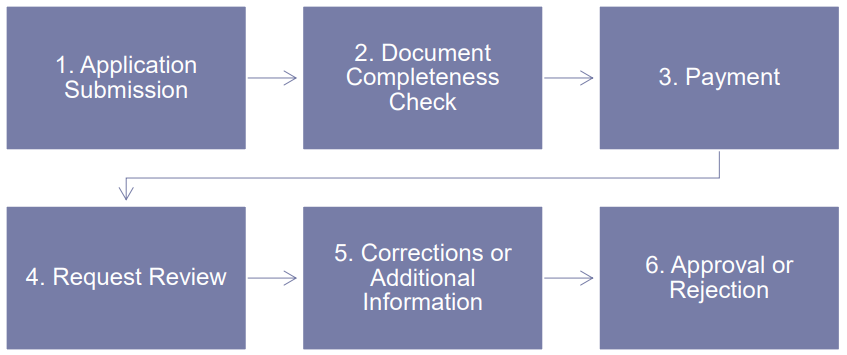 Procedure 1. Food registration process
Process Description [6, 7]
1. Application Submission
Applicants can access the website http://privus.fda.moph.go.th to submit a request via the FDA's e-Submission system. Using the Username and Password obtained from the OPEN ID application, log into the system and select the type of request form. Download the appropriate request form from the food system, complete it, and upload it along with supporting documents, if any.
2. Document Completeness Check: The e-submission system verifies the accuracy and completeness of the application and supporting documents.
3. Payment: Applicants can print the payment form generated by the e-Submission system and make the payment as per the specified amount and channel.
4. Request Review
The legal compliance assessment officer reviews the application.
Note: The review time depends on the product's complexity and the information provided. If corrections or clarifications are required, the officer will request them through the e-submission system.
5. Corrections or Additional Information
If issues or additional clarifications are identified, the officer will notify the applicant via the e-submission system.
- Applicants must log in to the system, review the “Track Request Status” section, and respond to corrections or clarification requests by the deadline.
- Applicant Timeline: 10 working days per request (up to 3 requests).
- Note: If no response is received after the maximum allowable time, the application will be considered withdrawn.
6. Approval or Rejection
The authorized officer decides whether to approve or reject the application. The e-submission system notifies the applicant of the decision via email. Approved applicants can log in to download their permit immediately.
Required documents for food registration:
- Registration Application Template
- Certificate of Manufacturing Location Abroad
- Applicable for import cases. The certificate must meet or exceed GMP 420 standards.
- Refer to Section 7.3 of this guidebook for details regarding manufacturing certification body requirements and certificate standards.
- Quality/Standard Analysis Report (CoA), required for imports only.
- Additional Relevant Documents:
- Full 100% ingredient formula
- Production process documentation
- Raw material quality specifications
- Documentation for extending the shelf life of pasteurized products (e.g., milk, flavored milk, yogurt), if applicable
- Food weight approval certificate issued by the FDA, if applicable
- Food label
Any additional relevant evidence, if applicable.
Timeline: The review and approval timeline for product registration varies based on the product type. For instance, registering beverages in sealed containers takes 58 days, whereas approving nutritional products for infants and young children requires 92 days. Detailed timelines for specific approvals can be found in FDA guidelines or the e-submission system [7, 8].
All templates for product registration, label amendment, certificate revision, and other FDA-related services are available for download through the FDA website https://food.fda.moph.go.th/download/ and can be accessed via e-submission system [9, 10]
Administrative costs:
The Thai FDA implements a tiered fee structure based on the content and complexity of applications [11, 12].
Examples of applicable fees include:
- Application Submission and Verification: Fees for processing and verifying application documents related to food production, imports, advertising, safety assessments, and health claims.
- Academic Document Assessments:
- Evaluation of product or label licensing documents.
- Review of safety claims, production methods, and new technologies.
- Assessment of sterilization processes or reports for low-acid and acidified sealed foods. (Additional fees may apply depending on the complexity of the request.)
- Inspection Costs: Travel and accommodation expenses for evaluation teams, which must be covered by the food service establishment requesting the inspection.
- General Fees: For instance, 2,000 THB is charged for submitting food registration or food detail notification forms.
Applicants are encouraged to consult with officers to confirm accurate payments, particularly for assessments or inspections.
Category
Alcoholic beverages
Alcoholic beverages are not required to be registered with the Thai FDA. Approval of alcoholic beverages is handled by the Excise Department. Before proceeding with a liquor import license, the product must first be approved by the Excise Department [13, 14].
Prerequisites for liquor importation application by a foreign liquor manufacturer or brand owner and evidence of the applicant being a sole agent for selling imported liquor into the Kingdom:
- Label Approval:
- Importers must obtain label approval from the Excise Department.
- All liquor bottles must bear the approved labels before being brought into Thailand.
- Product Sample Analysis:
- Submit liquor samples to the Excise Department for quality analysis, or
- Provide a certificate of liquor sample analysis issued by:
- An agency designated by the Director-General as a liquor quality analysis body.
- A foreign government agency.
- An agency certified by a foreign government responsible for controlling liquor production by foreign manufacturers.
Note: The importer can apply for a License to import liquor only after meeting the above requirements. The procedure to obtain a liquor import license is fully detailed in Section 7.5 of this guidebook under the Category – Alcoholic Beverages.
Product
1) Beer
Same as "Category" (alcoholic beverages) above.
2) Alcoholic ready-to-drink beverages (such as Chuhai)
Same as "Category" (alcoholic beverages) above.
3) Whisky
Same as "Category" (alcoholic beverages) above.
6.3 Other Notes or Requirements
Product Notification
N/A.
Product Registration
N/A.
6.4 Manufacturing Site Registration
General Food
Domestic food production facilities in Thailand are required to obtain licensing from the Thai FDA. [15]
Category
Alcoholic beverages
Domestic liquor manufacturers must adhere to the regulations set forth in the Liquor Production Regulations B.E. 2565 and obtain their licenses from the Excise Department [20].
Product
1) Beer
Same as "Category" (alcoholic beverages) above.
2) Alcoholic ready-to-drink beverages (such as Chuhai)
Same as "Category" (alcoholic beverages) above.
3) Whisky
Same as "Category" (alcoholic beverages) above.
6.4.1 Standard/Rules for Manufacturing Site
General Food
Evaluation standards are based on Good Manufacturing Practices (GMP) principles, which serve as fundamental guidelines for ensuring safe food production. These principles focus on preventing and eliminating risks that could render food toxic, hazardous, or unsafe [16].
GMP compliance is enforced as a legal requirement under Section 6(7) of the Food Act B.E. 2522. Food producers who fail to comply with GMP regulations as outlined in the Ministry of Public Health (MOPH) announcements are subject to penalties.
Currently, MOPH has issued two key announcements regarding production methods, equipment, and food storage:
- Ministry of Public Health Announcement No. 386 B.E. 2560: Addresses production methods, equipment used in production, storage of certain types of fresh vegetables or fruits, and labeling requirements [17].
- Ministry of Public Health Announcement No. 420 B.E. 2563: Provides updated regulations on production methods, production equipment, and food storage under the Food Act B.E. 2522 [18].
Detailed instructions for submitting applications for evaluation and licensing are available on the Thai FDA website https://food.fda.moph.go.th/public-guide/category/permission-for-food-production-facility.
Manufacturing site registration is not required for imported foods. However, foreign manufacturers of processed foods must be certified under control systems that meet or exceed the standards outlined in GMP 420. Detailed requirements for certification bodies and equivalent certificates are provided in Section 7.3 of this guidebook [19].
Category
Alcoholic beverages
The conditions of liquor production and licensing are regulated by the Ministerial Regulation on Liquor Production B.E. 2565, which outlines comprehensive requirements for licensing, operations, and compliance in Thailand. It delineates production into non-commercial and commercial categories, with distinct requirements based on factory scale and liquor type. Licensing applications must be submitted to the Excise Department, accompanied by requisite documentation, with approvals granted following verification and fee payment. Factories are mandated to adhere to the Factory Act, environmental and public health laws, and quality standards set by the Director-General [20].
Specific conditions apply to factory types: small-scale factories must utilize agricultural raw materials, while larger distilleries are required to meet advanced production and environmental benchmarks. Licenses are subject to renewal, periodic inspections, and compliance with conditions such as product labeling, sample submission, and recall procedures to ensure safety and quality [20].
Process for Issuing Liquor Production Licenses for Trade [21, 22]
- Submission of Application: Applicants wishing to produce liquor for trade must submit the application in Form Por Sor 04-01 to the Excise Area Office or Branch Office in the area where the production site is located. The application must be accompanied by supporting documents.
- Verification of Application: The excise officer reviews the submitted application to ensure that all details and documents are correct and complete. If the application is incomplete or incorrect, the applicant will be notified to make corrections or provide additional documentation within a specified timeframe. Failure to comply within the given period will result in the application being withdrawn.
- Review and Decision: The Excise Area has 30 days to review the complete application. If the application meets the criteria specified in the Ministerial Regulations on Liquor Production B.E. 2565, the Excise Department will approve the license and notify the applicant in writing. The applicant must then pay the required fee as per the Excise Tax regulations.
- Issuance of License:
- After payment of the fee, the liquor production license for trade will be issued in Form Por Sor 04-02. License validity: 3 years from the date of permission.
- Each license costs 60,000 baht. The fee shall be paid in person at the Area Excise Office or Excise Department Branch Office. Monday to Friday, 8:30 AM - 4:30 PM.
- Rejection and Appeal: If the application does not meet the criteria, the Excise Department will issue a rejection and notify the applicant of the reasons for the denial. The applicant will be informed of their right to appeal under the Administrative Procedure Act.
- Application Transition: Applications submitted under the previous Excise Department announcement, before the effective date of this new process, will be treated according to the current process.
Product
1) Beer
Same as "Category" (alcoholic beverages) above.
2) Alcoholic ready-to-drink beverages (such as Chuhai)
Same as "Category" (alcoholic beverages) above.
3) Whisky
Same as "Category" (alcoholic beverages) above.
6.4.2 Other Notes or Requirements for Manufacturing Site Registration
None.
6.5 References
1. Product Licensing
https://food.fda.moph.go.th/for-entrepreneurs/product-register1
2. Food Act B.E. 2522 (1979)
https://food.fda.moph.go.th/media.php?id=536782813802930176&name=law_act_EN.pdf
3. What is Food and How to Categorize Food?
https://en.fda.moph.go.th/entrepreneurs-food/category/food-what-is-food-and-how-to-categorize-food
4. FDA announcement on food product registration through the e-Submission system from November 8, 2021.
https://food.fda.moph.go.th/e-submission-system/hm-d5
5. E-Submission system
https://privus.fda.moph.go.th/
6. The Public Manual for Entrepreneurs - Food Products
https://food.fda.moph.go.th/media.php?id=461454372606451712&name=EngVersion.pdf
7. Request product permission
https://food.fda.moph.go.th/public-guide/category/product-authorization
8. Permission consideration period according to the Citizen's Handbook (working days)
https://food.fda.moph.go.th/media.php?id=511588379696177152&name=time.pdf
9. User Manual - Food e-Submission System
https://food.fda.moph.go.th/media.php?id=513116258871418880&name=5_OpenID.pdf
10. Thai FDA – downloadable templates
https://food.fda.moph.go.th/download/
11. Reference fee according to Ministerial Regulation No. 5, Food Act B.E. 2522
https://food.fda.moph.go.th/media.php?id=470835186347679744&name=rate.pdf
12. Costs to be collected from applicants during the permit consideration process
https://food.fda.moph.go.th/media.php?id=470832518736781312&name=costs.pdf
13. Ministerial Regulation Permission to Import Liquor into the Kingdom (B.E. 2560)
https://www.ratchakitcha.soc.go.th/DATA/PDF/2560/A/095/65.PDF
14. Requesting permission to import liquor into the Kingdom from Excise Department
https://www6.excise.go.th/portal/ExciseTax/manual/BB_052.pdf
15. Request permission for food production premises
https://food.fda.moph.go.th/public-guide/category/permission-for-food-production-facility
16. GMP (Production methods, production equipment and food storage)
https://food.fda.moph.go.th/gmp-head/category/gmp-420
17. Ministry of Public Health Announcement (No. 386) Re: production methods, tools, equipment used in production and storage of certain types of fresh vegetables or fruits, and labeling
https://food.fda.moph.go.th/media.php?id=509400357386985472&name=P386.PDF
18. MOPH (No. 420) B.E. 2563 Re Food Production Processes, Processing Equipment/ Utensils and Storage Practices
https://food.fda.moph.go.th/media.php?id=509431569765769216&name=P420_E.pdf
19. Announcement of the Food and Drug Administration Regarding documents or certificates of food production system standards for the importation of food products
https://food.fda.moph.go.th/media.php?id=702397300592484352&name=announ-fda-import67.pdf
20. Liquor Production Regulations B.E. 2565
https://www.ratchakitcha.soc.go.th/DATA/PDF/2565/A/068/T_0001.PDF
21. Announcement of the Excise Department Regarding the criteria and methods for issuing a license to produce liquor for trade
https://lawelcs.excise.go.th/lawdetail?id=7592
22. Requesting permission to produce all types of liquor (except for traditional fermented liquor and traditional distilled liquor)
https://www6.excise.go.th/portal/ExciseTax/manual/BB_056.pdf
Was this article helpful?