
3. Compositional Aspects
- 4 Mins to read
- DarkLight
3. Compositional Aspects
- 4 Mins to read
- DarkLight
Article summary
Did you find this summary helpful?
Thank you for your feedback
Beers, RTDs, Whisky
Philippines

This section provides the compositional requirements for the food category and/or food products in scope and information on permitted nutrients, ingredients, and additives.
3.1 Composition Requirements
Category
Alcoholic beverages
- Methanol – zero (0) ppm
However, methanol may be present in alcoholic beverages provided that it is derived from the natural alcohol fermentation process and not added. Technical documents shall be submitted for justification during the registration of locally manufactured or imported alcoholic beverages. [1]
Product
1) Beer
Same as alcoholic beverages above.
2) Alcoholic ready-to-drink beverages (such as Chuhai)
Same as alcoholic beverages above.
Ready-to-drink beverages shall also comply with the legal definition of aromatized alcoholic beverage which contains less than 15% alcohol; or up to 24% alcohol for traditional non-standardized aromatized products.
3) Whisky
Same as alcoholic beverages above.
Whisky shall also comply with the legal definition of distilled spirituous beverage which contains more than 15% alcohol.
3.2 Raw Material Requirements
General Food
Raw materials or ingredients used in the processing of a finished product shall comply with the Food Safety Act of 2013.
Category
Alcoholic beverages
Same raw material requirements as General Food above.
Product
1) Beer
Same as General Food.
Beer shall also comply with the legal definition of the product category where it is brewed from germinated barley (malt), hops, yeast, and water.
2) Alcoholic ready-to-drink beverages (such as Chuhai)
Same as General Food.
3) Whisky
Same as General Food.
Whisky shall also comply with the legal definition of distilled spirituous beverage which is made from malted cereals, with or without whole grains of unmalted cereals.
3.3 Fortification
General Food
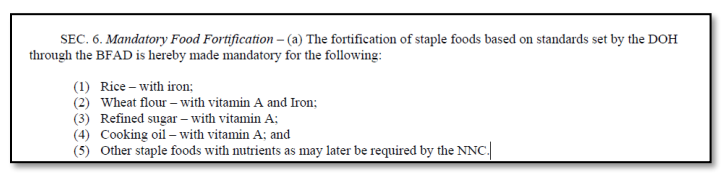
Republic Act 8976 [3] defined fortification as the addition of nutrients to processed foods or food products at levels above the natural state. As an approach to control micronutrient deficiency, food fortification is the addition of a micronutrient, deficient in the diet, to a food, which is widely consumed by specific at-risk groups. The Philippine Food Fortification Program consists of two systems, one mandatory and one voluntary. Only the following foods are mandatory for fortification:
Category
Alcoholic beverages
Alcoholic beverages and products under this category are not allowed fortification with vitamins and minerals. Because they do not fall into the official recommendation provided in the authority Guideline [6]:“ Fortification shall be recommended for processed foods to replace or simulate traditional foods to compensate for nutritional inferiority due to use of substitute ingredients.”
Product
1) Beer
Same as "Category" (alcoholic beverages) above.
2) Alcoholic ready-to-drink beverages (mainly Chuhai)
Same as "Category" (alcoholic beverages) above.
3) Whisky
Same as "Category" (alcoholic beverages) above.
3.4 Other Permitted Ingredients
General Food
No restriction on the use of ingredients if the general principles of food safety are complied with.
Category
Alcoholic beverages
Same as General Food.
1) Beer
Same as "Category" (alcoholic beverages) above.
2) Alcoholic ready-to-drink beverages (mainly Chuhai)
Same as "Category" (alcoholic beverages) above.
3) Whisky
Same as "Category" (alcoholic beverages) above.
3.5 Permitted Additives
General Food
Food Additive refers to any substance the intended use of which results or may reasonably be expected to result, or indirectly, in its becoming a component or otherwise affecting the characteristics of any food (including any substance intended for use in producing, manufacturing, packing, processing, preparing, treating, packaging, transporting, or holding food; and including any source of radiation intended for any such use), if such substance is generally recognized, among experts qualified by scientific training and experience to evaluate its safety, as having been adequately shown through scientific procedures to be safe under the conditions of the intended use. (RA No. 3720).[4]
The positive list and limits of permitted food additives are in the Bureau Circular No. 2006-016 Updated List of Food Additives adopted from Codex GSFA.
Category
Alcoholic beverages
Manufacturers may first refer to the latest Codex GSFA provisions, otherwise in the Bureau Circular No. 2006- 016 provisions. There is no limit defined for Category 12, the limit is defined by specific alcoholic beverages. [3]
Product
1) Beer
Manufacturers may first refer to the latest Codex GSFA provisions, otherwise in the Bureau Circular No. 2006- 016 provisions.
2) Alcoholic ready-to-drink beverages
Same as the category (alcoholic beverages) above.
Manufacturers may first refer to the latest Codex GSFA provisions, otherwise in the Bureau Circular No. 2006- 016 provisions
3) Whisky
Same as the category (alcoholic beverages) above.
Manufacturers may first refer to the latest Codex GSFA provisions, otherwise in the Bureau Circular No. 2006- 016 provisions.
3.6 Permitted Flavors and Colors
General Food
Flavoring Substances refer to flavor preparations composed of substances derived from plant/animal products and/or chemically synthesized substances whose significant function in food is flavoring rather than nutritional. If food additives are to be used as flavoring substances, they should abide by the regulations set by FEMA and or IOFI. The use of flavoring may be restricted by product definition (refer to Section 2.2 of this guidebook).
Coloring substances fall under the definition of food additives (refer to Section 3.5 above).
Category
Alcoholic beverages [4]
Same as requirements for permitted flavors and colors as General Food.
Product
1) Beer
Same as General Food. In addition, as per the product definition, the use of flavoring is authorized only in flavored beer.
2) Alcoholic ready-to-drink beverages
Same as General Food above.
3) Whisky
Philippines authorities recognize international standards, as per whisky European Union's definition, plain caramel (E150a) is authorized at quantum satis. Flavoring is not permitted.
3.7 Permitted Processing Aids
General food
As defined in Administrative Order 2014-0030 [5], Processing aid means a substance or material not including apparatus or utensils, and not consumed as a food ingredient by itself, intentionally used in the processing of raw materials, food or its ingredients, to fulfill a certain technological purpose during treatment or processing and which may result in the non-intentional but unavoidable presence of residues or derivatives in the final product.
For additives used as Processing Aids, refer to Section 3.5 above.
Category
Alcoholic beverages
Same requirements for Processing Aids as General Food above.
Product
1) Beer
Same as General Food above.
2) Alcoholic ready-to-drink beverages
Same as General Food above.
3) Whisky
Same as General Food above.
3.8 Additional Notes
None.
3.9 References
1. Memorandum Circular No. 13 s. 1989 Methanol Content in Alcohol Beverages as defined by Memo Circular 88-003
https://www.fda.gov.ph/wp-content/uploads/2021/05/Memorandum-Circular-No.-13-s.-1989.pdf
2. Republic Act No. 10611
https://www.fda.gov.ph/wp-content/uploads/2021/05/Republic-Act-No.-10611.pdf
3. Republic Act 8976 An Act Establishing The Philippine Food Fortification Program And For Other Purposes, only the following food are mandatory for fortification
https://www.fda.gov.ph/wp-content/uploads/2021/05/Republic-Act-No.-8976_IRR.pdf
4. BUREAU CIRCULAR No. 2006-016 Updated List of Food Additives
https://www.fda.gov.ph/wp-content/uploads/2021/05/Bureau-Circular-No.-2006-016.pdf
5. Administrative Order 2014-0030
https://www.fda.gov.ph/wp-content/uploads/2021/03/Administrative-Order-No.-2014-0030.pdf
6. GUIDELINES ON MICRONUTRIENT FORTIFICATION OF PROCESSED FOODS AO4-A s. 1995
https://www.fda.gov.ph/wp-content/uploads/2021/05/Administrative-Order-No.-4-A-s.-1995.pdf
Was this article helpful?