
3. Compositional Aspects
- 9 Mins to read
- DarkLight
3. Compositional Aspects
- 9 Mins to read
- DarkLight
Article summary
Did you find this summary helpful?
Thank you for your feedback
Whisky
USA

This section provides the compositional requirements for the food category and/or food products in scope and information on permitted nutrients, ingredients, and additives.
3.1 Composition Requirements
Category
Alcoholic drinks
Each class of alcoholic beverage has definitions as to its content.
Product
Whisky
The basic composition requirements are noted in Table 1 under Section 3.8 below. In summary:
- Products labeled as ‘straight whiskey’ cannot contain added flavor or color. Blended whiskey may contain coloring materials, flavors, and blenders. (1)
- The minimum alcohol content of a product labeled as ‘whiskey’ is 40%, see pages 4-2 of the reference. (2)
- The tolerance limit for alcohol by volume on the product label is 0.3%. (3)
3.2 Raw Material Requirements
General Food
All food and beverage products produced for human consumption are required to conform with the requirements of the Food Safety Modernization Act [1]. There is no exhaustive list of approved ingredients that can be used in food. Each ingredient needs to be assessed individually for its intended level and purpose.
Category
Alcoholic drinks
The ingredients used to produce an alcoholic beverage must be suitable for use in food [2].
Product
Whisky
Please refer to Table 1 under Section 3.8 below for the raw material requirements for each type of whisky.
3.3 Fortification
General Food
The FDA has a food fortification policy that outlines the foods that can be fortified [3]. It specifies that the fortification policy does not apply to food subject to any other Federal regulation for a food or class of food that requires, permits, or prohibits nutrient additions.
Category
Alcoholic drinks
The addition of vitamins or other nutritional ingredients is not specifically identified in the regulations at 27 CFR subchapter A on Alcohol, therefore fortification of alcohol is not permitted [4].
Product
Whisky
Same as "Category" (alcoholic drinks) above.
3.4 Other Permitted Ingredients
Category
Alcoholic drinks
Each class of alcoholic beverage has a list of permitted ingredients (please refer to Table 1 under Section 3.8 below).
Product
Whisky
Blended whisky can contain an approved food color, a flavor that is approved for use in alcoholic beverages, and a blender, which is typically a solution of high-proof alcohol and flavoring substances.
3.5 Permitted Additives
General Food
In the US, "food additive" is defined in Section 201(s) of the FD&C Act as any substance the intended use of which results or may reasonably be expected to result, directly or indirectly, in its becoming a component or otherwise affecting the characteristic of any food (including any substance intended for use in producing, manufacturing, packing, processing, preparing, treating, packaging, transporting, or holding food; and including any source of radiation intended for any such use); if such substance is not GRAS or sanctioned prior to 1958 or otherwise excluded from the definition of food additives [5].
There is an extensive list of substances that are permitted for use in food and beverages, some of them have restrictions on the types of food and/or limits on the amount that may be added. Substances added to food are either permitted food additives found at 21 CFR 173 or GRAS substances found at 21 CFR 184 or are listed on the GRAS notice website. The best means to investigate the use of a substance in food is via the Food Additives Listing website [6].
Category
Alcoholic drinks
Each category of alcoholic beverages (beer, malt liquor, wine, and distilled spirits) has its own list of accepted ingredients including additives that are detailed in 27 CFR part 24 for wine, 25 for beer, and part 5 for distilled spirits.
Product
Whisky
The ingredients, including additives permitted in whisky, are found in 27 CFR 5.143 [7] and in the table in Section 3.8 below.
3.6 Permitted Flavors and Colors
General Food
Permitted coloring additives are identified at 21 CFR 73 [8]. Some flavoring materials are identified at 21 CFR 172.510 [9] and 172.515 [10]. Most flavoring materials are Generally Recognized As Safe (GRAS) and the GRAS list is maintained by the Flavor and Extract Manufacturers Association which is accessible at https://www.femaflavor.org/fema-gras.
Category
Alcoholic drinks
Color additives approved for alcoholic beverages, in general, are the same as those for food (refer to "General Food" under Section 3.6 above). Each type of alcoholic beverage may have restrictions.
Product
Whisky
Depending upon the type of whisky, color may or may not be added as per 21 CFR 5.143 (please refer to the table in Section 3.8 below). There are four flavoring compounds that have limits that, if exceeded, require a label declaration.
If the levels of each of these, or a combination of them, exceed TTB's limitation, the alcoholic beverage must be labeled as "imitation" (see Section 4 of this guidebook). The ingredients and their limits are vanillin (40 ppm), ethyl vanillin (16 ppm), maltol (250 ppm), and ethyl maltol (100 ppm) [11].
3.7 Permitted Processing Aids
General Food
The USA does not have a list of processing aids suitable for use in food and beverage production.
A processing aid is an approved food additive or GRAS substance that is added to a food during processing but is not present in the consumer food product or is at a concentration that is so low it has no effect on the consumer food product. [12]
Category
Alcoholic drinks
Same as "General Food" above.
Product
Whisky
Same as "Category" above.
3.8 Additional Notes
General Food
N/A
Category
Alcoholic drinks
N/A
Product
Whisky
Table 1 to Paragraph (c)—Types of Whisky and Production, Storage, and Processing Standards [13]
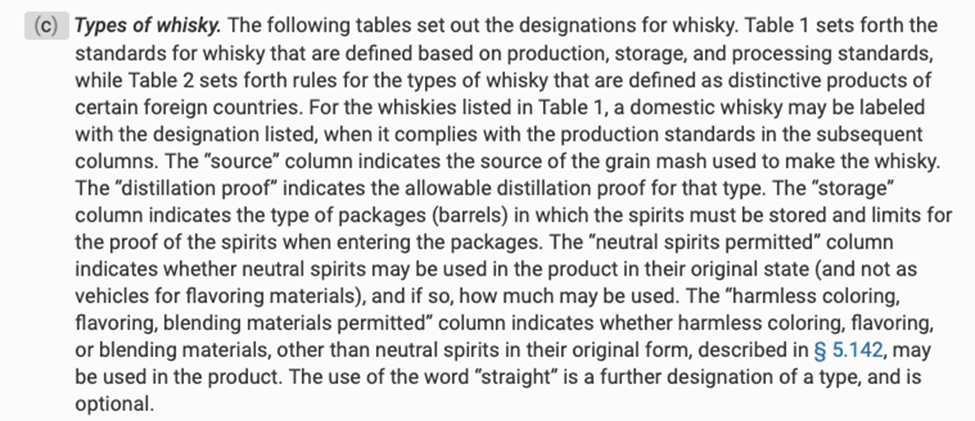
Type | Source | Distillation proof | Storage | Neutral spirits | Allowable coloring, flavoring, and blending materials permitted |
(1) Whisky, which may be used as the designation for any of the type designations under the class “whisky,” or may be used as the designation if the whisky does not meet one of the type designations but satisfies the class designation | Fermented grain mash | Less than 190° | Oak barrels with no minimum time requirement. | No | Yes |
(2) Bourbon Whisky, Rye Whisky, Wheat Whisky, Malt Whisky, Rye Malt Whisky, or [name of other grain] Whisky | Fermented mash of not less than 51%, respectively: Corn, Rye, Wheat, Malted Barley, Malted Rye Grain, [Other grain] | 160° or less | Charred new oak barrels at 125° or less. | No | Yes, except for bourbon whisky. |
(3) Corn Whisky (Whisky conforming to this standard must be designated as “corn whisky.”) | Fermented mash of not less than 80% corn | 160° or less | Required only if age is claimed on the label. If stored, must be stored at 125° or less in used or uncharred new oak barrels. | No | Yes |
(4) Straight Whisky | Fermented mash of less than 51% corn, rye, wheat, malted barley, malted rye [or other] grain. (Includes mixtures of straight whiskies made in the same state.) | 160° or less | Charred new oak barrels at 125° or less for a minimum of 2 years. | No | No |
(5) Straight Bourbon Whisky, Straight Rye Whisky, Straight Wheat Whisky, Straight Malt Whisky, or Straight Rye Malt Whisky | Fermented mash of not less than 51%, respectively: Corn, Rye, Wheat, Malted Barley, Malted Rye Grain | 160° or less | Charred new oak barrels at 125° or less for a minimum of 2 years. | No | No |
(6) Straight Corn Whisky | Fermented mash of not less than 80% corn | 160° or less | 125° or less in used or uncharred new oak barrels for a minimum of 2 years. | No | No |
(7) Whisky distilled from Bourbon/Rye/Wheat/Malt/Rye Malt/[Name of other grain] mash | Fermented mash of not less than 51%, respectively: Corn, Rye, Wheat, Malted Barley, Malted Rye Grain, [Other grain] | 160° or less | Used oak barrels. | No | Yes |
(8) Light Whisky | Fermented grain mash | More than 160° | Used or uncharred new oak barrels. | No | Yes |
(9) Blended Light Whisky (Light Whisky—a blend) | Light whisky blended with less than 20% Straight Whisky on a proof gallon basis | Blend | Will contain a blend. | No | Yes |
(10) Blended Whisky (Whisky—a blend) | At least 20% Straight Whisky on a proof gallon basis plus Whisky or Neutral Spirits alone or in combination | 160° or less | Will contain a blend of spirits, some stored and some not stored. | Maximum of 80% on a proof gallon basis | Yes |
(11) Blended Bourbon Whisky, Blended Rye Whisky, Blended Wheat Whisky, Blended Malt Whisky, Blended Rye Malt Whisky, Blended Corn Whisky (or Whisky—a blend) | At least 51% on a proof gallon basis of Straight Bourbon, Rye, Wheat, Malt, Rye Malt, or Corn Whisky; the rest comprised of Whisky or Neutral Spirits alone or in combination | Blend | Will contain a blend of spirits, some stored and some not stored. | Maximum of 49% on a proof gallon basis | Yes |
(12) Blend of Straight Whiskies (Blended Straight Whiskies) | Mixture of Straight Whiskies that does not conform to “Straight Whisky” | 160° or less | Will contain a blend of spirits that were aged at least 2 years. | No, except as part of a flavor | Yes |
(13) Blended Straight Bourbon Whiskies, Blended Straight Rye Whiskies, Blended Straight Wheat Whiskies, Blended Straight Malt Whiskies, Blended Straight Rye Malt Whiskies, Blended Straight Corn Whiskies, (or a blend of straight whiskies) | Mixture of Straight Whiskies of the same named type produced in different states or produced in the same state but contains coloring, flavoring, or blending material | 160° or less | Will contain a blend of spirits that were aged at least 2 years. | No, except as part of a flavor | Yes |
(14) Spirit Whisky | Mixture of Neutral Spirits and 5% or more on a proof gallon basis of Whisky or Straight Whisky or a combination of both. The Straight Whisky component must be less than 20% on a proof-gallon basis | Blend | Will contain a blend of spirits, some stored and some not stored. | Maximum of 95% on a proof gallon basis | Yes |
The following definitions are described below, for information, as it does not apply, by definition, to Japanese whisky.
Table 2 to Paragraph (c)—Types of Whisky That Are Distinctive Products
(16) Scotch whisky | Whisky which is a distinctive product of Scotland, manufactured in Scotland in compliance with the laws of the United Kingdom regulating the manufacture of Scotch whisky for consumption in the United Kingdom: Provided, That if such product is a mixture of whiskies, such mixture is “blended Scotch whisky” or “Scotch whisky—a blend”. |
(17) Irish whisky | Whisky which is a distinctive product of Ireland, manufactured either in the Republic of Ireland or in Northern Ireland, in compliance with their laws regulating the manufacture of Irish whisky for home consumption: Provided, That if such product is a mixture of whiskies, such mixture is “blended Irish whisky” or “Irish whisky—a blend”. |
(18) Canadian whisky | Whisky which is a distinctive product of Canada, manufactured in Canada in compliance with the laws of Canada regulating the manufacture of Canadian whisky for consumption in Canada: Provided, That if such product is a mixture of whiskies, such mixture is “blended Canadian whisky” or “Canadian whisky—a blend”. |
A new product type was added to the list in December 2024, ‘American Single Malt Whiskey’ which is defined as [14]:
The adopted criteria for American single malt whisky specify that the product be a type of whisky that is mashed, distilled, and aged in the United States; is distilled entirely at one U.S. distillery; is distilled to a proof of 160 or less; is distilled from a fermented mash of 100 percent malted barley; is stored in oak barrels (used, uncharred new, or charred new) with a maximum capacity of 700 liters; and is bottled at not less than 80° proof. In addition, the criteria allow for the use of caramel coloring as long as its use is disclosed on the product label.
The regulation also allows the use of the term “Straight” for an American single malt whisky that is aged for at least two years. This regulation is effective from January 19, 2025. [14]
3.9 References
1. Food Safety Modernization Act (FSMA)
https://www.fda.gov/food/guidance-regulation-food-and-dietary-supplements/food-safety-modernization-act-fsma
2. The beverage Alcohol Manual and TTB website
https://www.ttb.gov/system/files/images/pdfs/spirits_bam/complete-distilled-spirit-beverage-alcohol-manual.pdf
https://www.ttb.gov/scientific-services-division/limited-ingredients
3. 21 CFR Part 104 Subpart B
https://www.ecfr.gov/current/title-21/part-104/subpart-B
4. 27 CFR 1 Alcohol
https://www.ecfr.gov/current/title-27/chapter-I/subchapter-A
5. Food Ingredient & Packaging Terms
https://www.fda.gov/food/food-ingredients-packaging/food-ingredient-packaging-terms#:~:text=Food%20Additive%20%2D%20A%20food%20additive,substance%20intended%20for%20use%20in
6. Food Additive Listings
https://www.fda.gov/food/food-ingredients-packaging/food-additive-listings
7. 27 CFR 5.143 Whisky
https://www.ecfr.gov/current/title-27/section-5.143
8. 21 CFR Part 73 - LISTING OF COLOR ADDITIVES EXEMPT FROM CERTIFICATION
https://www.ecfr.gov/current/title-21/part-73
9. 21 CFR 172.510 - Natural flavoring substances and natural substances used in conjunction with flavors
https://www.ecfr.gov/current/title-21/section-172.510
10. 21 CFR 172.515 - Synthetic flavoring substances and adjuvants
https://www.ecfr.gov/current/title-21/section-172.515
11. TTB – SCIENTIFIC SERVICE DIVISION - Limited Ingredients
Limited Ingredients | TTB: Alcohol and Tobacco Tax and Trade Bureau
12. 21 CFR 101.100(a)(3)(ii)
https://www.ecfr.gov/current/title-21/part-101/section-101.100#p-101.100(a)(3)(ii)
13. 27 CFR 5.143(c) - Types of whisky
https://www.ecfr.gov/current/title-27/part-5/section-5.143#p-5.143(c)
14. Federal Register / Vol. 89, No. 243, 102726
https://www.govinfo.gov/content/pkg/FR-2024-12-18/pdf/2024-29938.pdf
Was this article helpful?