
3. Compositional Aspects
- 5 Mins to read
- DarkLight
3. Compositional Aspects
- 5 Mins to read
- DarkLight
Article summary
Did you find this summary helpful?
Thank you for your feedback
Mixture of Food Additives
Sri Lanka

This section provides the compositional requirements for the food category and/or food products in scope and information on permitted nutrients, ingredients, and additives.
3.1 Composition Requirements
Please contact our team for more information.
3.2 Raw Material Requirements
Category
Food additives
Raw materials or substances used in the primary production or manufacturing of foods are not specified under Sri Lankan food laws unless detailed in legislations - Sri Lanka Standards [1] and Food (Adoption of Standards) Regulation [2]. Only SLS standards for Food Additives of coloring substances are noted.
Sri Lankan regulations do not define what evidence is required to show that a substance is safe at its intended level of use before it may be added to foods. Furthermore, additives are not subject to ongoing safety reviews. Safety parameters and limits for the substances are regulated by referring to the published guidance in General Standard for Food Additives (GSFA) of the Codex Alimentarius Commission and the FAO JECFA database [3].
In addition, any food additive added in such a manner as to conceal or damage or make any inferiority in the quality of that food is prohibited. (Sec 4 of [4]).
Product
Mixture of Food Additive/Additive Premix
The main requirement relating to the Mixture of food additives is that each individual additive in the mixture should be a permitted food additive covered by the Food (Additive – General) Regulation [4] and need to follow the SLS standards as described in the legislations [1] [2].
3.3 Fortification
Please contact our team for more information.
3.4 Other Permitted Ingredients
Category
Food Additives
The addition of any ingredient that does not have any natural or added deleterious substance which renders it injurious to health, and is fit for human consumption, is permitted [5].
Product
Mixture of Food Additives/ Additive Premix
Same as "Category" above.
3.5 Permitted Additives
Category
Food Additives
As described in Section 2.2 of this guidebook, depending on the type, food additives fall under several regulations. The Food (Additives – General) Regulations (2019) [4] sum up all the different types of regulations.
The regulation permits food additives and their use for technological functions. These are specified in the Regulation. In the event that the list and limits for the substances are not specified, the General Standard for Food Additives (GSFA) of the Codex Alimentarius Commission [3] is referred to as illustrated below.
A) Food additives that are covered by regulations are specified below (Sec 2 of [4]):
1. Food (Coloring substances) Regulations - 2006
- Amendment to Food (Coloring substances) Regulations - 2009
- Amendment to Food (Coloring substances) Regulations - 2011
The Food (Coloring Substances) Regulations [6] listed the permitted coloring substances to be used in food and also the food items that are permitted to contain specific coloring substances.
2. Food (Antioxidant) Regulations - 2009
- Amendment to Food (Antioxidant) Regulations - 2013
Sri Lanka permits food with certain antioxidants under the Food (Antioxidants) Regulations (2009) as amended by the Food (Antioxidant) Amendment Regulations 2013 [7]. The regulations list permitted antioxidants and the maximum permissible levels are for use in edible fats and oils, margarine, fat spread, salad oils, lard and drippings, and essential oils per Table 1 below. The regulation does not allow the use of antioxidants in food intended for infants or young children.
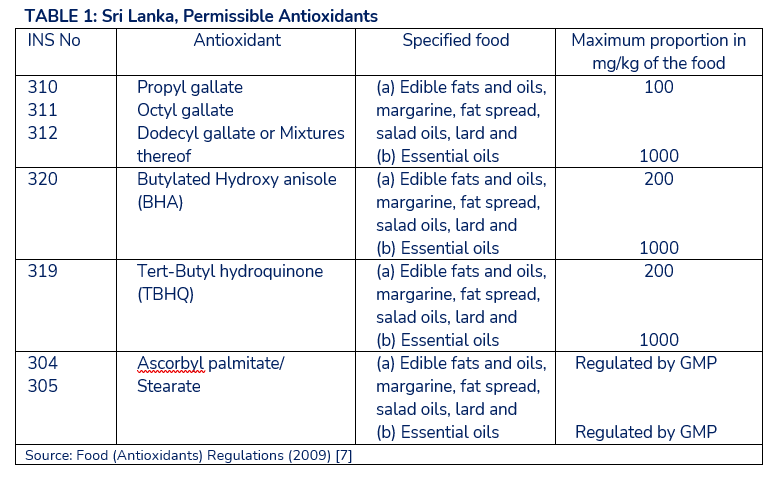 It is noteworthy that, even though the Food (Antioxidants Amendment) Regulations-2013 [7] has been amended, all matters relating to antioxidants should be reviewed and read with the Food (Additives) Regulations – 2009 [7].
3. Food (Flavoring substances and flavor enhancers) Regulations - 2013
The regulation [8] defined the requirement to declare the permitted flavoring substance or flavor enhancer under the provisions of the Food (labeling and Advertising) Regulations, 2005 [11] and note the list of flavoring substances that are prohibited for use, the permissibility of flavor enhancers and solvents for flavoring substances.
4. Food (Sweeteners) Regulations - 2014
The Regulation [9] provides guidelines for the use of sweeteners. The regulation establishes the maximum usage amount of each sweetener depending on the food type. Sri Lanka does not permit the use of any sweetener in, or on any food specially prepared for infants or young children.
5. Food (Preservatives) Regulations - 2019
A list of designated Food Preservatives and Maximum Limits that could be applied to designated food products are defined under SCHEDULE 1 of the Food (Preservatives) Regulation (2019) [10] Articles of Food which may contain permitted preservatives and quantity of the permitted preservatives in each case are defined under SCHEDULE II i.e.
- Column I Specified Foods
- Column II Permitted Preservatives
- Column III Maximum Permitted Level (mg/kg)
B) Classes of food additives used for other technological functions published in the General Standard for Food Additives (GSFA) of the Codex Commission are as listed below:
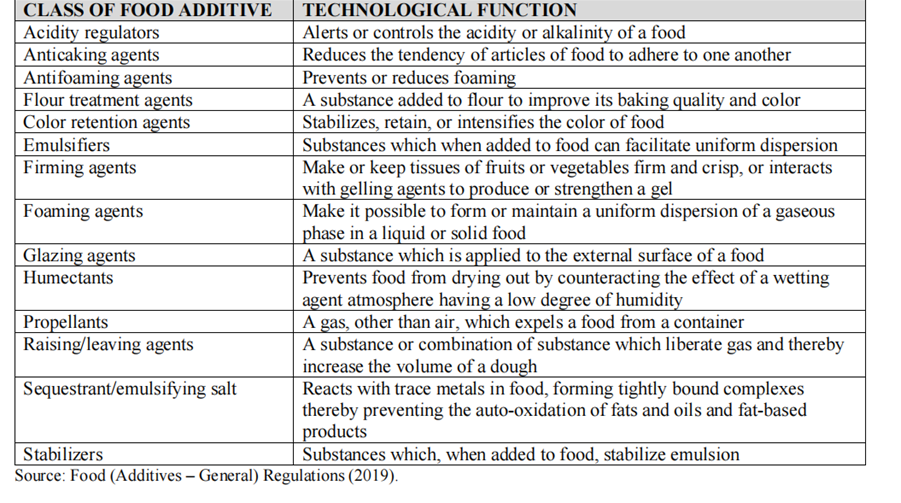
Provisions are in place under Section 3 of the Food (Additives-General) Regulations – 2019 [4], to allow the usage of new Food Additives permitted by the CODEX Commission on the recommendation of the Food Advisory Committee by the Chief Food Authority.
Product
Mixture of Food Additives/Additive Premix
For the following mixture of Food Additives as an example: Tertiary butylhydroquinone, TBHQ + Citric acid + Propylene glycol + Vegetable oil (soybean oil) as a carrier:
- TBHQ can be classified as antioxidants, so the following regulations will apply:
- Food (Antioxidant) Regulations - 2009, and its Amendment [7]
- Critic acid depending on its function whether acidity regulator, antioxidant, color retention agent, or sequestrant, can follow the Food (Antioxidant) Regulations – 2009 for antioxidants [7] or follow the limits as permitted in the specified food category published in the General Standard for Food Additives (GSFA) of the Codex Alimentarius Commission [3].
- Propylene glycol which has functions as a carrier, emulsifier, glazing agent, and humectant will follow the limits as permitted in the specified food category published in the General Standard for Food Additives (GSFA) of the Codex Alimentarius Commission [3].
- Soybean oil is just a carrier ingredient and follows the requirements as a raw material as stated in Section 3.2 above.
3.6 Permitted Flavors and Colors
Please contact our team for more information.
3.7 Permitted Processing Aids
Category
Food Additives
The use of a substance as a processing aid and the permitted list of processing aids are not defined under Sri Lankan food laws. The general principle is to refer to the permitted food additives listed under food Additives regulations [4].
Product
Mixture of Food Additives/Additive Premix
Same as "Category" above.
3.8 Additional Notes
Category
Food Additives
None.
Product
Mixture of Food Additives/Additive Premix
Same as "Category" above.
3.9 References
1. Sri Lanka Standards Catalogue 2021
https://slsi.lk/web/wp-content/uploads/2023/01/SLS-Catalogue-2021.pdf
2. Food (Adoption of Standards) Regulations 2008
https://faolex.fao.org/docs/pdf/srl134107.pdf
Food (Adoption of Standards) Amendment Regulation, 2013
3. Codex General Standard for Food Additives (GSFA) Online data base
https://www.fao.org/gsfaonline/additives/index.html
4. Food (Additives - General) Regulations 2019
http://www.eohfs.health.gov.lk/food/images/pdf/regulations/additive-english.pdf
5. Food Act No 26 of 1980
http://www.eohfs.health.gov.lk/food/images/pdf/acts/food_act_no26_1980_en.pdf
6. Food (Colouring Substances) Regulations - 2006
7. Food (Antioxidants) Regulations (2009), Amendment 2013
http://eohfs.health.gov.lk/food/images/pdf/regulations/Antioxident-Regulations-2009.pdf
Amendment to Food (Antioxidant) Regulations - 2013
http://eohfs.health.gov.lk/food/images/pdf/regulations/food_antioxidants_regulations_2013_en.pdf
8. Food (Flavouring Substances and Flavour Enhancers) Regulations 2013
9. Food (Sweeteners) Regulations (2014)
http://eohfs.health.gov.lk/food/images/pdf/regulations/food_sweeteners_regulations_2014_en.pdf
10. Food (Preservatives) Regulation (2019)
http://eohfs.health.gov.lk/food/images/pdf/regulations/preservative-english.pdf
11. Food (Labelling and Advertising) Regulations 2005
http://eohfs.health.gov.lk/food/images/pdf/regulations/food_labelling_and_advertising_regulations_2005_en.pdf
Was this article helpful?