
3. Compositional Aspects
- 8 Mins to read
- DarkLight
3. Compositional Aspects
- 8 Mins to read
- DarkLight
Article summary
Did you find this summary helpful?
Thank you for your feedback
General Foods
South Korea

This section provides the compositional requirements for the food category and/or food products in scope and information on permitted nutrients, ingredients, and additives.
3.1 Composition Requirements
For the composition of foods covered by specific food standards in “Section 5—Standards and Specifications for Each Food” of the Food Code, their respective standards and specifications shall take precedence. However, for food additives, the Food Additive Code should be followed first for food additives. (Section 1-2 of [1])
In addition, foods must also comply with “Section 2—Common Standards and Specifications for General Foods.” However, if the requirements seem unnecessary or ineffective due to the specific characteristics of the foods, they can be applied selectively based on their importance. (Section 1-2 of [1])
3.2 Raw Material Requirements
Section 1-3 of the Food Code [1] defines “ingredients” as per below:
"Ingredients" refer to substances used in food production that are edible, including animals, plants, or processed forms of these. They also include food additives permitted by the "Standards and Specifications for Food Additives," as well as processed foods used in the manufacturing of other foods."
Section 2-1 of the Food Code [1] provides Standards for Food Ingredient.
Ingredients used in all foods, including alcoholic beverages, must follow the requirements specified in (Section 2-1.1) of the Food Code.
The requirements are as follows:
- Ingredients used in food production must be collected, handled, processed, manufactured, or managed for the purpose of being edible.
- Ingredients must be of good quality and freshness, free from decay, spoilage, or contamination by toxic or harmful substances, ensuring safety.
- When using natural ingredients that are not subject to food manufacturing and processing business registration, foreign substances like soil, sand, and dust must be thoroughly removed, and they must be washed with food-grade water if necessary, with inedible parts completely removed.
- When purchasing and using food ingredients from businesses requiring permits, registration, or notification, the ingredients must come from registered manufacturers or importers and comply with the standards and specifications of the relevant food. Ingredients that violate related laws, such as those past their expiration date, must not be used.
- Foods and food additives with established standards and specifications must comply with those standards. Ginseng, red ginseng, and black ginseng must comply with the "Ginseng Industry Act," wild-simulated ginseng must comply with the "Act on the Promotion of Forestry and Mountain Villages," and livestock products must comply with the "Livestock Products Sanitary Control Act." If the final product has stricter standards for harmful contaminants than the ingredients, the appropriate ingredients must be used to meet the final product standards.
- When using crushed ingredients, they must be of good freshness, free from decay, spoilage, or contamination by foreign substances.
- Water used in food production must meet the quality standards of drinking water under the "Drinking Water Management Act" or the standards for raw water, concentrated water, mineral-depleted water, and mineral-concentrated water under the "Act on the Development and Management of Deep-Sea Water.”
- Agricultural, livestock, and fishery products grown or raised using biotechnology, such as genetically engineered methods, must pass the safety review according to the "Regulations on the Safety Review of Genetically Modified Foods" under the "Food Sanitation Act."
- Lactic acid bacteria and other microorganisms used in food must be edible and safe for food hygiene.
- For ginseng or red ginseng products: ① Spring ginseng, seedling ginseng, ginseng skin, and ginseng dregs cannot be used. Diseased parts of ginseng must be removed before use. ② Ginseng leaves must be free from foreign substances and must not come from diseased ginseng plants. ③ Fresh ginseng roots used whole must be at least three years old (except hydroponically grown ginseng under the Ginseng Industry Act), and diseased or damaged ginseng cannot be used.
- Edible eggs used in food manufacturing and processing must not be rotten, have rancid odors, be moldy, contain foreign substances, have blood, have leaking contents, have broken yolks (except for physical damage), be halted or failed to hatch eggs, and must meet residue limits.
- Raw milk must not contain neutralizing, sterilizing, or preservative agents, and milk and goat milk must not be milked or mixed in the same facility.
- Peppers must not be diseased, moldy, rotten, or dried while damaged or mottled.
- Edible by-products generated during food manufacturing and processing must be hygienically collected, handled, and managed to be used as ingredients for other foods.
- For fruits with seeds that are not allowed for use as ingredients, the entire fruit, including the seeds, can be used in food manufacturing and processing if the seeds are removed before consumption.
As specified above, ingredients must be of good quality and freshness. Section 1-2 of the Food Code [1] further explains this.
"Good quality and freshness of ingredients" refers to agricultural, forestry, livestock, and fishery products, as well as processed foods, meeting the standards and specifications set forth in this notification. Additionally, for agricultural and forestry products, it means they retain their natural form and color without any foreign or unpleasant odors. This includes products that have had bruised or damaged parts removed to make them suitable for consumption.
Hence, ingredients with applicable standards and specifications must meet those requirements unless the final food has stricter requirements. In such cases, the final standards and specifications take precedence.
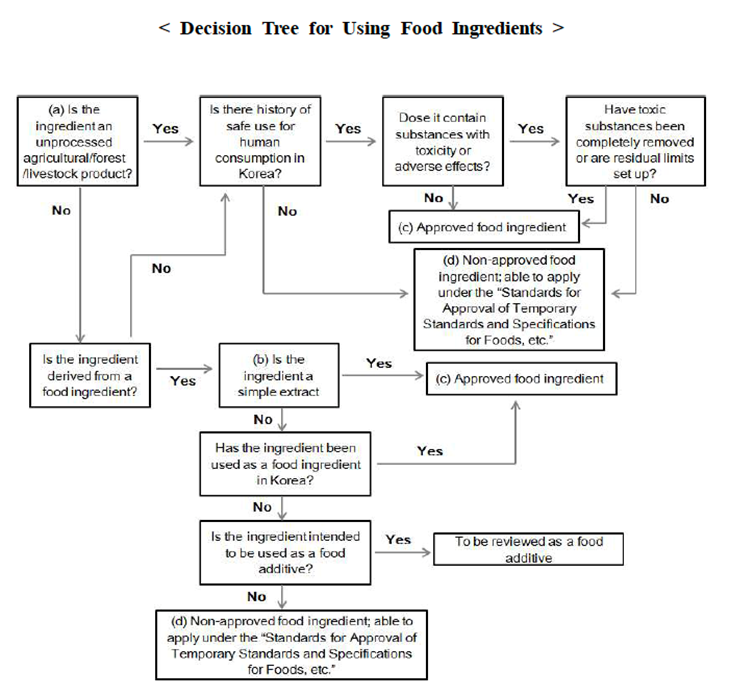
(Section 2-1.2) of the Food Code [1] provides Standards for Determining Food Ingredients. Food ingredients must be from one of the following lists:
- Classification of Food Ingredients (Section 1-4 of [1])
- Ingredients Approved for Use in Food (Annex 1 of [1])
- Ingredients Approved for Limited Use in Food (Annex 2 of [1])
- Ingredients Transitioned from Temporary Standards and Specifications (Annex 3 of [1])
This section of the Food Code also provides a decision tree that may be referred to when determining whether an ingredient is permissible for use.
3.3 Fortification
Nutrients permitted for fortification are regulated under the Food Additives Standards and Specifications [2] (Food Additive Codes), and their functional class is referred to as “Fortifying nutrient”.
Section II-5 provides Usage Standards for each additive. These additives must be used according to the specified usage standards. However, if the usage standards do not specify particular food groups to which it can be added, the additive can be assumed to be permitted for general food use unless it has its own specific standards and specifications to meet. This rule also applies to nutrient fortification.
It is important to remember that Nutrient fortifiers added to food must be used to maintain or improve the nutritional quality of the food and must not cause excessive or imbalanced intake of nutrients. ((Section II-2.3) of [2])
For those nutrient fortifiers without specified usage limits, the amount used should be limited to the minimum necessary to achieve the desired nutritional effects. ((Section II-2.1) of [2])
3.4 Other Permitted Ingredients
Refer to Section 3.2 above.
3.5 Permitted Additives
Food Additives Standards and Specifications [2] (Food Additive Codes) regulate and provide a list of additives that are permitted to be used in foods.
Section II-2 of the Food Additive Codes specifies the general standards for usage levels, and the relevant sections are provided below. If there are no specified usage levels indicated in the Food Additive Code and this guidebook, item 1) below should be followed. This includes all additives permitted under the Food Additive Codes.
- The amount of food additives used in foods must be the minimum necessary to achieve physical, nutritional, or other technical effects.
- Food additives must not be used to cover up defects in raw materials or unsanitary manufacturing processes during food production and processing.
- Nutritional fortifiers added to foods should maintain or improve the nutritional quality of the food and must not cause excessive or imbalanced nutrient intake.
- Food additives should be used in the manufacturing, processing, cooking, or preservation of food and should not be used for direct consumption or inhalation.
- Food additives used for cultivating microorganisms intended for food consumption must not remain in the final product unless specified in this notice or listed as a microbial nutrient source by the Codex Alimentarius Commission. If unavoidable, they must comply with usage standards for each item.
- When combining two or more of the following food colorants: Food Colour Green No. 3 and its aluminum lake, Food Colour Red No. 2 and its aluminum lake, Food Colour Red No. 3, Food Colour Red No. 40 and its aluminum lake, Food Colour Red No. 102, Food Colour Blue No. 1 and its aluminum lake, Food Colour Blue No. 2 and its aluminum lake, Food Colour Yellow No. 4 and its aluminum lake, Food Colour Yellow No. 5 and its aluminum lake, each should be used within its specified usage range, and the total combined amount should not exceed the limits specified for each food type in the table below.
Food Type | Usage Amount |
Beer, Fruit Wines, Whisky, Brandy, General Distilled Spirits, Liqueurs, Other Alcoholic Beverages | 0.3 g/kg |
- In addition to the primary uses specified for each item in this notice, food additives may be used for other internationally recognized uses if the technical effect has been proven and the justification for use is acknowledged.
- Food additives used as sterilizing agents should be used by immersion unless otherwise specified by individual item usage standards and should not be mixed with detergents or other sterilizing agents.
- Enzyme preparations should be used for decomposition, addition, or other purposes in accordance with their definition during the manufacturing and processing of food unless otherwise specified. They should not be used to increase the enzyme content in the final food product or for consumption to aid digestion.
Section III-5.A of the Food Additive Codes lists permitted additives. Unless restricted to specific food groups, these additives may be used as long as they comply with the usage standards.
If a food additive that is generally prohibited in a certain food is present as a carry-over from a permitted raw material, it is not subject to the usual usage restrictions as long as it stays within the limits transferred from the raw material. (Section 2-3 of [1]).
3.6 Permitted Flavors and Colors
Flavoring and coloring are permitted under specific requirements. Refer to Section 3.5 above.
3.7 Permitted Processing Aids
Processing aid is regulated under the Food Additive Codes and is defined as food additives intentionally used during the manufacturing process to achieve a technical purpose. They are either broken down or removed before the final product is completed, leaving no residue or only trace amounts unintentionally. It includes the following functional classes (Section II-2 of [2]):
- Sterilizing agents
- Filtering aids
- Release agents
- Manufacturing solvents
- Cleaning agents
- Extracting solvents
- Enzyme preparations
Section III-5.A of the Food Additive Codes lists permitted processing aids with the above functional classes for General Foods. Unless restricted to specific food groups, these processing aids may be used as long as they comply with the usage standards.
3.8 Additional Notes
None.
3.9 References
1. Food Codes (Issued date: 9 April 2024)
https://www.mfds.go.kr/brd/m_211/view.do?seq=14826&srchFr=&srchTo=&srchWord=&srchTp=&itm_seq_1=0&itm_seq_2=0&multi_itm_seq=0&company_cd=&company_nm=&page=1
2. Food Additive Codes (Issued date: 21 Dec 2023)
https://www.mfds.go.kr/brd/m_211/view.do?seq=14803&srchFr=&srchTo=&srchWord=&srchTp=&itm_seq_1=0&itm_seq_2=0&multi_itm_seq=0&company_cd=&company_nm=&page=1
Was this article helpful?