
Analytical Method for Resistant Dextrin
- 3 Mins to read
- DarkLight
Analytical Method for Resistant Dextrin
- 3 Mins to read
- DarkLight
Article summary
Did you find this summary helpful?
Thank you for your feedback
Regulatory Assessment on Analytical Method for Resistant Dextrin
Malaysia

The below version control table serves to document all updates made to the report. The purpose is to ensure the information is always accurate and up-to-date.
| Version Number | Content Creation Date | Publishing Date | Section(s) Updated & Reason(s) for Update |
|---|---|---|---|
| V0 | 08 March 2024 | 11 March 2024 | N/A (new report) |
Disclaimers
A) At RegASK, we are committed to providing our clients with the most up-to-date and accurate information on regulatory requirements and compliance. To ensure the highest level of accuracy and relevance, we regularly review and update our e-guidebooks at least twice per year to reflect the latest regulatory developments in the market. (Please contact us if you wish to activate this feature.) In the meantime, our RegAlerts service is designed to keep our clients notified of any regulatory updates that may impact their business.
B) The contents on this platform are exclusively intended for the use of RegASK and its authorized representatives. All materials herein are confidential and the sole property of RegASK. Any reproduction, distribution, or display of this content to others is strictly prohibited without the express written consent of RegASK.
1. Regulatory Overview of Analytical Methods Prescribed in the Country’s Regulation for the Determination of Dietary Fiber Content
In Malaysia, the Food Regulations 1985 and its Schedules [1] do not provide analytical methods for nutrient content such as dietary fiber.
According to the Malaysia Guide to Nutrition Labeling and Claims [2], nutrient content should generally be analyzed by internationally recognized methods such as those prescribed by the Association of Official Analytical Chemists (AOAC). Alternatively, the manufacturer may calculate the nutrient content based on the product formulation with reference to the Malaysia Food Composition Database (FCD) [3].
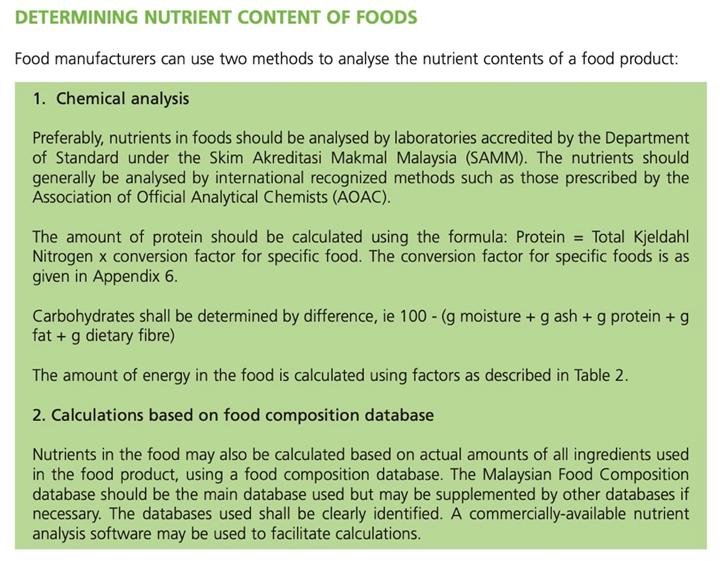
Figure 1. Excerpt from Malaysia Guide to Nutrition Labeling and Claims
The Institute for Medical Research (IMR) and the Institute for Public Health (IKU) under the Ministry of Health issued protocols for sampling and methods of analysis for Malaysian FCD in 2011 [4]. Although not a formal legal document, this protocol is an essential guideline for participating institutions to ensure a standard methodology is used for all food analyses. It provides a list of standard analytical methods to determine nutrient content in food.
Analytical methods applying to dietary fiber stated in the Protocol include:
- Method for proximate analysis
Type of nutrient | Method of analysis | Method Reference | Nature of sample |
Total dietary fiber (TDF) | Enzymatic gravimetric method | AOAC Method 991.43, 1991 [5] | Total, soluble, and insoluble fiber content |
From reference method AOAC 991.43, the Protocol describes a detailed analytical method to determine total, soluble, and insoluble dietary fiber contents in foods in Section 3.3.1.6. The method can be applied to determine total dietary fiber (TDF), and insoluble and soluble dietary fiber (IDF and SDF) in processed foods, grains, cereal products, fruits, and vegetables.
- Method Performance Characteristics (for laboratory competency test)
Type of nutrient | Method of analysis | Method Reference |
Total Dietary fiber TDF | Total dietary fiber in foods by Enzymatic- gravimetric Method (phosphate buffer) JKM F 1206 | AOAC 985.29 (1995) [6] |
In summary, it can be surmised that Malaysia MOH accepts test results of nutrients analyzed by AOAC methods.
2. Applicable Analytical Method for Resistant Dextrin
In the absence of local regulation prescribing analytical methods for dietary fiber, and considering resistant dextrin as a type of dietary fiber (see Figure 2 below), the manufacturer may refer to the methods outlined in Section 1 for the determination of dietary fiber content.
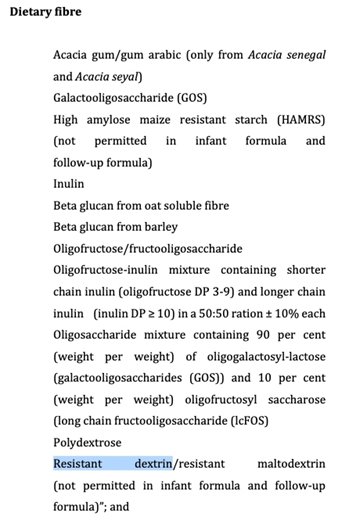
Figure 2. Excerpt from Twelfth Schedule of Malaysia Food Regulations 1985 [1]
Conclusion
- In Malaysia, nutrient content in food should generally be analyzed by internationally recognized methods such as those prescribed by the Association of Official Analytical Chemists (AOAC). Based on the Protocol for sampling and methods of analysis for the Malaysian Food Composition Database, two AOAC methods are recommended for the determination of dietary fiber.
- While it is not explicitly specified that the methods described in Section 1 can be applied to resistant dextrin, the manufacturer may take reference from those AOAC methods and establish the most appropriate one via method validation to ensure the results would be precise and accurate. It is also recommended to engage ISO/IEC 17025 accredited laboratories.
3. References
1. Malaysian Food Regulations 1985 and its Schedules
https://hq.moh.gov.my/fsq/peraturanperaturan-makanan-1985
2. Malaysia Guide to Nutrition Labeling and Claims (as of December 2010)
3. Malaysian Food Composition Database
4. Protocol for Sampling and Methods of analysis for Malaysia Food Composition Database
https://imr.nih.gov.my/images/uploads/Protocol_Sampling_MY_FCD.pdf
5. AOAC Method 991.43 Total, Soluble and Insoluble Dietary Fiber
http://www.aoacofficialmethod.org/index.php?main_page=product_info&cPath=1&products_id=1183
6. AOAC Method 985.29 Total Dietary Fiber in Foods
http://www.aoacofficialmethod.org/index.php?main_page=product_info&cPath=1&products_id=572
Was this article helpful?