
Regulatory Requirements for Fat in Ice Cream, Chocolate, and Caramel (Candy) - Korea
- 4 Mins to read
- DarkLight
Regulatory Requirements for Fat in Ice Cream, Chocolate, and Caramel (Candy) - Korea
- 4 Mins to read
- DarkLight
Article summary
Did you find this summary helpful?
Thank you for your feedback
Regulatory Requirements for Fat in Ice Cream, Chocolate, and Caramel (Candy)
Korea

The below version control table serves to document all updates made to the report. The purpose is to ensure the information is always accurate and up-to-date.
| Version Number | Content Creation Date | Publishing Date | Section(s) Updated & Reason(s) for Update |
|---|---|---|---|
| V0 | 06 Dec 2023 | 07 Nov 2024 | N/A (new report) |
Disclaimers
A) At RegASK, we are committed to providing our clients with the most up-to-date and accurate information on regulatory requirements and compliance. To ensure the highest level of accuracy and relevance, we regularly review and update our e-guidebooks at least twice per year to reflect the latest regulatory developments in the market. (Please contact us if you wish to activate this feature.) In the meantime, our RegAlerts service is designed to keep our clients notified of any regulatory updates that may impact their business.
B) The contents on this platform are exclusively intended for the use of RegASK and its authorized representatives. All materials herein are confidential and the sole property of RegASK. Any reproduction, distribution, or display of this content to others is strictly prohibited without the express written consent of RegASK.
1. ICE CREAM
1.1 Regulatory background ice cream category
Ice cream are regulated under section 2 of the Food Code [1] - Frozen confectionaries as follows: 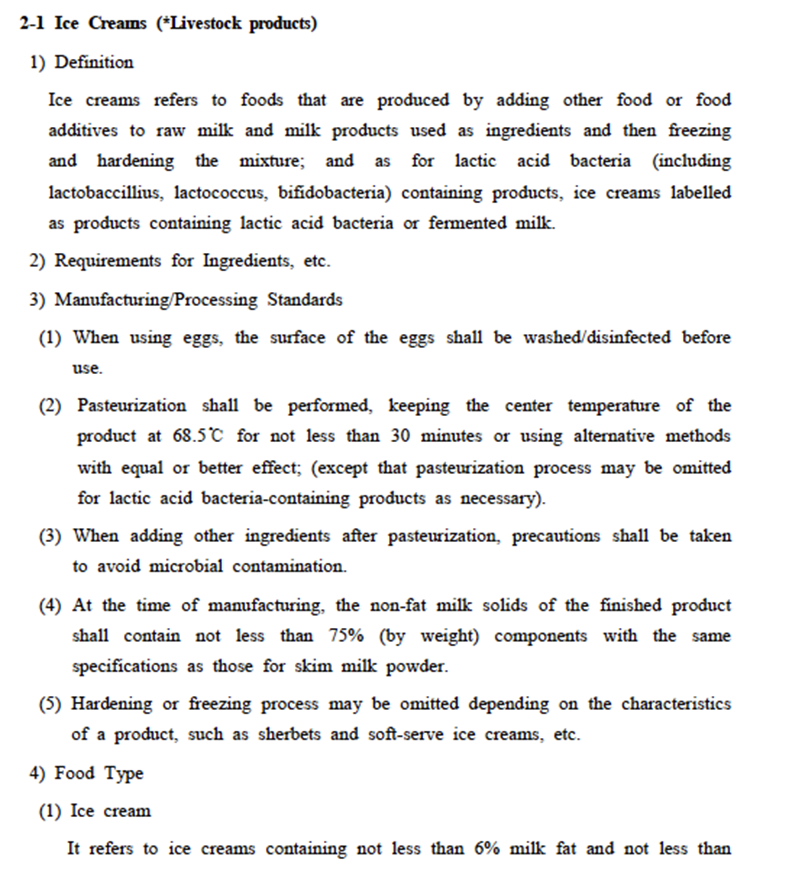
1.2 Composition criteria – fat and milk fat requirement
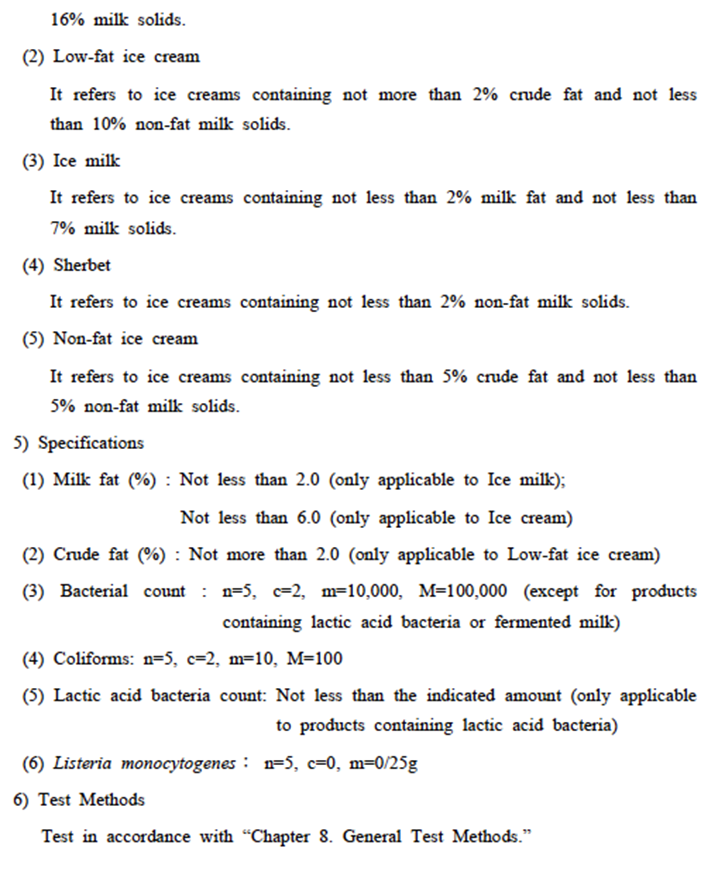
As described above, the criteria for fat are:
4) Food type
(1) Ice cream
It refers to ice creams containing not less than 6% milk fat and not less than 16% milk solids.
(2) Low-fat ice cream
It refers to ice creams containing not more than 2% crude fat and not less than 10% non-fat milk solids.
(3) Ice milk
It refers to ice creams containing not less than 2% milk fat and not less than 7% milk solids.
(4) Sherbet
It refers to ice creams containing not less than 2% non-fat milk solids.
(5) Non-fat ice cream
It refers to ice creams containing not less than 5% crude fat and not less than 5% non-fat milk solids.
5) Specifications
(1) Milk fat (%)
Not less than 2.0 (only applicable to Ice milk)
Not less than 6.0 (only applicable to Ice cream)
(2) Crude fat (%)
Not more than 2.0 (only applicable to Low-fat ice cream)
1.3 Can the milk fat be replaced by vegetable fat in ice cream?
Yes, the milk fat in ice cream can be replaced with vegetable fat.
In that case, the food type is changed to ‘(5) non-fat ice cream’ with no standards for milk fat or non-solid content.
The labeling requirements are the same as regular ice creams, only the food type needs to be changed to “non-fat ice cream” and the name of the vegetable fat should be indicated in the ingredient list.
Note: Edible oils and fats may be labeled as “edible oil or fat name” or “animal oil or fat” or “vegetable oil or fat (except olive oil).” However, edible oils cured by hydrogenation shall be labeled as hardened oil or partially hardened oil. (Example) Vegetable oil and fat (partially hardened oil) or soybean partially hardened oil [2].
2. CHOCOLATE
2.1 Regulatory background chocolate category
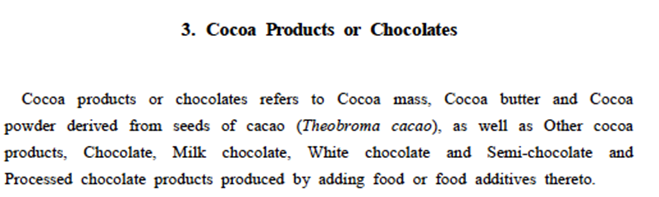
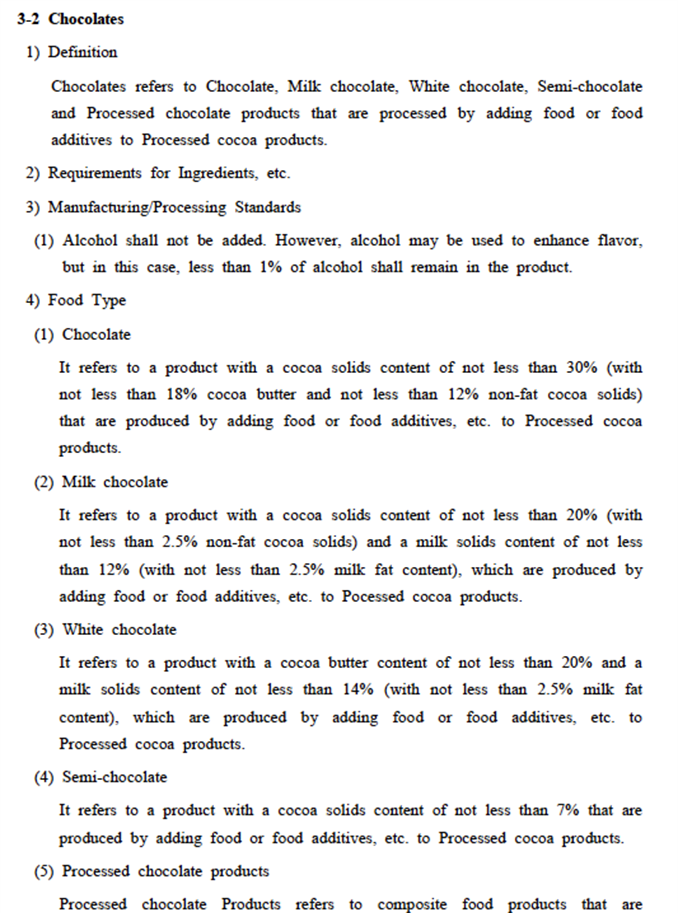
In Korea, Chocolate is regulated under section 3 Cocoa Products or Chocolates of the Food Code as follows:

2.2 Composition criteria – fat and milk fat requirement
As described above, the fact requirements for chocolate depend on the type or chocolate:
Chocolate food type | Fat related requirement |
Chocolate | - |
(2) Milk chocolate | milk solids content of not less than 12% (not less than 2.5% milk fat content) |
(3) White chocolate | milk solids content of not less than 14% (with not less than 2.5% milk fat content) |
(4) Semi-chocolate | - |
(5) Processed chocolate products processed chocolate | - |
2.3 Can the milk fat be replaced by vegetable fat in chocolate?
Yes, the milk fat in chocolate can be replaced with vegetable fat.
When replacing milk fat in existing products with vegetable fat: if the existing product falls under (2) Milk chocolate and (3) White chocolate, the food type on the label needs to be changed into food type (1) Chocolate, (4) Semi-chocolate, or (5) Processed chocolate products Processed chocolate depending on the cocoa solids content.
In addition, the name of the vegetable fat must be indicated in list of ingredients.
3. CARAMEL (candy)
3.1 Regulatory background caramel (candy)
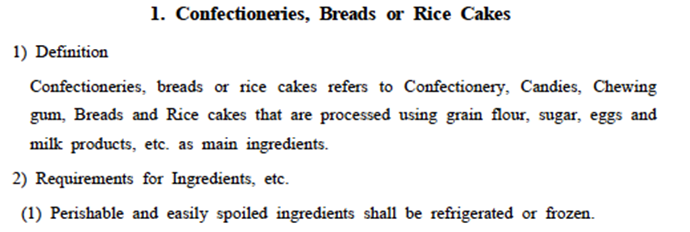
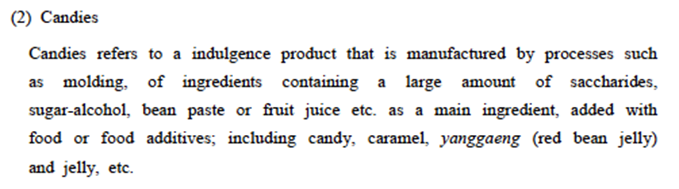
Caramel is included in section 1. Confectionaries, Breads or Rice Cake sub-section (2) Candies of the Food Code. Additionally, depending on the character of the product, it can be classified into 3-2. chocolate. Relevant provisions of the Standards are reproduced below :




3.2 Composition criteria – fat and milk fat requirements
There are no dairy/vegetable fat requirements for candies (caramels) and chocolates (processed chocolate products).
3.3 Can the milk fat be replaced by vegetable fat in caramel?
It is possible to replace the milk fat in caramel with vegetable fat.
The name of the vegetable fat must appear in the ingredient list of the product.
Note: If the product name was ‘Milk Caramel’ with milk fat, the product name needs to be changed.
Conclusion
- It is possible to replace milk fat with vegetable fat in ice cream, chocolate and caramel.
- If milk fat is changed to vegetable fat, the food type of ice cream and chocolate must change.
- For caramel, as there is no requirement for the use of milk fat, using milk fat instead of vegetable fat does not lead to a change of “Food type”, except if the candy could have been also classified as chocolate.
- The label must indicate the type of food that has been changed and the name of the changed ingredient (vegetable fat).
4. References
2. Labeling Standards of Foods, Etc.
Was this article helpful?