
Regulatory Status for Use in Food Supplements
- 2 Mins to read
-
DarkLight
Regulatory Status for Use in Food Supplements
- 2 Mins to read
-
DarkLight
Article summary
Did you find this summary helpful?
Thank you for your feedback
Tomato Liquid Concentrate
UK

This section provides a regulatory assessment for the use of Tomato Liquid Concentrate in Food Supplements in the UK.
1. Regulatory Background on Food Supplements in the UK
In the UK, food supplements are regulated by the Food Supplements (England) Regulations 2003 [1] which provides the following definition:

Figure 1. Excerpt from Regulation 2 of the Food Supplements
(England) Regulations 2003
Schedules 1 and 2 of the regulation provide a positive list of vitamins and minerals which can be used in food supplements.
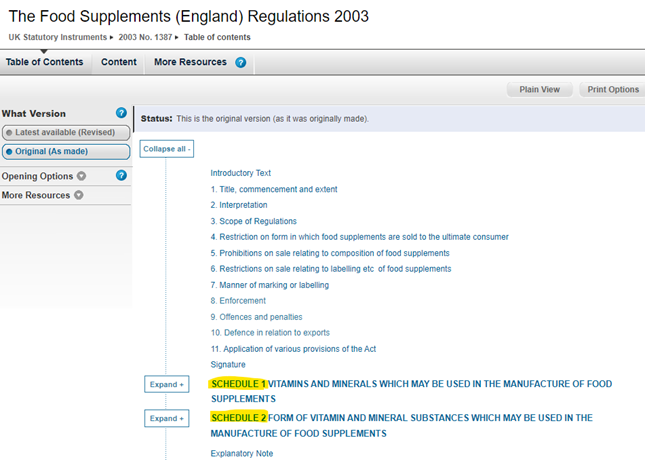
Figure 2. Table of Contents, Food Supplements (England) Regulations 2003
For other substances such as essential fatty acids, amino acids, or other nutrients or botanicals, there are currently no positive lists. Note that all substances are required to adhere to the general regulation requirements on packaging, labeling, and safety.
Presently there are two substances other than vitamins and minerals which are either prohibited or controlled at the national UK level for food supplements, i.e. the Kava-kava in Food (England) regulations 2002 [2] and the Tryptophan in Food (England) Regulation 2005 [3], including their equivalent legislation in Scotland, Wales, and Northern Ireland.
There is also a list of banned and restricted list of herbal ingredients published on 18 December 2014, which includes the legislation around the species Senecio [4, 5].
The person under whose brand it is sold has a primary responsibility to ensure that the product they sell is safe. Food supplements, like other foods, are not required to demonstrate their effectiveness before marketing, nor are they subject to prior approval unless they are genetically modified or are ‘novel’.
Novel foods which do not have a history of consumption in GB before May 1997, are subject to the terms and conditions of the Novel Foods (England) Regulation [6].
Finally, a product containing botanical substances may fall under a medicinal product depending on the substance, its form, and its claims. The Medicines and Healthcare Products Regulatory Agency (MHRA) has produced a guide to what is a medicinal product [7]. If it is not clear whether a product containing botanical substances should be regulated as a food supplement or as a medicinal product. Manufacturers may contact the Medicines Borderline Section at MHRA (email: borderline_medicine@mhra.gsi.gov.uk).
2. Permitted use of Tomato Liquid Concentrate as an Active Ingredient in Food Supplements
By ‘active’, it would refer to an ingredient with nutritional or physiological roles.
Tomato liquid concentrate is a foodstuff that has been consumed for a very long time in the UK and as such is not a novel food. The product specification and flowchart provided show no issues with the concentrate being suitable for use in food supplements.
Conclusion
Tomato liquid concentrate can be used as an active ingredient in food supplements in the UK; no legal maximum is set.
3. References
2. Kava-kava in Food (England) Regulation 2002
https://www.legislation.gov.uk/uksi/2002/3169/contents/made
3. The Tryptophan in Food (England) Regulations 2005
https://www.legislation.gov.uk/uksi/2005/2630/contents/made
4. Banned and restricted herbal ingredients 2014
5. The Medicines for Human Use (Prohibition) (Senecio and Miscellaneous Amendments) Order 2008
https://www.legislation.gov.uk/uksi/2008/548/contents/made
6. The Novel Foods (England) Regulations 2018
https://www.legislation.gov.uk/uksi/2018/154/made
7. A Guide to What is a Medicinal Product (March 2020) (MHRA)
Was this article helpful?