
Regulatory Status for Food Supplements
- 4 Mins to read
-
DarkLight
Regulatory Status for Food Supplements
- 4 Mins to read
-
DarkLight
Article summary
Did you find this summary helpful?
Thank you for your feedback
Ashwagandha
UK

This section provides a regulatory assessment for the use of Ashwagandha in Food Supplements in the UK.
1. Regulatory Background on Food Supplements in the UK
In the UK, food supplements are regulated by the Food Supplements (England) Regulations 2003 [1] which provides the following definition:

Figure 1. Excerpt from Regulation 2 of the Food Supplements
(England) Regulations 2003
Schedules 1 and 2 of the regulation provide a positive list of vitamins and minerals which can be used in food supplements.
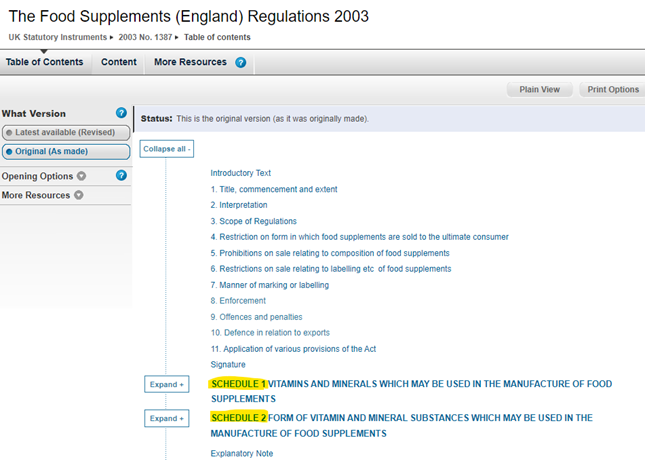
Figure 2. Table of Contents, Food Supplements (England) Regulations 2003
For other substances such as essential fatty acids, amino acids, or other nutrients or botanicals, there are currently no positive lists. Note that all substances are required to adhere to the general regulation requirements on packaging, labeling, and safety.
Presently there are two substances other than vitamins and minerals which are either prohibited or controlled at the national UK level for food supplements, i.e. the Kava-kava in Food (England) regulations 2002 [2] and the Tryptophan in Food (England) Regulation 2005 [3], including their equivalent legislation in Scotland, Wales, and Northern Ireland.
There is also a list of banned and restricted list of herbal ingredients published on 18 December 2014, which includes the legislation around the species Senecio [4, 5].
Note: Ashwagandha is not stated in either of the above regulations.
The person under whose brand it is sold has a primary responsibility to ensure that the product they sell is safe. Food supplements, like other foods, are not required to demonstrate their effectiveness before marketing, nor are they subject to prior approval unless they are genetically modified or are ‘novel’.
Novel foods which do not have a history of consumption in GB before May 1997, are subject to the terms and conditions of the Novel Foods (England) Regulation [6].
Finally, a product containing botanical substances may fall under a medicinal product depending on the substance, its form, and its claims. The Medicines and Healthcare Products Regulatory Agency (MHRA) has produced a guide to what is a medicinal product [7]. If it is not clear whether a product containing botanical substances should be regulated as a food supplement or as a medicinal product. Manufacturers may contact the Medicines Borderline Section at MHRA (email: borderline_medicine@mhra.gsi.gov.uk).
2. Permitted use of Ashwagandha as an Active Ingredient in Food Supplements
The Novel Foods (England) Regulation recognizes the EU Novel Food Catalogue [8]. The latter states that Ashwagandha was on the market as a food or food ingredient and consumed to a significant degree before 15 May 1997 (see Figure 3). Thus, its access to the market is not subject to the Novel Food Regulation (EU) 2015/2283 [9]. Other specific legislations may restrict the placing on the market of this product as a food or food ingredient in Europe.
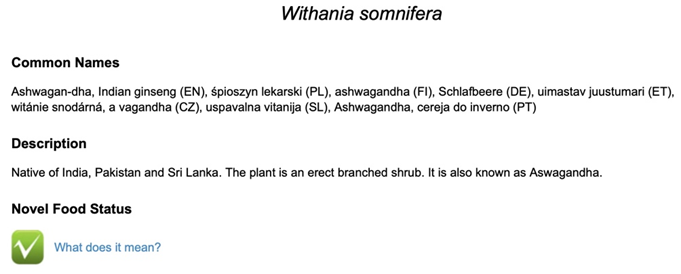

Figure 3. Excerpt from EU Novel Food Catalogue
The UK Food Standards Agency have confirmed they are aware that a significant history of consumption exists for Ashwagandha (Withania somnifera) as a food/food supplement in the UK/EU prior to 15 May 1997 and therefore it does not fall within the scope of the retained EU law. However, like all foods sold in the UK, such products should comply with General Foods Law and not be injurious to human health. It should also be clearly labeled and inform consumers as to the exact nature of the food [10].
The UK is not proactive in setting maximum levels for the inclusion of botanicals but depends instead upon the general requirements in Regulation (EC) No 178/2002 [11] that food manufacturers must ensure the foods they sell are safe. Hence, the amount used in a food supplement should be based on GMP (Good Manufacturing Practice) principle at a level sufficient to meet the intended benefits and ensure safety for consumption following the recommended daily dosage of the supplement.
In principle, the onus does not rest with the Government to prove a product is unsafe. It is for the manufacturer/FBO to prove their product is safe, with no pharmacological effects, and this can be done through validated risk assessments. As a guideline, the UK has developed Guidance on Food Traceability, Withdrawals and Recalls [12] which basically sets out the legal requirements of Regulation (EC) No 178/2002 and also best practices.2.1 Applicable Specifications for Ashwagandha (Local and/or International Standards)
Ashwaganda's scientific name is Withania somnífera. Any specific ingredient should come from the named and approved source.
Currently, there are no applicable specifications for Ashwagandha in the UK regulations. As the UK has retained a lot of EU legislation, manufacturers may refer to relevant specifications adopted at the EU level for botanical substances.
Conclusion
In the UK, Ashwagandha is permitted for use as an active ingredient in food supplements. There is currently no applicable specification and criteria of use set in the UK regulations. Manufacturers may refer to relevant international references including those adopted at the EU level for botanical substances.
3. References
2. Kava-kava in Food (England) Regulation 2002
https://www.legislation.gov.uk/uksi/2002/3169/contents/made
3. The Tryptophan in Food (England) Regulations 2005
https://www.legislation.gov.uk/uksi/2005/2630/contents/made
4. Banned and restricted herbal ingredients 2014
5. The Medicines for Human Use (Prohibition) (Senecio and Miscellaneous Amendments) Order 2008
https://www.legislation.gov.uk/uksi/2008/548/contents/made
6. The Novel Foods (England) Regulations 2018
https://www.legislation.gov.uk/uksi/2018/154/made
7. A Guide to What is a Medicinal Product (March 2020) (MHRA)
8. EU Novel Food Catalogue
https://webgate.ec.europa.eu/fip/novel_food_catalogue
9. Regulation (EU) 2015/2283 of the European Parliament and of the Council of 25 November 2015 on novel foods
https://www.legislation.gov.uk/eur/2015/2283/contents
10. Response from UK Food Standards Agency regarding Ashwagandha
PDF provided
11. Regulation (EC) No 178/2002 of the European Parliament and of the Council of 28 January 2002 laying down general principles and requirements of the food law, establishing the European Food Safety Authority and laying down procedures in matters of food safety
https://www.legislation.gov.uk/eur/2002/178/introduction
12. Guidance on Food Traceability, Withdrawals, and recalls within the UK Food Industry
Was this article helpful?