
Packaging Requirements for FCM
- 9 Mins to read
- DarkLight
Packaging Requirements for FCM
- 9 Mins to read
- DarkLight
Article summary
Did you find this summary helpful?
Thank you for your feedback
Food Contact Materials (FCM)
Indonesia

The below version control table serves to document all updates made to the report. The purpose is to ensure the information is always accurate and up-to-date.
| Version Number | Content Creation Date | Publishing Date | Section(s) Updated & Reason(s) for Update |
|---|---|---|---|
| V0 | 10 Feb 2025 | 12 Feb 2025 | N/A (new report) |
Disclaimers
A) At RegASK, we are committed to providing our clients with the most up-to-date and accurate information on regulatory requirements and compliance. To ensure the highest level of accuracy and relevance, we regularly review and update our e-guidebooks at least twice per year to reflect the latest regulatory developments in the market. Please contact us if you would like to activate this feature. In the meantime, our RegAlerts service is designed to keep our clients notified of any regulatory updates that may impact their business.
B) The contents on this platform are exclusively intended for the use of RegASK and its authorized representatives. All materials herein are confidential and the sole property of RegASK. Any reproduction, distribution, or display of this content to others is strictly prohibited without the express written consent of RegASK.
1. Overview of Relevant Regulatory Standards for Food Contact Materials
In Indonesia, food contact materials are regulated by BPOM Decree No. 20 Year 2019 on Food Packaging [1]. This regulation defines several key terminologies as follows:
- Food Contact Substances: Substances used in food packaging that come into direct contact with food during use, e.g. phthalic acid (used as a plasticizer) and ESBO (epoxidized soybean oil used as a stabilizer).
- Food Contact Materials: Materials used for food packaging, including tableware and food processing equipment, that come into contact with food, e.g. monolayer and multilayer plastics, paper, cardboard, and metal.
- Article: material that is already shaped and can function as food packaging, e.g. PET bottles, cans, and polystyrene foam.
This regulation includes a negative list of food contact substances in Annex I and a positive list of food contact substances in Annex II. [1]
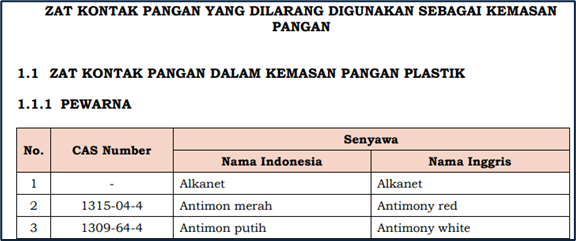
Figure 1. Excerpt of Annex I of BPOM Decree No. 20 Year 2019 [1]
Translation: Food Contact Substances (FCS) prohibited from use as food packaging
Example of Part 1.1. for FCS’ in plastic food packaging, subpart 1.1.1 Prohibited color.
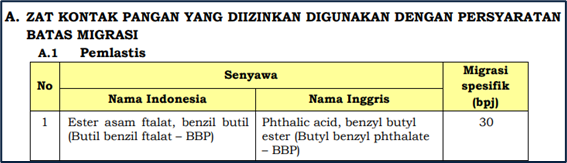
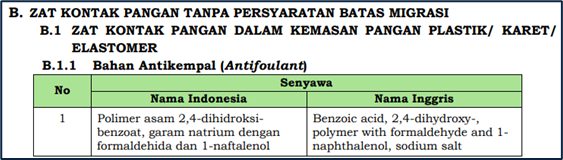
Figure 2. Excerpt of Annex II of BPOM Decree No. 20 Year 2019 [1]
Food Contact Substances (FCS) permitted to be used as food packaging
Example of Part A for FCS’ permitted with a maximum level of migration; and Part B for FCS’ permitted with no maximum limit of migration.
Furthermore, permitted food contact materials are listed in Annex III of this food packaging regulation [1]. These materials are permitted as long as they do not exceed the migration limits specified for each material in Annex III.
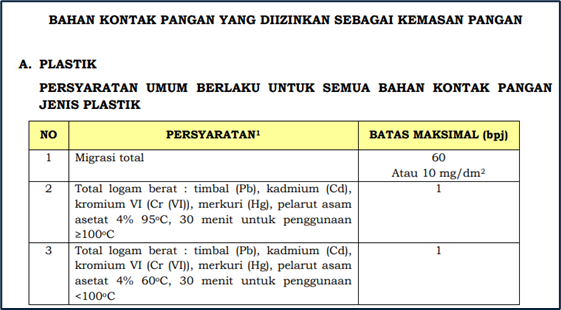
Figure 3. Excerpt of Annex III of BPOM Decree No. 20 Year 2019 [1]
Food Contact Materials (FCM) permitted to be used as food packaging
Example of Part A for plastic packaging with maximum limit stipulated in this regulation for total migration and total heavy metal
To conduct packaging migration testing, the use of food simulants is required, depending on the type of food and the conditions under which the packaging will be used. These requirements are outlined in Annex IV of this regulation. [1]
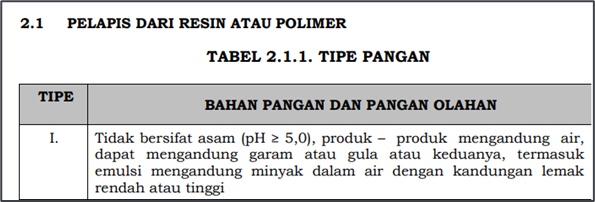
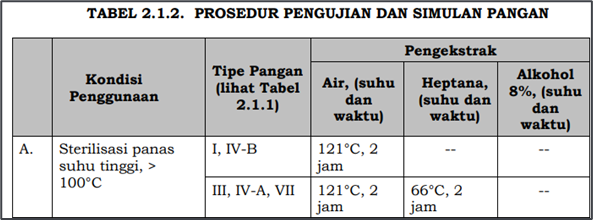
Figure 4. Excerpt of Annex IV of BPOM Decree No. 20 Year 2019 [1]
Testing procedure and food simulant based on each type of food and conditions of packaging
Example of Part 2.1 for coating from resin or polymer, table 2.1.1 listed types of food and table 2.1.2 listed the use condition of packaging with the testing procedure and food simulant.
2. General Standards for Food Contact Materials
Food packaging (including food contact material) should follow these requirements: [1]
- To not use food contact substances listed in Annex I.
- Food contact substances and materials listed in Annex II and III may be used, ensuring that the migration limit does not exceed the maximum limit set by the regulation.
- Recycled packaging should meet the same requirements as virgin packaging, as outlined in the regulation.
- Preform packaging may be complied with migration limits depending on the type of food contact substances/materials used in the manufacture of the articles.
3. Specific Requirements per Type of Food Contact Materials
3.1 Glass Bottles [1]
- Prohibited food contact substance:
- Ink printed directly on the packaging (Annex I Subpart 1.2; table 1.2.1 Colour, 1.2.2 Stabilizer, and 1.2.3 Solvent).
- Tin-coated lead foil (Annex I Table 1.5)
- Permitted food contact substances: substances with maximum limit of migration (Annex II Part A; Table A.1 Plasticizer until A.9 Acetaldehyde scavenger).
- Permitted food contact materials and migration limits (Annex III Part H. Glass). The requirement applies for:
- Cadmium extracted with 4% acetic acid, at room temperature (dark place) for 24 hours; and
- Lead extracted with 4% acetic acid, at room temperature (dark place) for 24 hours
Migration limit can refer depending on:
- Depth < 2.5 cm after filled with liquid or non-fillable (migration limit in table 1.1)
- Depth > 2.5 cm when filled, for use other than cooking with heating with a capacity < 600 ml (migration limit in table 2.1).
- Depth > 2.5 cm when filled, for use other than cooking with heating with a capacity between 600 ml and 3 L (migration limit in table 3.1)
- Depth > 2.5 cm when filled, for use other than cooking with heating with a capacity > 3 L (migration limit in table 4.1).
- Depth > 2.5 cm when filled, for heating cooking (migration limit in table 5.1).
Migration limit requirements in this regulation are typically determined by the type of food and the packaging conditions, as detailed for various food contact materials in Annex IV. However, specific requirements for glass packaging are not included in Annex IV.
3.2 Metal Can [1]
- Prohibited food contact substance:
- Ink printed directly on the packaging (Annex I Subpart 1.2; table 1.2.1 Colour, 1.2.2 Stabilizer, and 1.2.3 Solvent).
- Lead solders (Annex I Table 1.3).
- Permitted food contact substances:
- Substances with maximum limit of migration (Annex II Part A; table A.1 Plasticizer until A.9 Acetaldehyde scavenger).
- Substances with no migration limit (Annex II Part B; Subpart B.2 Metal; Table B.2.1 Anticorrosive until B.2.4 Modifier: Others).
- Permitted food contact materials and migration limits (Annex III Part I. Metal, Subpart 1. Can). The requirement applies for, with each maximum migration limit (Table 1.1):
- Cadmium extracted with water at temperature of 60°C for 30 minutes, for food with pH > 5
- Cadmium extracted with water at 95°C for 30 minutes for use > 100°C, for food with pH > 5
- Cadmium extracted with 0.5% citric acid solvent at 60°C for 30 minutes, for foods with pH ≤ 5
- Lead extracted with water at 60°C for 30 minutes for foods with pH > 5
- Lead extracted with water at 95°C for 30 minutes for use > 100°C, for food with pH > 5
- Lead extracted with 0.5% citric acid solvent at 60°C for 30 minutes, for food with pH ≤ 5
Please note:
- Parameters may include extracted content, specific content, total migration, and/or specific migration.
- If the food simulant, temperature, and test time are not specified in Annex III, the test procedure (food simulant, temperature, and test time) shall be carried out in accordance with the food type and conditions of use listed in Annex IV.
3.3 Caps/stoppers (Plastics, Metal) [1]
- Prohibited food contact substance:
- for plastic caps/stoppers:
- Ink printed directly on the packaging (Annex I Subpart 1.2; table 1.2.1 Colour, 1.2.2 Stabilizer, and 1.2.3 Solvent).
- substances in Annex I Subpart 1.1 (table 1.1.1 Colour until 1.1.8 Sanitizer).
- for metal caps/stoppers: See Section 3.2 above. If caps/stoppers are combination within plastics and metal, the prohibition applies to all of the above materials.
- for plastic caps/stoppers:
- Permitted food contact substances:
- for plastic caps/stoppers:
- Substances with maximum limit of migration (Annex II Part A; table A.1 Plasticizer until A.9 Acetaldehyde scavenger).
- substances with no migration limit in Annex II Part B Subpart B.1 Food contact substances in plastic/rubber/elastomer food packaging (table B.1.1 Antifoulant until B.1.18.2 Pigment Dispersant).
- for metal caps/stoppers: See Section 3.2 above. If caps/stoppers are combination within plastics and metal, the allowance applies to all of the above materials.
- for plastic caps/stoppers:
- Permitted food contact materials and migration limits (Annex III Part E. Covers/Gaskets/Seals; Subpart 4. Total plates or pre-formed rings of polymeric or resin-coated paper, cardboard, plastic, or sheet metal substrates): The requirement applies for, with each maximum migration limit (Table 4.1 Extracted Maximum Limit):
- Fraction of chloroform after contact with distilled water, under the conditions mentioned in Annex IV tables 2.3.1 and 2.3.2.
- Fraction of chloroform after contact with n heptane, under the conditions mentioned in Annex IV tables 2.3.1 and 2.3.2.
- Fraction of chloroform after contact with alcohol, under the conditions mentioned in Annex IV tables 2.3.1 and 2.3.2.
Please note:
- Parameters may include extracted content, specific content, total migration, and/or specific migration.
- If the food simulant, temperature,e and test time are not specified in Annex 2B, the test procedure (food simulant, temperature, and test time) shall be carried out in accordance with the food type and conditions of use listed in Annex IV.
4. Other Rules
- Testing methods can be referred to local Indonesian National Standard (Standar Nasional Indonesia/SNI):
- SNI 8215-2-2017 Test method for total migration from food packaging - Part 2: Plastic packaging [2]
- SNI 8280.1-2016 Test method for migration of food contact substances from metal food packaging - Part 1: Cadmium (Cd), chromium (VI) [Cr(VI)] and lead (Pb) [3]
- SNI 7741-2013 Test method for migration of food contact substances from food packaging - Lead (Pb), cadmium (Cd), chromium (VI) [Cr(VI)], and mercury (Hg) from plastic packaging [4]
In the absence of local standards or updated methods, international standards like ISO may be used as a reference for testing methods.
- Food contact substances or materials not listed in this regulation must undergo prior evaluation by BPOM through a special permit application. The applicant should complete the form and submit the required documents as per Annex V. [1]
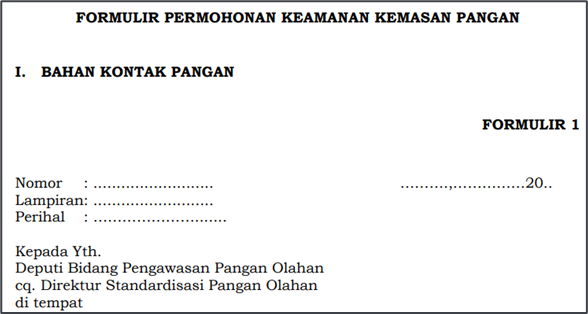
Figure 5. Excerpt of Annex V of BPOM Decree No. 20 Year 2019 [1]
Application form of food packaging safety for special permit request to BPOM
Note: BPOM is currently working on a draft of a new BPOM Decree on Food Packaging [5] and a Guideline [6] that describes how to implement the BPOM Decree and all other Indonesian references (regulations from various Ministries and standards) on Food Packaging. The timeline for publication for both drafts is expected in around 2025.
5. Summary Table
Food contact materials | General legislation applicable | Specific legislation applicable |
Glass bottle | BPOM Decree No. 20 Year 2019 on Food Packaging | N/A |
Metal Can | Testing methods: SNI 8280.1-2016 Test method for migration of food contact substances from metal food packaging - Part 1: Cadmium (Cd), chromium (VI) [Cr(VI)] and lead (Pb) | |
Caps/stoppers (Plastics, Metal) | Testing methods:
|
6. References
1. BPOM Decree No. 20 Year 2019 on Food Packaging
https://jdih.pom.go.id/download/rule/842/20/2019/Kemasan%20Pangan
2. SNI 8215-2-2017 Test method for total migration from food packaging - Part 2: Plastic packaging (paid document)
https://pesta.bsn.go.id/produk/detail/11095-sni8215-22017
3. SNI 8280.1-2016 Test method for migration of food contact substances from metal food packaging - Part 1: Cadmium (Cd), chromium (VI) [Cr(VI)] and lead (Pb) (paid document)
https://pesta.bsn.go.id/produk/detail/10896-sni828012016
4. SNI 7741-2013 Test method for migration of food contact substances from food packaging - Lead (Pb), cadmium (Cd), chromium (VI) [Cr(VI)], and mercury (Hg) from plastic packaging (paid document)
https://pesta.bsn.go.id/produk/detail/9466-sni77412013
5. Draft BPOM Decree on Food Packaging
https://members.wto.org/crnattachments/2024/SPS/IDN/24_07823_00_x.pdf
6. Draft BPOM Guideline on Implementation of Food Packaging Decrees
https://drive.google.com/drive/folders/1jN_96fPWQC1CoWj9g5WwtBpFW5h_7hWy
Was this article helpful?