
Regulatory Overview on Food Contact Materials
- 14 Mins to read
- DarkLight
Regulatory Overview on Food Contact Materials
- 14 Mins to read
- DarkLight
Article summary
Did you find this summary helpful?
Thank you for your feedback
Food Contact Materials (FCM)
Australia

The below version control table serves to document all updates made to the report. The purpose is to ensure the information is always accurate and up-to-date.
| Version Number | Content Creation Date | Publishing Date | Section(s) Updated & Reason(s) for Update |
|---|---|---|---|
| V0 | 23 October 2023 | 16 May 2024 | N/A (new report) |
| V1 | 02 July 2024 | 03 July 2024 | V0 updated to V1 (except for Ceramics) |
Disclaimers
A) At RegASK, we are committed to providing our clients with the most up-to-date and accurate information on regulatory requirements and compliance. To ensure the highest level of accuracy and relevance, we regularly review and update our e-guidebooks at least twice per year to reflect the latest regulatory developments in the market. Please contact us if you would like to activate this feature. In the meantime, our RegAlerts service is designed to keep our clients notified of any regulatory updates that may impact their business.
B) The contents on this platform are exclusively intended for the use of RegASK and its authorized representatives. All materials herein are confidential and the sole property of RegASK. Any reproduction, distribution, or display of this content to others is strictly prohibited without the express written consent of RegASK.
Overview of Relevant Regulatory Standards
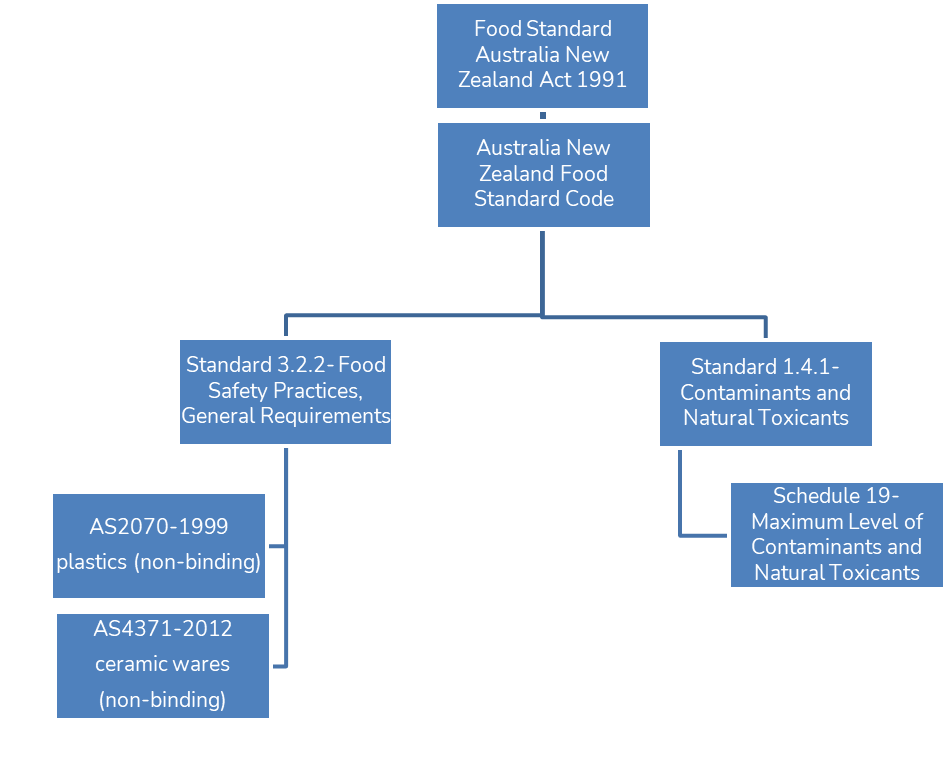
Figure 1: Overview of the relevant regulatory standards for food contact materials in Australia.
Regulatory Requirements on Food Contact Materials
1. General Requirements
Food Standards Australia New Zealand (FSANZ) [1] develops the shared food standards for Australia and New Zealand. The standards together make up the Australia New Zealand Food Standards Code (FSC) [2]. Within the FSC, there are provisions relating to food contact materials including packaging, coatings, edible substances in contact with foods, and contaminants.
In general, the FSC rules for food contact materials used in packaging are principles-based and not prescriptive. Standard 1.1.1 [3] includes information on packaging requirements (Figure 2), including that manufacturers are required to meet any packaging requirements captured in relevant Standards (clause 1.1.1 – 10(10)) and safety requirements in the case of accidental ingestion (clause 1.1.1 – 10(11)). These apply to a food for sale, that is, retail packaging.
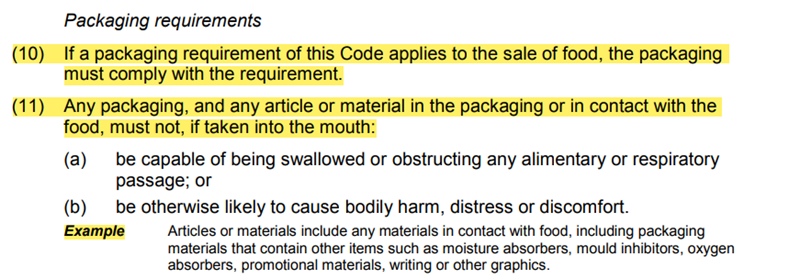
Figure 2: Overarching packaging requirements from Clauses 1.1.1 – 10 (10 and 11) of [3]
Food imported in the packaging in which it is intended to be sold must also comply with the FSC requirements (Figure 3):
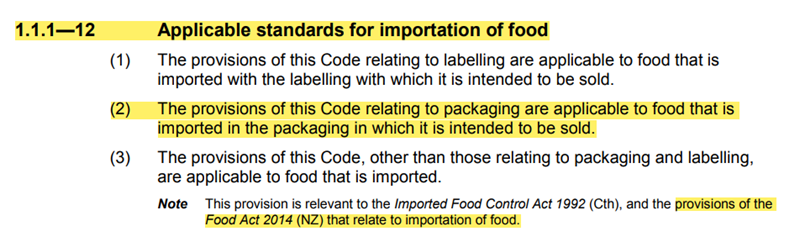
Figure 3: Packaging requirements for imported food from Clause 1.1.1 –12 of [3].
Standard 1.4.1 [4] and Schedule 19 [5] of the FSC provide a mechanism for FSANZ to regulate specific chemical contaminants which can migrate from packaging and may pose a risk to human health and safety. The Schedule contains maximum permitted levels for chemicals, arranged under certain foodstuffs. These contaminants are addressed regardless their origin, that is, whether naturally occurring or from other sources. It may be observed that some of these chemicals with limitations may be originated from food contact materials, for example vinyl chloride (PVC, PVDC), methanol (solvent impurity), acrylonitrile (SAN resins), 1,3-dichloro-2-propanol (solvent impurity), tin (from canned foods) and others. Therefore, it will be necessary to consult this Standard while using or developing food contact materials if any such materials are used.
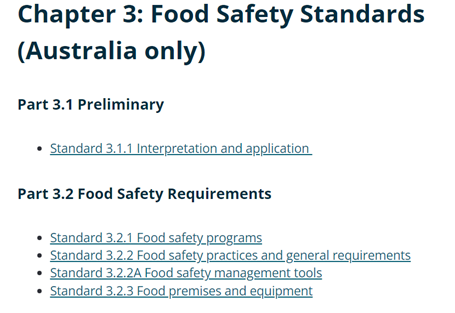
It should be noted that there is no specific guidance on materials permitted for use in food contact items, apart from the provisions of Standard 1.4.1 [4]. There is no requirement to have any packaging or packaging material approved for use. Chapter 3 of the FSC [6] included Food safety standards that apply to Australia only:
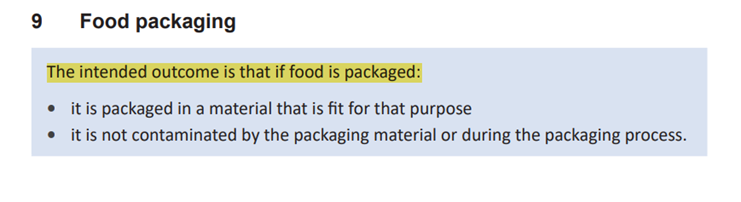
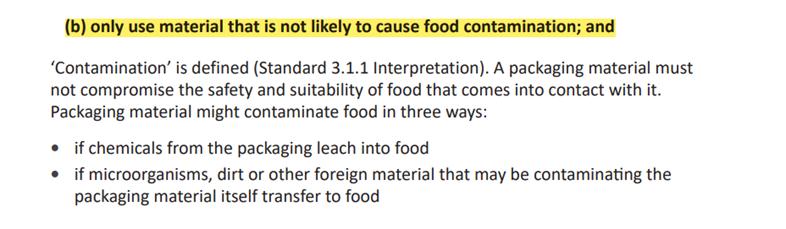
 Clause 9 of Standard 3.2.2 [7] concerns food packaging. Again, the provisions are principles-based:
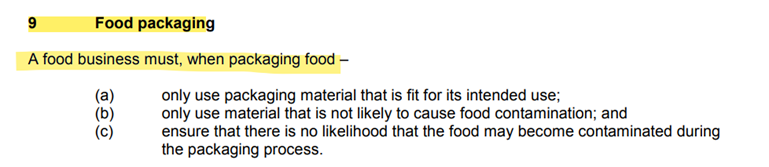
Figure 4: Packaging requirements from clause 3.2.2-9 of [7].
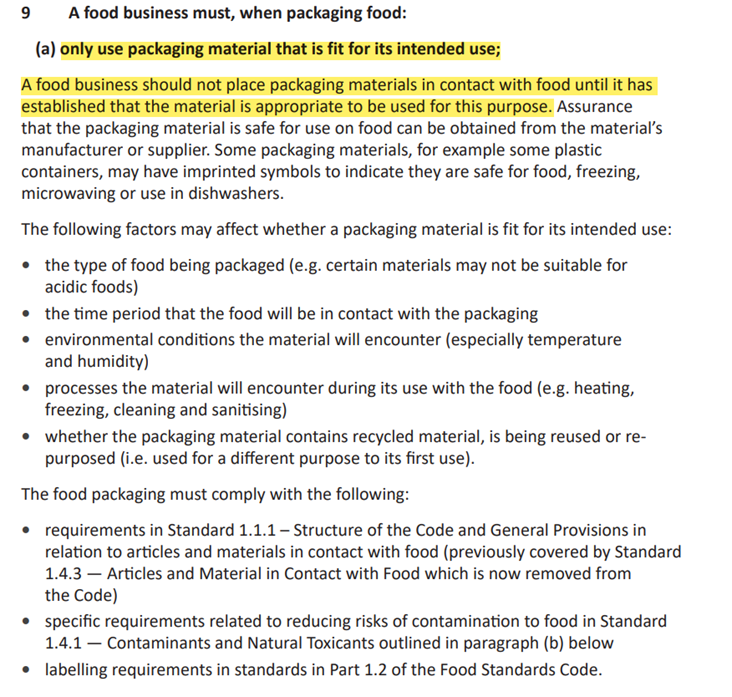
FSANZ’s guidance document, “Safe Food Australia” [8], pertains to the Australia-only food safety standards in Chapter 3 of the FSC [6]. It also provides further input (pages 54 to 56 of the guidance document) on the requirements under Standard 1.4.1 [4], reminding manufacturers that they should minimise chemical migration into food and ensure that any substance used in packaging will not impact the safety and suitability of the food that comes into contact with it. Some relevant excerpts from [8] are provided in Figure 5.
In 2014, FSANZ commenced work on Proposal P1034 (Chemical Migration from Packaging into Food) [9] which involved scientific and technical assessment to support consideration of measures which mitigate risks from chemicals which may migrate from packaging materials into food. At that time the FSC included the now rescinded Standard 1.4.3 – Articles and materials in contact with food [10]. Most provisions in [10] were migrated into other parts of the FSC. However, an editorial note (Figure 6) was not carried across since such notes are not legally binding.
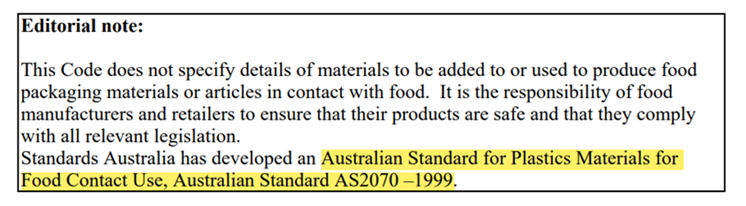
Figure 6. Editorial note from rescinded Standard 1.4.3 [10].
Following extensive consultation with industry and other stakeholders, FSANZ decided to abandon Proposal P1034. This was partially based on the results from multiple analytical surveys in both New Zealand and Australia. When examining a number of potential chemical migrations and estimated dietary exposure to these chemicals due to migration into food, the FSANZ conclusion was that there was no public health and safety concern. More information and technical documentation from P1034 is available [9]. However, the change to rescind Standard 1.4.3 of the FSC and the note shown in Figure 5 did go ahead.
Due to the broad requirements of the FSC that food contact materials need to be ‘suitable and safe’ (refer above) and the abandonment of Proposal P1034, the industry has generally demonstrated suitability of their food contact materials by adopting either EU or US packaging standards and also the Australian Standard AS2070-1999 [11]. More information on [11] is provided in Section 2 below.
Current trends favoring the use of reusable, recyclable or compostable packaging materials have led large food retailers to require compliance with the Australasian Recycling Logo (ARL) [12] which, while voluntary, is supported by the Australian Packaging Covenant (APCO) [13]. APCO manages the ARL program. The ARL program is voluntary and mostly concerns provision of recycling information for consumers using a number of consistent images to inform what consumers should do with packaging items. This and the planned phase out of some single-use food contact materials mean that there is more awareness of the composition of food contact packaging. Many larger food retailers, including supermarket chains that own bottle shops (alcohol retailers), support the use of the ARL.


2. Specific Requirements per Type of Food Contact Materials
2.1 Plastics
Australian Standard AS2070-1999
The non-binding standard AS2070-1999 [11] was developed by the Joint Standards Australia/Standards New Zealand Committee FT/8, Plastics for Food Contact in 1999 in order to ensure that plastic materials intended to become in contact with food fulfil the requirements of the FSC.
AS2070-1999 makes reference to the US FDA Regulations contained in the US Code of Federal Regulation, Title 21, Parts 170 to 199, as well as a number of EU Directives in the field of food contact plastics. Although these Directives are currently obsolete in Europe and have been superseded by new versions, they are still relevant in Australia. It should be noted that this Australian Standard has been ‘withdrawn’, which means that it is no longer being maintained or updated though it is still in widespread use. Therefore, it will not reflect recent changes such as the introduction of EU Regulation 2022/1616 [14] which concerns the use of recycled plastic materials.
It applies to:
- Plastic packages
- Plastic food and beverage containers, lunch boxes, water bottles, and jars
- Plastic wrapping materials
- Plastic utensils
In addition of plastic materials, coating and printing of plastic items also fall within the scope of the standard. This includes such items as packages, domestic containers, wrapping materials, utensils or any other plastics items intended for food contact applications.
The list of EU Directives referenced in AS2070-1999 is reported below:
- 82/711/EEC Directive laying down the basic rules necessary for testing the migration of the constituents of plastic materials and articles intended to come into contact with foodstuffs.
- 85/572/EEC Directive laying down the list of simulants to be used for testing of migration of constituents of plastics materials and articles intended to come into contact with foodstuffs.
- 89/109/EEC Directive relating to materials and articles intended to come into contact with foodstuffs.
- 90/128/EEC Directive relating to plastic materials and articles intended to come into contact with foodstuffs.
- 92/39/EEC Directive amending Directive 90/128/EEC
- 93/9/EEC Directive amending Directive 90/128/EEC
- 93/8/EEC Directive amending Directive 82/711/EEC
- 95/3/EC Directive amending Directive 90/128/EEC
- 96/11/EC Directive amending Directive 90/128/EEC
- The Council of Europe Resolution AP(89)1 on the use of colorants in plastic materials coming into contact with food.
The AS2070-1999 implies the following consequences:
- Directives 82/711/EEC and 85/572/EEC, which set out the testing protocols for food contact plastics, have been consolidated (with some changes) in the European Regulation (EU) 10/2011, therefore compliance with the latter implies compliance with AS2070-1999.
- Directive 89/109/EEC has been replaced by Regulation (EC) 1935/2004, compliance with the latter implies compliance with AS2070-1999.
- Directive 90/128/EEC (as well as all amendments) has been replaced by Regulation (EU) 10/2011. However, as this Regulation addresses the list of authorized substances and the relevant limits, and has been frequently modified in its content, compliance with the EU Regulation may not necessarily imply compliance with AS2070-1999 (i.e. with an old version of the EU positive list).
Other requirements are placed on non-plastic components that may be used in combination with food contact plastics. The requirements are reported here below.
Rework materials
Rework materials used in the manufacture of plastic items for food contact use shall be prepared from plastics that have not been used or printed and have been manufactured in compliance with the Australian Standard. Rework material may be processed outside the manufacturer’s own plant, provided that only original material is processed and returned, and that material is not contaminated with any other plastics from any other source. Rework materials shall be selected by an authorized person, and accepted by the manufacturer only in closed containers, clearly and correctly labeled; the manufacturer shall ensure that traceability of such rework materials is maintained.
Post-consumer recycled material
The original AS2070-1999 prescribes that post-consumer recycled material shall not be used in direct contact with food. This clause is now superseded by common practices that accept food contact PET made out of resins recycled in modern recycling plants, which has obtained a positive opinion by the European Food Safety Authority (EFSA) or a Letter Of No Objection by FDA. Please refer to information on EU Regulation 2022/1616 below, which is a more recent regulation concerning the use of recycled materials. In addition, New Zealand is banning certain single use plastics, as described below.
GMP
GMP is not explicitly mentioned in AS2070-1999; however, all elements of GMP are contained in the standard such as traceability for original plastic raw materials, processing aids, additives and colorants, requirements on hygiene procedures, handling, packaging and storage of finished products, and labeling to identify suitability for food contact application (though no specific marking is indicated). Particular attention is put on traceability and parameters for the identification of rework materials, as specified above.
Printing inks and coatings
Printing inks should not be placed on any part of a plastic item that normally comes into contact with foodstuffs. If such contact is unavoidable, the printing ink shall meet the requirements of the ANZ Food Standards Code (i.e. should be food colorants). Coating materials shall comply with the relevant regulations of the US FDA or the European Union directives or be approved by the ANZ Food Authority for use with food.
EU Regulation 2022/1616
Non-binding EU Regulation 2022/1616 [14] came into effect in September 2022. It covers recycled materials which come into contact with foods. This is intended to support efforts to increase plastic reuse in order to transit to a circular economy. Unlike the provisions contained in the US Code of Federal Regulation Title 21, which focus on the types of materials used, the EU focuses on policy designed to encourage recycling of packaging. Regulation 2022/1616 excludes from its scope substances which are already regulated under Regulation 10/2011. Instead, it introduces new requirements for recycled substances. It focuses on substances that are 'incidental contaminants', that cannot easily be ruled out from an otherwise 'pure' mixture, such as oligomers and polymers.
Regulation 2022/1616 repealed Regulation 282/2008. The majority of the new obligations are found in chapters 4 and 5. These are designed to accommodate the development, assessment, and use of novel recycling technologies. These chapters also include regulations on decontamination and other quality and safety control measures prior to packaging. The main differences with the old law are:
- Extent of recycling technologies covered: Regulation 282/2008 only covered a limited number of recycling technologies, and excluded chemical depolymerisation, the use of offcuts and scraps, and the use of barrier layers. Regulation 2022/2016 is drafted more broadly to cover existing as well as future plastic recycling technologies.
- Requirements imposed on ‘food business operators’: Regulation 2022/2016 imposes its requirements specifically on a ‘food business operator’, which is defined as “the natural or legal persons” within a food business responsible for ensuring the food business meets food law requirements. This was not the case in the previous regulation.
- New packaging and labeling requirements:
- Article 8 of Regulation 2022/2016 requires food business operators to comply with the labeling requirements set out in Article 5 (such as labeling the order of registry and batch numbers and listing the percentage content of recycled plastic).
- Article 9 requires food business operators to ensure that food contact materials are not contaminated with materials or substances other than those permitted by the specific recycling scheme.
- The regulation also prescribes other obligations when collecting and processing plastic waste for food business operators.
2.2 Ceramic Tableware
Ceramic tableware is regulated by the Australian Standard AS 4371:2012 [16]. The standard specifies the maximum permissible migration of lead and cadmium from ceramic tableware. The following are examples of products to which the standard applies:
- Ceramic bowls
- Ceramic knives
- Ceramic cutting boards
- Ceramic mugs
Definitions of the articles covered by the Standard are:
- Flatware: Ceramic ware having an internal depth not exceeding 25 mm, measured from the lowest point to the horizontal plane passing through the point of overflow.
- Hollow ware: Ceramic ware having an internal depth greater than 25 mm, measured from the lowest point to the horizontal plane passing through the point of overflow. Hollow ware is subdivided into three categories based on volume:
- Small: hollow ware with a capacity of 1.1 liters
- Large: hollow ware with a capacity > 1.1 liters
- Storage: hollow ware with a capacity > 3.0 liters
- Tableware: Ceramic wares comprising hollow ware, flatware, cups, and mugs that are intended to be used for the preparation, serving; and storage of food or drinks. Cups and mugs are described as small ceramic hollow ware commonly used for the consumption of beverages of elevated temperature, e.g. coffee or tea.
Testing requirements
The following attributes shall be tested, using the methods in the Standard.
Content of Lead and Cadmium
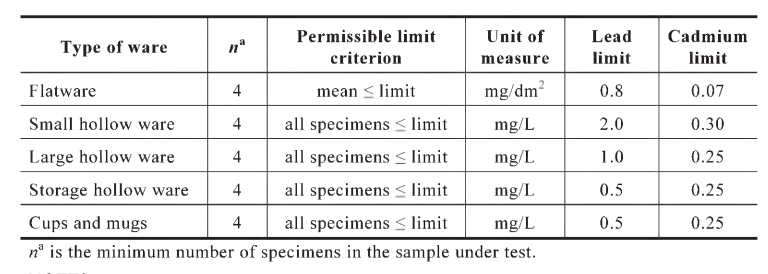
When an item of tableware is tested in accordance with ISO 6486-1, the amounts of Lead and Cadmium released shall not be more than the limits specified in the Table below. In the preparation and preservation of test samples in ISO 6486-1, the washing solution shall be a solution containing 0.2% of a non-acidic detergent.
Water absorption
When the tableware is tested in accordance with Appendix C of this standard, the mean of the results obtained for each specimen shall not exceed 0.4%.
Chipping
When the tableware is tested in accordance with Appendix D of this standard, there shall be no chips of glaze and/or body removed and no development of a crack, visible to the naked eye, at more than one location tested.
Thermal shock
When the tableware is tested in accordance with Appendix E of this standard, there shall be no cracking or glaze crazing.
Marking
Marking is applicable, before firing, with the following:
- The name, trademark, or any other means of identifying the manufacturer or supplier
- The country of origin (manufacture)
Each package or accompanying document during sales shall report:
- The name, trademark, or any other means of identifying the manufacturer or supplier
- The country of origin (manufacture)
- Any of the following terms (as appropriate for commercial/industrial grade): Commercial grade; Industrial grade; Hotel ware; Hotel-grade; Complies with AS 4371
3. Other Rules
Not applicable.
4. Summary Table
Food contact materials | General legislation applicable | Specific legislation applicable | National Food Safety Standard |
All food contact packaging | Food Standards Australia New Zealand Act 1991 [15] | Australia New Zealand Food Standards Code (FSC) [2] | Standard 1.1.1 – Structure of the Code and general provisions [3].
Standard 1.4.1 – Contaminants and natural toxicants [4] and Schedule 19 – Maximum levels of contaminants and natural toxicants [5]. |
All food contact packaging (safety standards for food products) | Food Standards Australia New Zealand Act 1991 [15] | Australia New Zealand Food Standards Code (FSC) [2] | Chapter 3 of the FSC [6] in addition to any manufacturing licence/quality system in place. |
Plastics | N/A | Not mandatory | AS2070-1999 Australian Standards: Plastic materials for food contact use [11]. Plus, any relevant FDA/EU standards referred to in this standard (refer to section 2 of the report). |
Food contact materials | General legislation applicable | Specific legislation applicable | National Food Safety Standard |
Paper and Paperboard/ Recycled Paper and board | N/A | Not mandatory | Only required to be safe and suitable for use under the FSC [2]. May use international standards (not mandatory). |
Bioplastics/ Coatings/Cellulose/Multimaterial multilayers | N/A | Not mandatory | Only required to be safe and suitable for use under the FSC [2]. May use international standards (not mandatory). |
5. References
1. Food Standards Australia New Zealand homepage
https://www.foodstandards.gov.au/about-us
2. Australia New Zealand Food Standard Code (FSC) available from the landing page:
https://www.foodstandards.gov.au/food-standards-code/legislation
3. Standard 1.1.1 – Structure of the Code and general provisions
https://www.legislation.gov.au/F2015L00383/latest/downloads
4. Standard 1.4.1 – Contaminants and natural toxicants
https://www.legislation.gov.au/F2015L00408/latest/downloads
5. Schedule 19 – Maximum levels of contaminants and natural toxicants
https://www.legislation.gov.au/F2015L00454/latest/downloads
6. Chapter 3 of the FSC, available from here
https://www.foodstandards.gov.au/food-standards-code/legislation#Foodsafetystandards(Australiaonly)
7. Standard 3.2.2 – Food safety practices and general requirements
https://www.legislation.gov.au/F2008B00576/latest/downloads
8. Safe Food Australia ‘A guide to the food safety standards’ 4th Edition, February 2023
PDF attached below.
9. Proposal P1034 – Chemical migration from packaging into food
10. Standard 1.4.3 – Articles and materials in contact with food (rescinded)
https://www.legislation.gov.au/F2008B00620/asmade/downloads
11. Australian Standard AS2070-1999
https://www.saiglobal.com/PDFTemp/Previews/OSH/As/as2000/2000/2070.pdf
12. Australasian Recycling Logo (ARL) homepage
13. Australian Packaging Covenant (APCO)
https://apco.org.au/about-apco
14. Commission Regulation (EU) 2022/1616 of 15 September 2022 on recycled plastic materials and articles intended to come into contact with foods, and repealing Regulation (EC) No 282/2008
PDF attached below
15. Food Standards Australia New Zealand Act 1991
https://www.legislation.gov.au/C2004A04193/latest/downloads
16. AS4371-2012 Australian Standards: Ceramic tableware
https://infostore.saiglobal.com/en-us/Standards/AS-4371-2012-126669_SAIG_AS_AS_267391/
Was this article helpful?