
Packaging Requirements for FCM
- 9 Mins to read
- DarkLight
Packaging Requirements for FCM
- 9 Mins to read
- DarkLight
Article summary
Did you find this summary helpful?
Thank you for your feedback
Packaging Requirements for FCM
EU

The below version control table serves to document all updates made to the report. The purpose is to ensure the information is always accurate and up-to-date.
| Version Number | Content Creation Date | Publishing Date | Section(s) Updated & Reason(s) for Update |
|---|---|---|---|
| V0 | 20 June 2024 | 24 June 2024 | N/A (new report) |
| V1 | 20 May 2025 | 30 May 2025 | Full review of the report to reflect the amendments introduced by Commission Regulation (EU) 2025/351 of 21 February 2025. |
| V2 | 25 Aug 2025 | 25 Aug 2025 | Summary table for clearer referrence. |
| V3 | 01 September 2025 | 03 September 2025 | Part 1 - General Requirements: further details by articles on Regulation (EU) No. 1935/2004. |
Disclaimers
A) At RegASK, we are committed to providing our clients with the most up-to-date and accurate information on regulatory requirements and compliance. To ensure the highest level of accuracy and relevance, we regularly review and update our e-guidebooks at least twice per year to reflect the latest regulatory developments in the market. (Please contact us if you wish to activate this feature.) In the meantime, our RegAlerts service is designed to keep our clients notified of any regulatory updates that may impact their business.
B) The contents on this platform are exclusively intended for the use of RegASK and its authorized representatives. All materials herein are confidential and the sole property of RegASK. Any reproduction, distribution, or display of this content to others is strictly prohibited without the express written consent of RegASK.
1. Overview of Regulatory Standards of Food Contact Materials
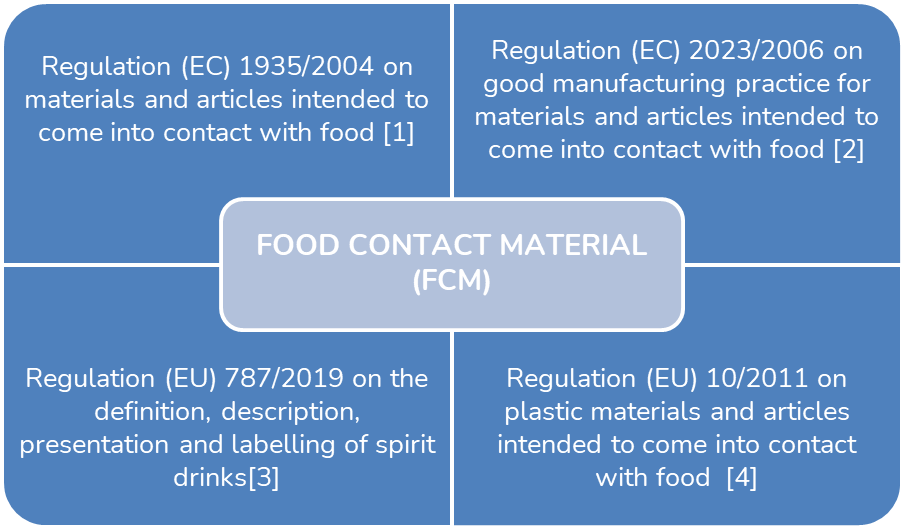
In the European Union (EU), food contact materials (FCM) are regulated by two general Regulations:
- Commission Regulation (EC) No 1935/2004 of the European Parliament and of the Council of 27 October 2004 on materials and articles intended to come into contact with food and repealing Dir. 80/590/EEC and Dir. 89/109/EEC [1]
- Commission Regulation (EC) No 2023/2006 of 22 December 2006 on good manufacturing practices for materials and articles intended to come into contact with food [2]
In addition, the EU Regulations define requirements for particular FCMs:
- Commission Regulation (EU) 10/2011 of 14 January 2011 on plastic materials and articles intended to come into contact with food [4], amended by Regulation (EU) 2025/351 [10].
Furthermore, some relevant provisions are established by:
- Commission Regulation (EU) 787/2019 of the European Parliament and of the Council of 17 April 2019 on the definition, description, presentation, and labeling of spirit drinks, the use of the names of spirit drinks in the presentation and labeling of other foodstuffs, the protection of geographical indications for spirit drinks, the use of ethyl alcohol and distillates of agricultural origin in alcoholic beverages.[3]
Note: For hygiene requirements, please refer to the next report on EU's ‘Hygiene Standards for FCM’.
2. Regulatory Requirements on Food Contact Materials (Including Coatings & Materials)
2.1 General Requirements
The relevant regulatory standards for food contact materials (FCMs) are based on compliance with the requirements set by Regulation (EC) 1935/2004 [1], which ensures the effective functioning of the internal market and provides a high level of protection for human health and consumer interests.
This Regulation is applicable to materials and articles, including active and intelligent food contact materials and articles, which in their finished state (Article 1):
- are intended to be brought into contact with food; or
- are already in contact with food and were intended for that purpose; or
- can reasonably be expected to be brought into contact with food or to transfer their constituents to food under normal or foreseeable conditions of use.
This Regulation includes general requirements for all FCMs and special requirements and specific measures:
- All FCMs must be manufactured in compliance with Good Manufacturing Practice (GMP) to ensure safety requirements (Article 3): under normal or foreseeable conditions of use, FCMs do not transfer their constituents to food in quantities which could:
(a) endanger human health;
or
(b) bring about an unacceptable change in the composition of the food;
or
(c) bring about a deterioration in the organoleptic characteristics thereof.
- For all FCMs, traceability must be ensured at all stages in order to facilitate control (Article 17 (Traceability)
- Special requirements for active and intelligent materials and articles (Article 4): applies to active FCMs meaning “may bring about changes in the composition or organoleptic characteristics of food”, Glass is considered as non-active.
- Specific measures for groups of materials and articles (Article 5) : applies to specific FCMs listed in Annex I (which includes plastics, but not glass), for Authorized Substances, Migration Limit/testing, Declaration of Compliance
- National specific measures may apply(Article 6), in the absence of specific measures referred to in Article 5
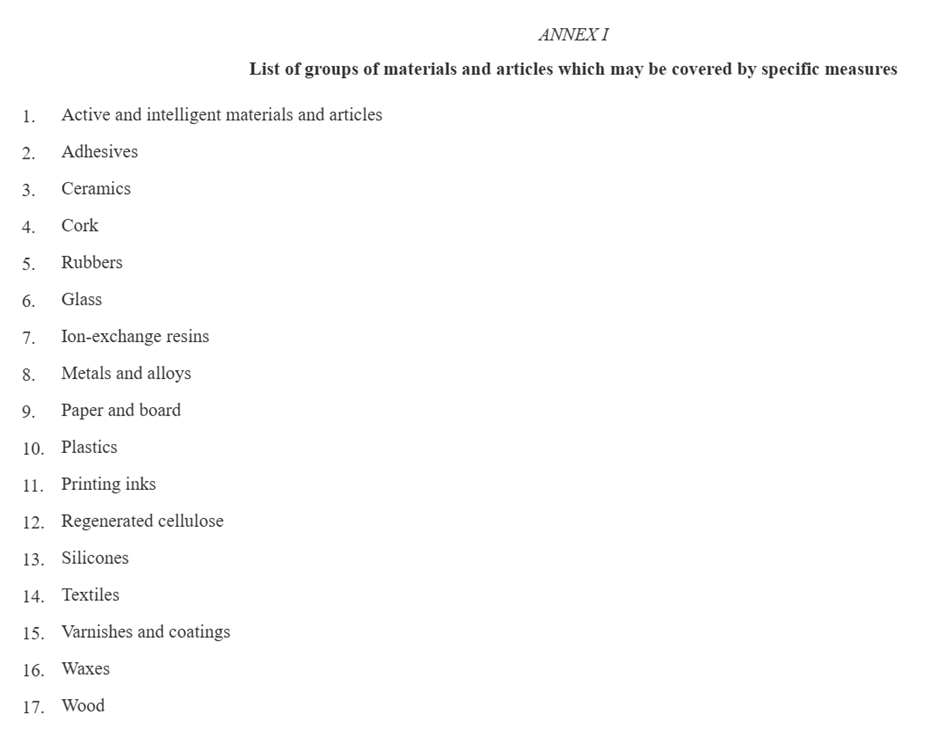 Figure 1: Annex 1 of Regulation (EC) 1935/2004[1]
Consequently, the food business operator placing products on the EU market must obtain from FCM suppliers both the required documentation and testing evidence to demonstrate compliance with Regulation (EC) No 1935/2004.
In addition to this Regulation, all food contact materials must be manufactured in accordance with Good Manufacturing Practices (GMP, Commission Regulation (EC) 2023/2006 [2]), and specific Union legislation on certain materials, as well as with National legislation on other materials.
A declaration of conformity with compliance with the specific migration limits is required in application of Article 16.
Sanctions for violations of the provisions of applicable regulations are established at the national level (Article 25).
2.2 Specific Requirements per Type of Food Contact Materials
Lead
In addition to the FCM Regulations, lead-based capsules, and lead-based foil are prohibited for spirit drinks as provided by Article 17 of Regulation (EU) 2019/787 [3]:

Plastics
Regarding the stoppers and caps made of plastics, the requirements defined by COMMISSION REGULATION (EU) 10/2011 [4] apply.
This Regulation has been amended by Regulation (EU) 2025/351 [10] which entered into force on March 16, 2025, with the transition measure mentioned in Article 4; plastic products compliant with Regulation (EU) No 10/2011 [4] before March 16, 2025 can remain on the market until stocks are exhausted. If a product or substance is compliant with the old regulation [4] but placed on the market after December 16, 2025, and does not meet the new regulation [10], its declaration of compliance must state its non-compliance which restricts its use to products marketed before September 16, 2026.
This amended regulation applies to materials and articles which are placed on the EU market and fall under the following categories:
- materials and articles and parts thereof consisting exclusively of plastics;
- plastic multi-layer materials and articles held together by adhesives or by other means;
- materials and articles referred to in points a) or b) that are printed and/or covered by a coating;
- plastic layers or plastic coatings, forming gaskets in caps and closures, that together with those caps and closures compose a set of two or more layers of different types of materials;
- plastic layers in multi-material multi-layer materials and articles.
Note that this Regulation [4] does not apply to ion exchange resins, rubber and silicones, but applies as well to substances that may be used in the manufacture of adhesives, coatings and printing inks and applied on or incorporated in plastic materials and articles as amended by Regulation (EU) 2025/351 [10].
It defines the Union list of authorized substances in the manufacture of plastic layers in plastic materials and migration test for each substance (Annexes). Article 17, which refers to the expression of migration test results, specifies that for caps, gaskets, stoppers, and similar sealing articles the specific migration value shall be expressed in:
- mg/kg using the actual content of the container for which the closure is intended applying the total contact surface of the sealing article and sealed container if the intended use of the article is known.
- mg/article if the intended use of the article is unknown.
In addition, for caps, gaskets, stoppers, and similar sealing articles, the overall migration value shall be expressed in:
- mg/dm2 applying the total contact surface of the sealing article and sealed container if the intended use of the article is known;
- mg/article if the intended use of the article is unknown.
In addition, this Regulation [4], as amended by Regulation (EU) 2018/213 [9], establishes requirements and restrictions related to coatings and varnishes, including those containing bisphenol A (BPA). However, the current restrictions on the use of BPA do not apply to spirit drinks, as they are intended for adult consumption only.
Additionally, this Regulation [4], as amended by Regulation (EU) 2025/351[10], defines the specific requirements for recycled plastic intended to be in food contact, defining migration testing and high purity criteria to protect human health.
The national transpositions of Council Directive 82/711/EEC [5], which outlines the basic rules for testing the migration of constituents from plastic materials and articles intended to come into contact with foodstuffs, and Council Directive 85/572/EEC [6], which lists the simulants to be used for such testing, establish the technical requirements for migration testing and should also be considered.
Glass
There are no specific requirements for glass intended to be in contact with food set at the EU level at the moment.
2.3 Other Rules
Regarding glass, some requirements are established through national provisions. In the absence of existing EU rules, national provisions should be taken into account (eg. Italian provisions on glass).
In the absence of both EU and national provisions, other non-binding references may be considered. For example, the position paper on food contact materials released by Glass for Europe, the trade association for Europe’s flat glass sector, can be used as a reference [8].
Note: Other specific provisions set at EU level refers to epoxy derivatives, recycled plastic materials, active and intelligent materials and ceramics which are expected not relevant for glass bottle and caps/stoppers.
3. Summary Table
Food contact materials | General legislation applicable | Specific legislation applicable |
Glass bottles | - Regulation (EC) 1935/2004 [1] including article 3, 4, 5, 8, 9, 16, 17
- Regulation (EC) 2023/2006 on GMP [2] | Not existing at the EU level; national provisions, if any, are to be considered as binding. |
Caps | If made of plastic, Regulation (EU) 10/2011 [4] amended by Commission Regulation (EU) 2025/351 [10]. If made of lead, prohibited by Regulation (EU) 787/2019 [3]. | |
Stoppers | If made of plastic, Regulation (EU) 10/2011 [4] amended by Commission Regulation (EU) 2025/351 [10]. If made of lead, prohibited by Regulation (EU) 787/2019 [3]. |
4. References
1. Regulation (EC) 1935/2004 of the European Parliament and of the Council of 27 October 2004 Regulation (EC) 1935/2004 of the European Parliament and of the Council of 27 October 2004 on materials and articles intended to come into contact with food and repealing Dir. 80/590/EEC and Dir. 89/109/EEC
https://eur-lex.europa.eu/legal-content/EN/ALL/?uri=celex%3A32004R1935
2. Regulation (EC) 2023/2006 of 22 December 2006 on good manufacturing practice for materials and articles intended to come into contact with food
https://eur-lex.europa.eu/legal-content/GA/TXT/?uri=celex:32006R2023
3. Regulation (EU) 787/2019 of the European Parliament and of the Council of 17 April 2019 on the definition, description, presentation and labelling of spirit drinks, the use of the names of spirit drinks in the presentation and labelling of other foodstuffs, the protection of geographical indications for spirit drinks, the use of ethyl alcohol and distillates of agricultural origin in alcoholic beverages
https://eur-lex.europa.eu/legal-content/EN/TXT/?uri=CELEX%3A02019R0787-20240513
4. Regulation (EU) 10/2011 of 14 January 2011 on plastic materials and articles intended to come into contact with food, amended by [10]
http://data.europa.eu/eli/reg/2011/10/2025-03-16
5. Council Directive 82/711/EEC of 18 October 1982
https://eur-lex.europa.eu/LexUriServ/LexUriServ.do?uri=CELEX%3A31982L0711%3AEN%3AHTML
6. Council Directive 85/572/EEC of 19 December 1985
https://eur-lex.europa.eu/LexUriServ/LexUriServ.do?uri=CONSLEG:1985L0572:20070420:EN:PDF
7. Regulation (EC) 852/2004 of the european parliament and of the council of 29 April 2004
https://eur-lex.europa.eu/legal-content/EN/TXT/?uri=CELEX%3A02004R0852-20210324
8. Position paper on food contact materials – Glass for Europe April 2019
https://glassforeurope.com/food-contact-materials/
9. Commission Regulation (EU) 2018/213 of 12 February 2018 on the use of bisphenol A in varnishes and coatings intended to come into contact with food
https://eur-lex.europa.eu/eli/reg/2018/213/oj
10. Commission Regulation (EU) 2025/351 of 21 February 2025 amending Regulation (EU) No 10/2011 on plastic materials and articles intended to come into contact with food, amending Regulation (EU) 2022/1616 on recycled plastic materials and articles intended to come into contact with foods, and repealing Regulation (EC) No 282/2008, and amending Regulation (EC) No 2023/2006 on good manufacturing practice for materials and articles intended to come into contact with food as regards recycled plastic and other matters related to quality control and manufacturing of plastic materials and articles intended to come into contact with food
http://data.europa.eu/eli/reg/2025/351/oj
Was this article helpful?