
Packaging Requirements for FCM
- 16 Mins to read
- DarkLight
Packaging Requirements for FCM
- 16 Mins to read
- DarkLight
Article summary
Did you find this summary helpful?
Thank you for your feedback
Packaging Requirements for FCM
China

The below version control table serves to document all updates made to the report. The purpose is to ensure the information is always accurate and up-to-date.
| Version Number | Content Creation Date | Publishing Date | Section(s) Updated & Reason(s) for Update |
|---|---|---|---|
| V0 | 2 Feb 2024 | 28 Feb 2024 | N/A (new report) |
| V1 | 21 April 2025 | 21 May 2025 | Section 2.2: Updated regulation GB/T 29603 & GB/T 29335 (and updated references) |
Disclaimers
A) At RegASK, we are committed to providing our clients with the most up-to-date and accurate information on regulatory requirements and compliance. To ensure the highest level of accuracy and relevance, we regularly review and update our e-guidebooks at least twice per year to reflect the latest regulatory developments in the market. (Please contact us if you wish to activate this feature.) In the meantime, our RegAlerts service is designed to keep our clients notified of any regulatory updates that may impact their business.
B) The contents on this platform are exclusively intended for the use of RegASK and its authorized representatives. All materials herein are confidential and the sole property of RegASK. Any reproduction, distribution, or display of this content to others is strictly prohibited without the express written consent of RegASK.
1. Overview of Regulatory Standards of Food Contact Materials
According to the “Food Safety Law of P.R.C” [1], food-related products shall comply with laws, regulations, and national standards for food safety. The food contact materials belong to the food-related products. So the food contact materials shall comply with corresponding general standards and product standards.
Here is the regulatory framework for the food contact materials:
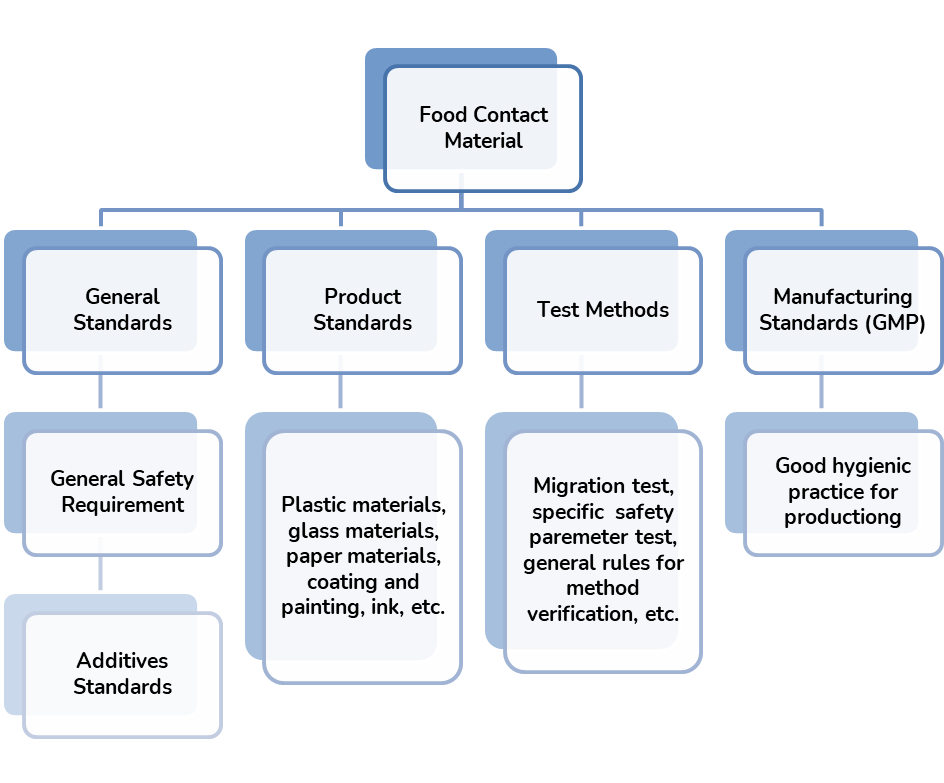 For import products, the general standards and product standards are mandatory standards. While the test methods and GMP standards are for reference, however, we recommend following those standards methods or requirements.
2. Regulatory Requirements on Food Contact Materials (Including Coatings & Materials)
2.1 General Requirements
The general standard for food contact materials is GB 4806.1-2016 National Standard for Food Safety General safety requirements for food contact materials and products [2] and GB 9685-2016 National Standard for Food Safety Standard for the use of additives for food contact materials and products [3]:
Product standard | Scope of application |
GB 4806.1-2016 National Standard for Food Safety General safety requirements for food contact materials and products [2] | This standard specifies the basic requirements, limit requirements, principles of conformity, inspection methods, traceability, and product information for food contact materials and products. This standard applies to all types of food contact materials and products. |
GB 9685-2016 National Standard for Food Safety Standard for the use of additives for food contact materials and products [3] | This standard specifies the principles for the use of additives for food contact materials and products, lists the permitted additives and use conditions, grouped by the type of food contact materials, the use of the norm, the maximum amount of use, the specific migration limit or maximum residue, the specific migration total limit and other restrictive requirements. This standard also covers monomers or other starting materials for polymerization of some of the base polymers used in the processing of food contact materials and products. |
2.1.1 General safety requirements for food contact materials and products
According to GB 4806.1-2016 National Standard for Food Safety General safety requirements for food contact materials and products [2], the general safety basic requirements for food contact materials and products include:
- Food contact materials and products that come into contact with food under the recommended conditions of use should migrate into food at levels that do not endanger human health.
- When food contact materials and products come into contact with food under the recommended conditions of use, the substances transferred into the food should not cause changes in the composition, structure, color, flavor, and other properties of the food, and should not produce technical functions of the food (except for specific provisions).
- The amount of substances used in food contact materials and products should be reduced as much as possible under the premise that the desired effect can be achieved.
- Food contact materials and substances used in products shall meet the corresponding quality specifications.
- Manufacturers of food contact materials and products shall control unintentionally added substances in products so that the amount of them transferred to food meets the requirements of points 1 and point 2.
- For substances that are not in direct contact with food and have an effective barrier layer between food and are not listed in the corresponding national food safety standards, food contact materials and products manufacturers should carry out safety assessment and control, so that the amount of their migration to food does not exceed 0.01 mg/kg. Carcinogenic, teratogenic, mutagenic substances and nano-substances are not applicable to the above principles and should be implemented in accordance with relevant laws and regulations.
- The production of food contact materials and products shall comply with the requirements of GB 31603 (please refer to the report on hygiene standards).
2.1.2 Uses of additives in food contact materials and their products
According to GB 9685-2016 National Standard for Food Safety Standard for the use of additives for food contact materials and products [3], the uses of additives general principle:
- When food contact materials and products come into contact with food under the recommended conditions of use, the levels of additives and impurities that migrate into food should not endanger human health.
- When food contact materials and products come into contact with food under the recommended conditions of use, additives that migrate into food should not cause food contamination. Changes in composition, structure, color, aroma and other properties (except for specific provisions).
- The amount of additives used should be as low as possible in food contact materials and products to achieve the desired effect.
- The additives used should meet the corresponding quality specifications.
- Substances listed in GB 2760, which are permitted to be used as additives for food, when they are used in food contact materials shall not produce technical functions in the food itself.
Appendixes of GB 9685-2016 set out a positive list of additives that can be used to produce various food contact materials and articles including their use scope, restrictions, and additional limits such as SML - Specific Migration Limit and QM - Maximum Quantity allowed:
Specific migration limit (SML)
Specific migration limit means the maximum permitted amount of a certain kind or type of substance that migrates from food contact materials and articles to food or food simulants. It is expressed as the milligrams of substances per kilogram of food or food simulants (mg/kg) or as the milligrams of migrants per square decimeter of contact surface area of food contact materials and articles with food or food simulants (mg/dm2).
Maximum permitted quantity (QM)
Maximum permitted quantity means the maximum permitted residual quantity of a certain kind or type of substance in final food contact materials and articles. It is expressed as the milligrams of the residual substance per kilogram of food contact materials and articles (mg/kg) or as the milligrams of the residual substance per square decimeter of contact surface area of food contact materials and articles with food (mg/dm2).
New additives or new uses that are not included in GB 9685-2016 must be approved by the National Health and Family Planning Commission (NHFPC) first before they can be used to produce certain types of food contact materials and articles in China.
2.2 Specific Requirements per Type of Food Contact Materials
The following product standards are for different types of food contact materials and food contact packaging:
Product standard | Scope of application |
GB 4806.5-2016 Food safety national standard glass products [4] | This standard is applicable to food contact glass products and includes technical requirements, migration tests, and label requirements. |
GB 4806.7-2023 Food Safety National standard for food contact plastic materials and products [5] | This standard applies to plastic materials and articles for food contact but includes thermoplastic elastomer materials and articles that have not been vulcanized. This standard also applies to starch-based plastic materials and products for food contact. The standard includes technical requirements, migration tests, and label requirements. |
GB 4806.8-2022 National Standard for Food Safety Food contact paper and paperboard materials and articles [6] | This standard applies to food contact paper and board materials and articles, including technical requirements, migration tests, microbial limit requirements, and label requirements. |
GB 4806.9-2023 National Standard for Food Safety Metallic materials and products for food contact [7] | This standard is applicable to metallic materials and products, including technical requirements, migration tests, and label requirements. |
GB 4806.10-2016 Food Safety National standard for food contact coatings and paintings [8] | This standard applies to coatings and paintings for food contact. This standard does not apply to paper coatings and paintings. The standard includes technical requirements, migration tests, and label requirements. |
GB 4806.11-2023 National Standard for Food Safety Rubber materials and products for food contact [9] | This standard applies to rubber materials and products for food contact and includes technical requirements, migration tests, and label requirements. |
GB 4806.12-2022 National Standard for Food Safety Bamboo and wood materials and products for food contact [10] | This standard applies to bamboo and wood materials and products for food contact, technical requirements, migration tests, microbial limit requirements, and label requirements. |
GB 4806.13-2023 Food Safety National standard for food contact composite materials and products [11] | This standard applies to composite materials and products for food contact and includes technical requirements, migration tests, microbial limit requirements, and label requirements. |
GB 4806.14-2023 Food Safety National standard ink for food contact materials and products [12] | This standard applies to inks for food contact materials and products and printing ink layers formed therefrom, and includes technical requirements, migration tests, and label requirements. |
GB/T 33320-2016 Adhesives for food packaging materials and containers [13] | This standard specifies the terms and definitions, classification, technical requirements, test methods, inspection rules, marking, packaging, transportation, and storage of adhesives for food packaging materials and containers. This standard is applicable to the production, management, and testing of adhesives for food packaging materials and containers |
GB/T 9106.1-2019 Packaging containers - Two pieces cans - Part 1: Aluminum easy open end and aluminum cans [17] | This part specifies the specification classification and structural size, technical requirements, test methods, inspection rules and marks, packaging, transportation, and storage of aluminum cans with easy open lids (hereinafter referred to as two cans). This part is applicable to the manufacture, circulation, supervision, and inspection of the unused aluminum easy-to-open lid and aluminum cans containing beer, carbonated, and nitrogen-filled beverages, and the two cans containing other contents can be used for reference. |
GB/T 9106.2-2019 Packaging containers - Two pieces cans - Part 2: Aluminum easy open end and steel cans [18] | This part specifies the specification classification and structural size, technical requirements, test methods, inspection rules and marks, packaging, transportation, and storage of aluminum easy-to-open steel cans (hereinafter referred to as two cans). This part applies to the manufacture, circulation, supervision, and inspection of unused aluminum and steel cans for beer, carbonated and nitrogen-filled soft drinks. Two cans for other contents may be used as a reference. |
GB/T 5738-1995 Plastic crates for beverage bottled [19] | This standard specifies the product classification, technical requirements, test methods, inspection rules, and marks of bottled wine and beverage plastic turnover boxes (referred to as bottle wine and beverage boxes), but loading, transportation, and storage. This standard is applicable to polyolefin plastics as raw materials, using injection molding methods to produce bottles of wine and beverage boxes with inner cells. |
GB/T 41220-2021 Laminated lidding film for food packaging [22] | This document specifies the classification and grading, requirements, test methods, inspection rules and marking, packaging, transportation, and storage of composite plastic cover films for food packaging. This document applies to composite films for sealing food containers with plastic as a thermal bonding layer. |
GB/T 29603-2024 General quality requirements for full aperture tinplate or ECCS easy open ends of food containers [23] | This document specifies the product classification and codes, main dimension symbols, requirements, test methods, inspection rules, marking, packaging, transportation, and storage of full-opening easy-open ends for food containers made of tin-plated or chromium-plated thin steel sheets. This document applies to full-opening easy-open ends for food containers made of tin-plated or chromium-plated thin steel sheets with coating or film. |
GB/T 13512-2016 Crown cap [24] | This standard specifies the dimensions, requirements, test methods, inspection rules and marking, packaging, transportation, and storage of crown caps (hereinafter referred to as "caps") made of electroplated tin (or chrome-plated) thin steel plates for food packaging such as beer and beverages. This standard applies to sealing caps with caps in accordance with QB/T 3729. Bottle caps for sealing containers of other materials can be followed. |
GB/T 29335-2024 General quality requirements for twist-off caps of food [25] | This document specifies the product classification, product specifications, requirements, test methods, inspection rules, marking, packaging, transportation, and storage of claw-type twist-off caps for food containers. This document applies to claw-type twist-off caps made of tin-plated or chromium-plated thin steel sheets or film-coated iron, which are used for the sealing packaging of bottled food. |
GB/T 17590-2008 Three-piece can with aluminum easy open end [26] | This standard specifies the requirements, test methods, inspection rules and marking, packaging, transportation, and storage of three pieces of aluminum with a to-open cover. This standard is applicable to the manufacture, use, circulation, supervision, and inspection of the aluminum easy-to-open three-piece cans with tin-chromium-plated steel plate and aluminum alloy sheet as raw materials for filling non-inflatable beverages that meet the commercial asepsis requirements after close sealing. Other similar products can refer to the implementation. |
GB/T 17876-2010 Packaging container-Tamper-evident plastic closure [27] | This standard specifies the definition, product classification, requirements, test methods, inspection rules and marks, packaging, transportation, and storage of plastic anti-theft bottle caps for beverages. This standard applies to plastic anti-theft bottle caps with polyolefin as the main raw material, molded by injection molding, hot pressing, or other processes. |
For specific types of food, the food contact material requirement is listed in the following table:
Food Category | Product standard | Scope of application |
Beer | GB 4544-2020 beer bottle [15] | This standard specifies the terms and definitions of glass beer bottles, product classification, requirements, test methods, inspection rules, and marking, packaging, transportation, and storage. This standard applies to glass bottles containing beer. |
GB/T 17714-2022 General rules for the quality of beer barrels [16] | This document specifies the product classification, raw materials, technical requirements, test methods, inspection rules, marking, packaging, transportation, and storage of beer kegs. This document is applicable to stainless steel kegs made of stainless steel raw materials with a volume of more than 5L and tin-plated (chromium) steel sheet for the barrel body. Design, production, and inspection of tin-plated (chromium) sheet steel beer keg with volume of 1L~10L, made of tin-plated (chromium) sheet steel or aluminum alloy sheet as barrel lid material. | |
Ready-to-drink beverages (mainly Chuhai*) | GB/T 9106.1-2019 Packaging containers - Two pieces cans - Part 1: Aluminum easy open end and aluminum cans [17] | This part specifies the specification classification and structural size, technical requirements, test methods, inspection rules and marks, packaging, transportation and storage of aluminum cans with easy open lids (hereinafter referred to as two cans). This part is applicable to the manufacture, circulation, supervision, and inspection of the unused aluminum easy-to-open lid and aluminum cans containing beer, carbonated, and nitrogen-filled beverages, and the two cans containing other contents can be used for reference. |
GB/T 9106.2-2019 Packaging containers - Two pieces cans - Part 2: Aluminum easy open end and steel cans [18] | This part specifies the specification classification and structural size, technical requirements, test methods, inspection rules and marks, packaging, transportation, and storage of aluminum easy-to-open steel cans (hereinafter referred to as two cans). This part applies to the manufacture, circulation, supervision, and inspection of unused aluminum and steel cans for beer, carbonated and nitrogen-filled soft drinks. Two cans for other contents may be used as a reference. | |
GB/T 17590-2008 Three-piece can with aluminum easy open end [26] | This standard specifies the requirements, test methods, inspection rules and marking, packaging, transportation and storage of three pieces of aluminum with a to-open cover. This standard is applicable to the manufacture, use, circulation, supervision, and inspection of the aluminum easy-to-open three-piece cans with tin-chromium-plated steel plate and aluminum alloy sheet as raw materials for filling non-inflatable beverages that meet the commercial asepsis requirements after close sealing. Other similar products can refer to the implementation. | |
Whisky | GB/T 24694-2021 Glass container-Quality requirements for Chinese spirits bottle [21] | This document specifies the requirements, test methods, inspection rules, marking, loading, transportation, storage, and other quality requirements of liquor glass bottles. This document applies to glass bottles containing liquor. |
GB/T 23778-2009 Cylindrical cork stoppers for alcohol and other food packaging [20] | This standard specifies the terms and definitions, product classification, requirements, test methods, inspection rules, marking, packaging, transportation, and storage of corks for wine and other food packaging. This standard applies to corks used in packaging containers for alcohol, beverages, and other foods. |
2.3 Other Rules
The test method shall use the national or industry-standard methods. If another non-standard method is used, the method verification is necessary. The verification must follow the GB 31604.59-2023 National Standard for Food Safety General Rules for verification of chemical analysis methods for food contact materials and products [14].
3. Summary Table
Food contact materials | General legislation applicable | Specific legislation applicable |
Glass | GB 4806.1-2016 National Standard for Food Safety General safety requirements for food contact materials and products [2]. GB 9685-2016 National Standard for Food Safety Standard for the use of additives for food contact materials and products [3]. GB 4806.14-2023 Food Safety National standard ink for food contact materials and products [12]. GB/T 33320-2016 Adhesives for food packaging materials and containers [13]. | GB 4806.5-2016 Food safety national standard glass products [4] |
Plastic materials | GB 4806.7-2023 Food Safety National standard for food contact plastic materials and products [5] | |
Paper and paperboard materials | GB 4806.8-2022 National Standard for Food Safety Food contact paper and paperboard materials and articles [6] | |
Metallic materials | GB 4806.9-2023 National Standard for Food Safety Metallic materials and products for food contact [7] | |
Coatings and paintings | GB 4806.10-2016 Food Safety National standard for food contact coatings and paintings [8] | |
Rubber materials | GB 4806.11-2023 National Standard for Food Safety Rubber materials and products for food contact [9] | |
Bamboo and wood materials | GB 4806.12-2022 National Standard for Food Safety Bamboo and wood materials and products for food contact [10] | |
Composite materials | GB 4806.13-2023 Food Safety National standard for food contact composite materials and products [11] |
4. References
1. Food Safety Law of the People’s Republic of China
https://www.samr.gov.cn/zw/zfxxgk/fdzdgknr/fgs/art/2023/art_6bff4ef87291497fa72949e1fc88efb5.html
2. GB 4806.1-2016 National Standard for Food Safety General safety requirements for food contact materials and products
https://sppt.cfsa.net.cn:8086/db?type=2&guid=D81D6399-32A6-4782-97E0-822496BDBF8C
PDF attached below
3. GB 9685-2016 National Standard for Food Safety Standard for the use of additives for food contact materials and products
https://sppt.cfsa.net.cn:8086/db?type=2&guid=AF786A76-DF3E-4611-9117-6013965E43A5
PDF attached below
4. GB 4806.5-2016 Food safety national standard glass products
https://sppt.cfsa.net.cn:8086/db?type=2&guid=BE91E716-8C39-4A8A-94D7-4077BB83EEEF
PDF attached below
5. GB 4806.7-2023 Food Safety National standard for food contact plastic materials and products
https://sppt.cfsa.net.cn:8086/db?type=2&guid=965C48D4-D5B6-4D1C-89DA-3B5DE3070D90
PDF attached below
6. GB 4806.8-2022 National Standard for Food Safety Food contact paper and paperboard materials and articles
https://sppt.cfsa.net.cn:8086/db?type=2&guid=B44A828B-8479-433F-8AAB-2DAE4AB81A2F
PDF attached below
7. GB 4806.9-2023 National Standard for Food safety Metallic materials and products for food contact
https://sppt.cfsa.net.cn:8086/db?type=2&guid=0AA5AA19-933F-4475-A70B-CB1B95D25ADD
PDF attached below
8. GB 4806.10-2016 Food safety National standard for food contact coatings and coatings
https://sppt.cfsa.net.cn:8086/db?type=2&guid=4A23C295-75C5-47FB-A6E7-522681595401
PDF attached below
9. GB 4806.11-2023 National Standard for Food safety Rubber materials and products for food contact
https://sppt.cfsa.net.cn:8086/db?type=2&guid=E66539B3-A4D1-4224-9E56-6B31141B6A4C
PDF attached below
10. GB 4806.12-2022 National Standard for Food Safety Bamboo and wood materials and products for food contact
https://sppt.cfsa.net.cn:8086/db?type=2&guid=BC2324BC-ED68-41C2-AD89-9D2B0D54F508
PDF attached below
11. GB 4806.13-2023 Food Safety National standard for food contact composite materials and products
https://sppt.cfsa.net.cn:8086/db?type=2&guid=8A1CEA79-FD69-4A04-A502-0C77ABA2C596
PDF attached below
12. GB 4806.14-2023 Food safety National standard ink for food contact materials and products
https://sppt.cfsa.net.cn:8086/db?type=2&guid=80810610-69C4-4A3E-9250-E2CFFC76F72E
PDF attached below
13. GB/T 33320-2016 Adhesives for food packaging materials and containers
http://c.gb688.cn/bzgk/gb/showGb?type=online&hcno=B0EEE402378EFD60E8840BDEAE5781E6
PDF attached below
14. GB 31604.59-2023 National Standard for Food Safety General Rules for verification of chemical analysis methods for food contact materials and products
https://sppt.cfsa.net.cn:8086/db?type=2&guid=12197C1E-32D2-47EC-BB8D-21DC7D3BC726
PDF attached below
15. GB 4544-2020 beer bottle
http://c.gb688.cn/bzgk/gb/showGb?type=online&hcno=6DAA0ADC15AADB8CF287F2D112C043B7
PDF attached below
16. GB/T 17714-2022 General rules for the quality of beer barrels
http://c.gb688.cn/bzgk/gb/showGb?type=online&hcno=E7FB75C881D7885EF859920B129B6255
PDF attached below
17. GB/T 9106.1-2019 Packaging containers - Two pieces cans - Part 1: Aluminum easy open end and aluminum cans
http://c.gb688.cn/bzgk/gb/showGb?type=online&hcno=CA5EBF116A874F09D7727BD7854A5A5D
PDF attached below
18. GB/T 9106.2-2019 Packaging containers - Two pieces cans - Part 2: Aluminum easy open end and steel cans
http://c.gb688.cn/bzgk/gb/showGb?type=online&hcno=E19805BA27BD83B13051315300C30917
PDF attached below
19. GB/T 5738-1995 Plastic crates for beverage bottled
http://c.gb688.cn/bzgk/gb/showGb?type=online&hcno=8887D12261DE525BDA639BA4B6D78EAE
PDF attached below
20. GB/T 23778-2009 Cylindrical cork stoppers for alcohol and other food packaging
http://c.gb688.cn/bzgk/gb/showGb?type=online&hcno=C4C84CAC704B1E6667399B5F9D4BA87B
PDF attached below
21. GB/T 24694-2021 Glass container-Quality requirements for Chinese spirits bottle
http://c.gb688.cn/bzgk/gb/showGb?type=online&hcno=720C4696FD5B2F82EE42B3F8214A7DBF
PDF attached below
22. GB/T 41220-2021 Laminated lidding film for food packaging
http://c.gb688.cn/bzgk/gb/showGb?type=online&hcno=5A0906D67C436D3B15577140B7B58EFE
PDF attached below
23. GB/T 29603-2024 General quality requirements for full aperture tinplate or ECCS easy open ends of food containers
http://c.gb688.cn/bzgk/gb/showGb?type=online&hcno=D725A469E70BDE1E060B1FB3F69DBD53
PDF attached below
24. GB/T 13512-2016 Crown cap
http://c.gb688.cn/bzgk/gb/showGb?type=online&hcno=F36F0F52AD2916787B595D34F2AA50EC
PDF attached below
25. GB/T 29335-2024 General quality requirements for twist-off caps of food containers
http://c.gb688.cn/bzgk/gb/showGb?type=online&hcno=0E67B1174C603F94273B6F3AD18A4EE7
PDF attached below
26. GB/T 17590-2008 Three-piece can with aluminum easy open end
http://c.gb688.cn/bzgk/gb/showGb?type=online&hcno=1FF10C5182C70F56CAB38E5C5DBC9E20
PDF attached below
27. GB/T 17876-2010 Packaging container-Tamper-evident plastic closure
http://c.gb688.cn/bzgk/gb/showGb?type=online&hcno=AA4182C1735AC928BFA2808CF794AB47
PDF attached below
Was this article helpful?