
9.0 Importation Requirements
- 6 Mins to read
- DarkLight
9.0 Importation Requirements
- 6 Mins to read
- DarkLight
Article summary
Did you find this summary helpful?
Thank you for your feedback
General Foods
Malaysia

This section provides information on the importation process (shipment, customs, licenses required, test requirements).
9.1 Shipment Declaration
Declaration of food importation to Royal Malaysian Customs Department. The importer shall make a full and true declaration of the goods imported, personally or by his agent upon arrival or landing of the goods in Malaysia.
- The declaration of importation is to use Customs Form No.1 (K1) electronically. Link: http://www.dagangnet.com/trade-facilitation/edeclare/
- Submit an import permit when making a customs declaration either electronically or in hard copy. Link: http://www.dagangnet.com/trade-facilitation/epermit/
The importer or his agent shall submit documents as requested by the authorized officer of customs for the purpose of assessing any declaration made by the importer. The list of supporting documents is as follows: Bill of Lading / Airway Bill, Invoices, Packing List, Country of Origin Certificate (if applicable), and other relevant documents.
Notification of food importations through FoSIM. The Importer or forwarding agent will use FoSIM and fill in the essential information required for the system to generate an examination level automatically. There are 6 levels:
Level 1: Green Release
Level 2: Examination of Specific Requirements Documents
Level 3: Release with Monitoring
Level 4: Release with Supervision
Level 5: Hold, Test and Release (3 retention results must be complied with)
Level 6: Prohibition of Importation
Notify the Malaysian Quarantine and Inspection Services (MAQIS), under The Department of Veterinary Services (DVS) on consignment arrival.
Notes: Each consignment of milk or milk products imported into Malaysia shall be carried by ship, aircraft or any vehicle directly to the prescribed landing place in Malaysia.
[1] [2] [3]
9.2 Customs Procedure
Customs general import procedures:
Step 1: Customs declaration
All imports of goods into Malaysia must be declared by:
- Appointed Customs Agent (check can be made at http://www.mytradelink.gov.my/tradeassociations); or
- Self-Declaration (AEO Program - AEO Portal http://customsgc.gov.my/index_aeo.html); or
- Direct User
Step 2: Classification of goods
Importers need to obtain confirmation on the goods to be imported into Malaysia and whether they are subject to any duties/taxes by obtaining the correct tariff code for the goods.
Step 3: Check whether the goods are controlled goods or import prohibited goods
- Check whether the goods to be imported are controlled goods or subject to import prohibitions or restrictions by the authorities.
- Check whether the goods require an Import Permit / Approval from Another Government Agency (OGA) or Permit Issuing Agency (PIA). Permit/approval must be obtained before any importation is made.
- Revisions can be made through the Customs (Prohibition on Imports) Order 2017. Link: http://www.federalgazette.agc.gov.my/outputp/pua_20170404_P.U.(A)103_Import.pdf (subject to amendment)
Step 4: Declaration & preparation of documents for customs release
Each importer shall make a full and true declaration of the goods imported, personally or by his agent upon arrival or landing of the goods in Malaysia.
- The declaration of importation is to use Customs Form No.1 (K1) electronically. Link: http://www.dagangnet.com/trade-facilitation/edeclare/
- Submit an import permit when making a customs declaration either electronically or in hard copy. Link: http://www.dagangnet.com/trade-facilitation/epermit/
The importer or his agent shall submit documents as requested by the authorized officer of customs for the purpose of assessing any declaration made by the importer. The list of supporting documents is as follows: Bill of Lading / Airway Bill, Invoices, Packing List, Country of Origin Certificate (if applicable), and other relevant documents such as catalog, product ingredients, etc.
Step 5: Inspection of goods
The authority (JKDM) reserves the right to inspect consignments to ensure that the importation complies with laws and regulations. Any authorized customs officer may conduct a physical inspection on any goods when required.
Step 6: Payment of duties/taxes
Duties/taxes payable on imported goods shall be paid by the importer at the time of arrival of the goods. Payment of duties/taxes can be made over the counter or through online payment.
Link: http://www.dagangnet.com/trade-facilitation/epayment/
Step 7: Customs approval
Goods to be imported can be approved for release provided that duties/taxes have been paid and a permit (if applicable) has been obtained.
Step 8: Customs release
Customs clearance can be allowed after all actions that have been set by the JKDM have been complied with and fulfilled.
Step 9: Save the document
Importation records shall be kept in Malaysia for a period of seven (7) years, except as approved by the Director General subject to any conditions imposed by him.
Notes:
Every omission or neglect to comply with, and every act done or attempted to be done contrary to, the provisions of the Customs Act 1967, or any breach of the conditions and restrictions subject thereto, or on the basis thereof, any license or permit issued or any exemption granted under this act, is an offense against this act.
[4]
9.3 Manufacturing License
A manufacturing license issued by the Competent Authority of the exporting country is required as part of the import permit application.
Food groups that are required to obtain an import permit before importing into Malaysia include plant and plant products, animal and animal products, and fish and fish products. In addition, seaweed and seaweed products are also required to have an import permit when importing into Sabah, a state of Malaysia. [5] [6]
9.4 Test for Importation
Imported food will be assigned a specific examination level depending on its risk.
The inspection of food consignments is divided into six (6) levels of inspection as follows:
- Level 1: Green Release – Automatic clearance. The system will automatically grant release.
- Level 2: Examination of Specific Requirements Documents – The Authorised Officer at the entry point is required to examine all relevant documents prior to release.
- Level 3: Release with Monitoring – Inspection is mandatory, and samples may be taken in order to achieve the Annual National Monitoring Plan for Imported Food.
- Level 4: Release with Supervision – Inspection and sampling are mandatory. The consignment will be released after sampling is carried out for surveillance.
- Level 5: Hold, Test, and Release - Inspection and sampling are mandatory. The consignment is detained and will be released after the result of the analysis is found to comply with the Food Act 1983/Food Regulations/Codex Alimentarius.
- Level 6: Prohibition of Importation – The system automatically rejects the consignment of food product.
Foods found not complying with the Malaysian Food Act 1983 and its regulations, the following action(s) may be taken:
- The food is denied entry (rejected) and re-exported back to its country of origin or other countries that can accept it.
- If the food has already entered the country, a notice of recall will be issued.
- A Level Five (5), Hold, Test, and Release action will be imposed for the subsequent food consignment imported from the same implicated exporter.
- Disposal.
- Recycling, Reprocessing, and Food Quality Improvement.
- Court action.
Testing parameters will depend on the specific types of food products which generally include microbiological and contaminant testing.
9.5 Other Notes or Requirements for Importation
None
9.6 Overview Flowchart for Importation Process
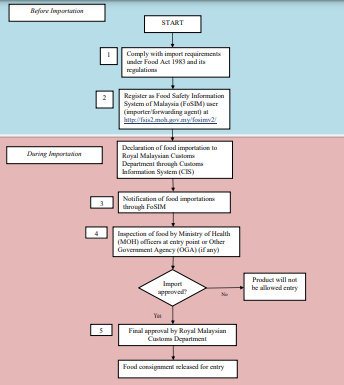
Flow Chart of Food Importation Procedure for Importer and Agent
- Declaration of import consignment in the Customs Information System (Declaration K1)
- Generate the K1 form in the Food Safety Information System of Malaysia (FoSIM) (For importers/agents who bring in food for the first time, it is necessary to register in the FoSIM System)
- Actions of Authority Officers at the Entrance:
- Determination of Examination Level: 6 levels
- Level 1: Automatically Release
- Level 2: Examination of Specific Requirements Documents
- Level 3: Release with Monitoring
- Level 4: Release with Supervision
- Level 5: Hold, test, and release (3 retention results must be complied with)
- Level 6: Prohibition of Importation
- Physical Examination
- Label Review
- Sampling
- Next:
- 4.1 Transfer the consignment to the warehouse belonging to the importer; or
- 4.2 The consignment is sealed and stored belonging to KKM/ Ministry of Health Malaysia at the entrance; or
- 4.3 Consignment Departure to the Domestic Market
- Next:
- 5.1 Level 3 and Level 4 Sampling; or
- 5.2 Detention of Consignment
- A) Reprocessing & Improvement of Imported Food Quality; or
- B) Re-Labeling of Imported Foods; or
- C) Level 5 - Hold, Test & Release
- If the food complies with regulations: Consignment Departure to the Domestic Market
- If the food does not comply with the regulations:
- D) Disposal; or
- E) Re-export; or
- F) Prosecution
9.7 References
1. Guide to Import Procedures (Malay version)
http://www.customs.gov.my/en/cp/Documents/Import/Import%20Procedure/Panduan%20Ringkas%20Prosedur%20Import-en.pdf
2. Clearance of imported food consignment via FoSIM
http://fsq.moh.gov.my/v6/xs/page.php?s=langkah2_C5
3. Regulations for the importation of milk or milk products into Malaysia https://www.dvs.gov.my/dvs/resources/auto%20download%20images/565e5de57eafe.pdf
4. Customs documentary requirements
http://mytraderepository.customs.gov.my/en/pd/Pages/doc_req.aspx
5. WTO note G/LIC/N/3/MYS/15 - Replies to questionnaire on import licensing procedures https://docs.wto.org/dol2fe/Pages/SS/directdoc.aspx?filename=q:/G/LIC/N3MYS15.pdf&Open=True
6. Matrix for Importation of Foods under the control of MOH
http://fsq.moh.gov.my/v6/xs/page.php?id=441000100
7. Inspection of food at entry point
http://fsq.moh.gov.my/v6/xs/page.php?s=langkah3
8. Malaysia: Food and Agricultural Import Regulations and Standards Country Report December 29, 2021
https://apps.fas.usda.gov/newgainapi/api/Report/DownloadReportByFileName?fileName=Food%20and%20Agricultural%20Import%20Regulations%20and%20Standards%20Country%20Report_Kuala%20Lumpur_Malaysia_12-31-2021.pdf
Was this article helpful?