
Hygiene Standards for FCM
- 2 Mins to read
- DarkLight
Hygiene Standards for FCM
- 2 Mins to read
- DarkLight
Article summary
Did you find this summary helpful?
Thank you for your feedback
Hygiene Standards for FCM
Hong Kong

The below version control table serves to document all updates made to the report. The purpose is to ensure the information is always accurate and up-to-date.
| Version Number | Content Creation Date | Publishing Date | Section(s) Updated & Reason(s) for Update |
|---|---|---|---|
| V0 | 08 July 2024 | 10 July 2024 | N/A (new report) |
| V1 | 18 May 2025 | 11 June 2025 | Addition of a note on Food Adulteration Regulations (Cap. 132V) & Harmful Substances in Food Regulations (Cap. 132AF). |
Disclaimers
A) At RegASK, we are committed to providing our clients with the most up-to-date and accurate information on regulatory requirements and compliance. To ensure the highest level of accuracy and relevance, we regularly review and update our e-guidebooks at least twice per year to reflect the latest regulatory developments in the market. (Please contact us if you wish to activate this feature.) In the meantime, our RegAlerts service is designed to keep our clients notified of any regulatory updates that may impact their business.
B) The contents on this platform are exclusively intended for the use of RegASK and its authorized representatives. All materials herein are confidential and the sole property of RegASK. Any reproduction, distribution, or display of this content to others is strictly prohibited without the express written consent of RegASK.
1. Overview of Regulatory Standards of Food Contact Materials (including Hygiene)
There is no specific local legislation governing the hygiene of food packaging materials. However, the Public Health and Municipal Services Ordinance (Cap.132) [1] stipulates that all food offered for sale in Hong Kong must be fit for human consumption.
2. Regulatory Requirements on Hygiene Standards for Food Contact Materials
2.1 General Standards for Hygiene Requirements
As previously mentioned, there is no specific local legislation governing the hygiene of food packaging materials. However, the Public Health and Municipal Services Ordinance (Cap.132) [1] requires that all food sold in Hong Kong must be fit for human consumption. If food is rendered unfit due to the poor hygiene of its container, selling it would constitute an offense.
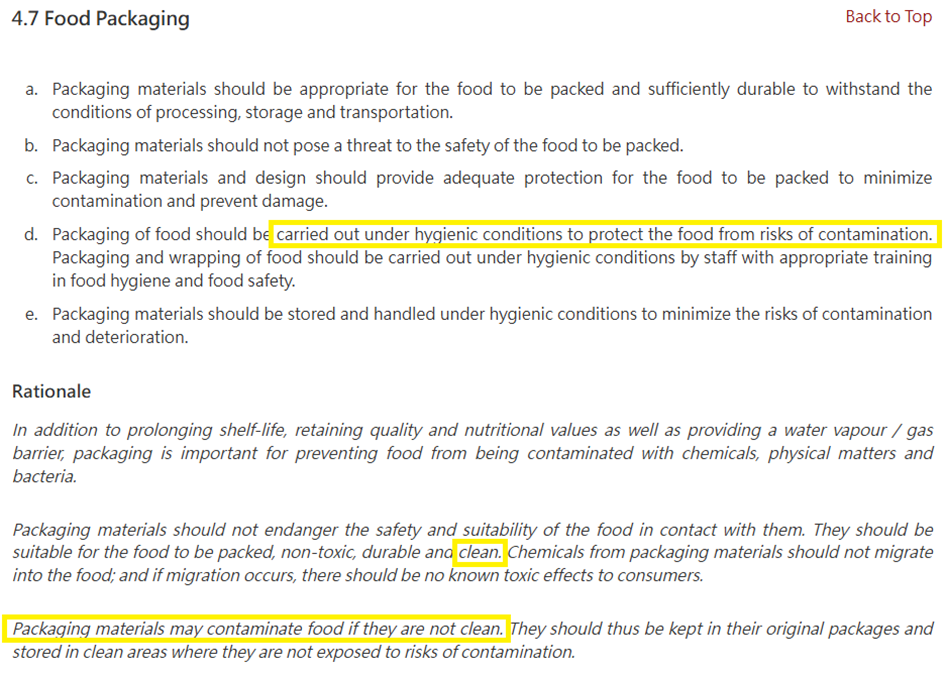
The Food Hygiene Code [2] provides the hygiene standard for packaging used by food businesses in Hong Kong. It does not apply to imported food, but it can be used as guidance:
2.2 Specific Hygiene Requirements per Type of Food Contact Materials
2.2.1 Liquor Bottles (B2C): Glass
There is no requirement laid down in Hong Kong legislation specific to the hygiene of glass.
2.2.2 Casks and Barrels (B2B): Wood, Metal
There is no requirement laid down in Hong Kong legislation specific to the hygiene of wood and metal.
Though there isn’t any specific requirement for hygiene, companies should take into consideration the potential migration of contaminants—such as heavy metals and melamine—into food from food contact materials. In addition, although there are no provisions on contaminants for food packaging or food contact materials, contaminants in food commodities and specific categories are regulated under the Food Adulteration (Metallic Contamination) Regulations (Cap. 132V) [3] and Harmful Substances in Food Regulations (Cap. 132AF) [4]. The levels of such contaminants in the finished product (i.e. General Food, alcoholic beverages) must remain within the permitted limits outlined in Section 8 of the Alcoholic Beverages Guidebook.
3. References
1. The Public Health and Municipal Services Ordinance (Cap.132)
https://www.elegislation.gov.hk/hk/cap132
https://www.fehd.gov.hk/english/publications/code/allc_4.html#
3. Food Adulteration (Metallic Contamination) (Amendment) Regulation 2018 (“the Amendment Regulation")
https://www.gld.gov.hk/egazette/pdf/20182223/es220182223113.pdf
4. Harmful Substances in Food Regulations
https://www.elegislation.gov.hk/hk/cap132AF?SEARCH_WITHIN_CAP_TXT=melamine
Was this article helpful?