
Hygiene Standards for FCM
- 4 Mins to read
- DarkLight
Hygiene Standards for FCM
- 4 Mins to read
- DarkLight
Article summary
Did you find this summary helpful?
Thank you for your feedback
Hygiene Standards for FCM
Indonesia

The below version control table serves to document all updates made to the report. The purpose is to ensure the information is always accurate and up-to-date.
| Version Number | Content Creation Date | Publishing Date | Section(s) Updated & Reason(s) for Update |
|---|---|---|---|
| V0 | 10 Feb 2025 | 12 Feb 2025 | N/A (new report) |
Disclaimers
A) At RegASK, we are committed to providing our clients with the most up-to-date and accurate information on regulatory requirements and compliance. To ensure the highest level of accuracy and relevance, we regularly review and update our e-guidebooks at least twice per year to reflect the latest regulatory developments in the market. (Please contact us if you wish to activate this feature.) In the meantime, our RegAlerts service is designed to keep our clients notified of any regulatory updates that may impact their business.
B) The contents on this platform are exclusively intended for the use of RegASK and its authorized representatives. All materials herein are confidential and the sole property of RegASK. Any reproduction, distribution, or display of this content to others is strictly prohibited without the express written consent of RegASK.
1. Overview of relevant regulatory standards on hygiene standard for food contact materials
In Indonesia, there is no specific legislation governing hygiene standards for food contact materials before they are filled with beverages. However, in general, the Government Regulation No. 86 Year 2019 on Food Safety [1] outlines food packaging standards in Articles 24, 25, and 26, which include the following requirements:
- Food contact materials used in the production of prepackaged food must not harm human health and must not exceed migration limits set by regulations;
- Prohibited food contact materials that may release hazardous substances endangering human health must not be used for food packaging;
- Repacking of final food products for trade is prohibited, except for bulk-packaged food.
These general food packaging standards are further detailed in BPOM Decree No. 20 Year 2019 on Food Packaging [2] and also detailed in the other report (Packaging Requirements for Food Contact Materials).
Regarding packaging procedures, in general, Government Regulation No. 86 Year 2019 [1] only mentions in Article 27 that packaging must meet the following requirements:
- Protecting and maintaining the food quality.
- Being resistant to treatment during processing, food transportation, and food distribution.
- Protecting food from contaminants, preventing damage, and allowing suitable labeling.
- Food packaging materials must be stored and handled in a hygienic condition apart from raw materials and the final product.
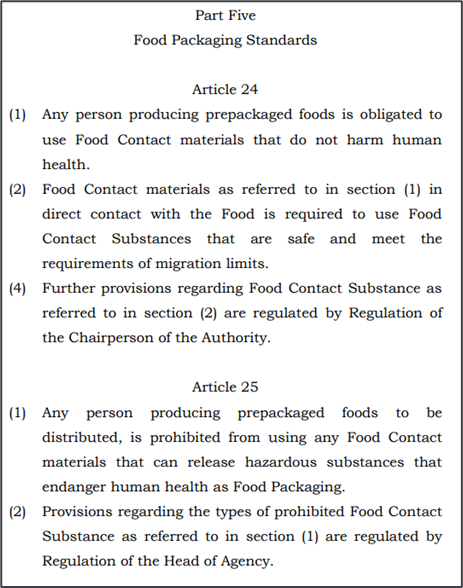
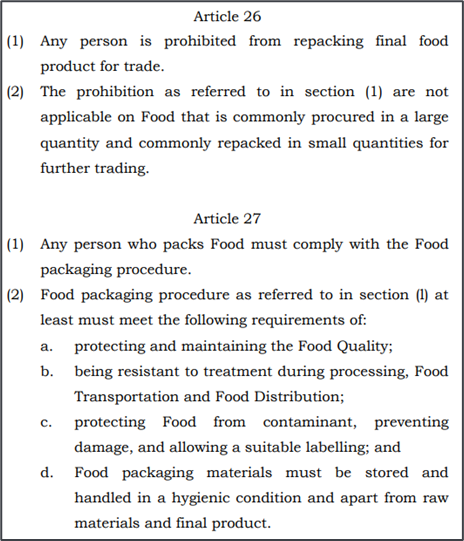
Figure 1. Excerpt of Article 24-27 of Government Regulation No. 86 Year 2019
regarding food packaging standards [1]
2. General Standards for Hygiene Requirements for Food Contact Materials
The mandatory hygiene requirements for food processing in the local industry are governed by the Good Manufacturing Practices (GMP), as outlined in the Ministry of Industry Decree No. 75/M-IND/PER/7/2010 on Good Manufacturing Practices [3].
For food packaging hygiene, this aligns with Government Regulation No. 86 Year 2019, which mandates that food packaging materials must be stored and handled in a hygienic condition and apart from raw materials and final product. Packaging materials should be stored in a clean, orderly, and protected environment to prevent contamination of the product when used.

Figure 2. Excerpt of Page 20 of Ministry of Industry Decree No. 75/M-IND/PER/7/2010 [3]
English translation:
8) Packaging materials must be stored and handled in a hygienic condition and apart from raw materials and final product.

Figure 3. Excerpt of Page 21 of Ministry of Industry Decree No. 75/M-IND/PER/7/2010 [3]
English translation:
3) Storage of containers and packaging
Containers and packaging should be stored in a neat, clean, and protected area to prevent contamination of the product when used.
For overseas manufacturers, international hygiene standards such as ISO, FSSC, or other relevant standards from the origin country can be referenced. ISO or FSSC certifications are commonly used by Indonesian manufacturers to ensure food safety management in their facilities.
In summary, for the hygiene standards of food packaging materials, local manufacturers can refer to the Ministry of Industry Decree No. 75/M-IND/PER/7/2010 on Good Manufacturing Practices [3], complement it with the voluntary local standard of Risk Management Program (RMP) regulated in BPOM Decree No. 10 Year 2023 on Risk Management Program in Food Industry [4], and other international standards such as ISO 22000 and FSSC.
For overseas manufacturers, they can follow ISO 22000, FSSC, or other international standards, or comply with the regulations in their country of origin.
3. Specific Hygiene Requirements per Type of Food Contact Materials
3.1 Liquor Bottles (B2C): Glass
Not available. See Section 2 above.
3.2 Casks and Barrels (B2B): Wood
Not available. See Section 2 above.
3.3 Casks and Barrels (B2B): Metal
Not available. See Section 2 above.
4. Summary Table
Food contact materials | General legislation applicable to hygiene | Specific legislation applicable to hygiene |
Liquor bottles (B2C): Glass |
| Not available. |
Casks and barrels (B2B): Wood | ||
Casks and barrels (B2B): Metal |
5. References
1. Government Regulation No. 86 Year 2019 on Food Safety
2. BPOM Decree No. 20 Year 2019 on Food Packaging
https://jdih.pom.go.id/download/rule/842/20/2019/Kemasan%20Pangan
3. Ministry of Industry Decree No. 75/M-IND/PER/7/2010 on Good Manufacturing Practices
https://peraturan.go.id/id/permenperin-no-75-m-ind-per-7-2010-tahun-2010
4. BPOM Decree No. 10 Year 2023 on Risk Management Program in Food Industry
Was this article helpful?