
Hygiene Standards for FCM
- 3 Mins to read
- DarkLight
Hygiene Standards for FCM
- 3 Mins to read
- DarkLight
Article summary
Did you find this summary helpful?
Thank you for your feedback
Hygiene Standards for FCM
South Korea

The below version control table serves to document all updates made to the report. The purpose is to ensure the information is always accurate and up-to-date.
| Version Number | Content Creation Date | Publishing Date | Section(s) Updated & Reason(s) for Update |
|---|---|---|---|
| V0 | 11 July 2024 | 16 July 2024 | N/A (new report) |
| V1 | 20 June 2025 | 24 June 2025 | Overall review and update. |
Disclaimers
A) At RegASK, we are committed to providing our clients with the most up-to-date and accurate information on regulatory requirements and compliance. To ensure the highest level of accuracy and relevance, we regularly review and update our e-guidebooks at least twice per year to reflect the latest regulatory developments in the market. (Please contact us if you wish to activate this feature.) In the meantime, our RegAlerts service is designed to keep our clients notified of any regulatory updates that may impact their business.
B) The contents on this platform are exclusively intended for the use of RegASK and its authorized representatives. All materials herein are confidential and the sole property of RegASK. Any reproduction, distribution, or display of this content to others is strictly prohibited without the express written consent of RegASK.
1. General Standards for Hygiene Requirements for Food Contact Materials
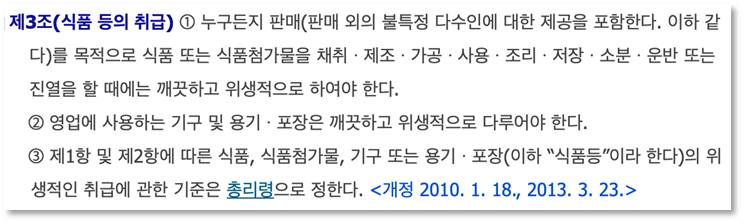
Article 3 of the Food Sanitation Act provides the general hygiene requirements as outlined below [1]:
English translation:
Article 3 (Handling of Food, etc.)
Anyone who collects, manufactures, processes, uses, cooks, stores, subdivides, transports, or displays food or food additives for the purpose of sale (including provision to an unspecified large number of people other than for sale) must do so in a clean and hygienic manner.
Utensils, containers, and packaging used in business operations must be handled in a clean and hygienic manner.
The standards for the hygienic handling of food, food additives, utensils, containers, and packaging (hereinafter referred to as "food, etc.") as stipulated in paragraphs 1 and 2 shall be determined by the Prime Minister's ordinance. <Amended January 18, 2010, March 23, 2013.>
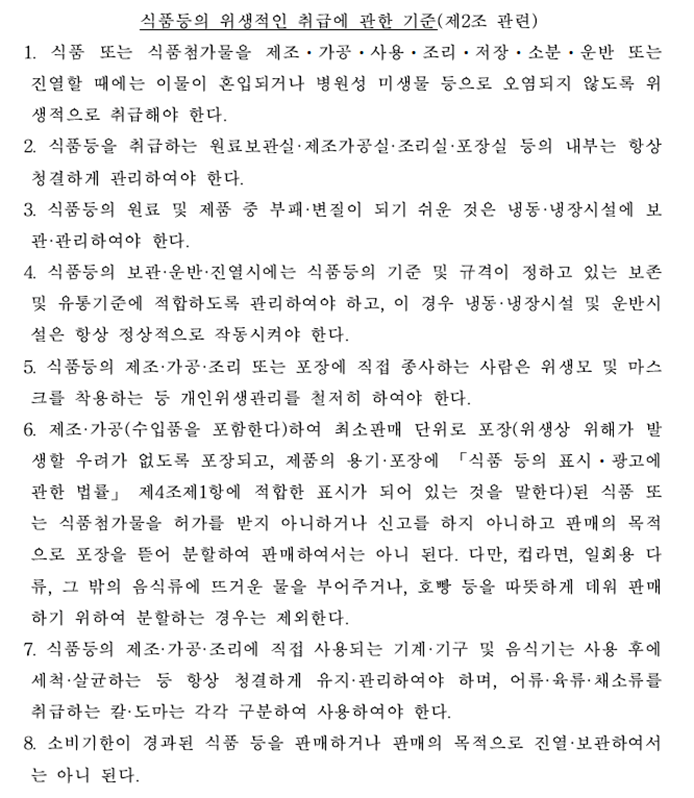
Furthermore, Annex 1 of the Enforcement Decree of the Food Sanitation Act provides the Standards for the hygienic handling of food, etc., which includes utensils, containers, and packaging [2]:
English translation:
Standards for the Hygienic Handling of Food, Etc. (Related to Article 2)
- When manufacturing, processing, using, cooking, storing, repackaging, transporting, or displaying food or food additives, they must be handled hygienically to prevent contamination by foreign substances or pathogenic microorganisms.
- The interiors of storage rooms for raw materials, manufacturing and processing rooms, kitchens, and packaging rooms handling food, etc., must always be kept clean.
- Raw materials and products prone to spoilage or deterioration must be stored and managed in refrigeration or freezing facilities.
- When storing, transporting, or displaying food, etc., it must be managed in accordance with the preservation and distribution standards set by the criteria and standards for food, etc. In this case, refrigeration and freezing facilities, as well as transport facilities, must always operate properly.
- Persons directly involved in the manufacturing, processing, cooking, or packaging of food, etc., must wear sanitary hats and masks, maintaining strict personal hygiene.
- It is prohibited to open and repack food or food additives that have been manufactured, processed (including imports), and packaged in minimum sales units (packaged to prevent sanitary hazards, and with containers or packaging labeled in accordance with Article 4(1) of the Act on Labeling and Advertising of Foods, etc.) for the purpose of resale without permission or notification. However, exceptions are made for dividing products such as cup noodles, single-use teas, and other food items for the purpose of adding hot water or heating items like steamed buns for sale.
- Machines, equipment, and utensils directly used in the manufacturing, processing, or cooking of food, etc., must always be kept clean by washing and sterilizing them after use. Knives and cutting boards used for fish, meat, and vegetables must be separately used and distinguished.
- Food products that have passed their use-by date must not be sold, displayed for sale, or stored for the purpose of sale.
2. Specific Hygiene Requirements per Type of Food Contact Materials
2.1 Liquor Bottles (B2C): Glass
There are no specific requirements on hygiene for glass bottle packaging as food contact material.
2.2 Casks and Barrels (B2B): Wood, Metal
There are no specific requirements on hygiene for wood and metal cask/barrels as food contact materials.
3. Other Rules
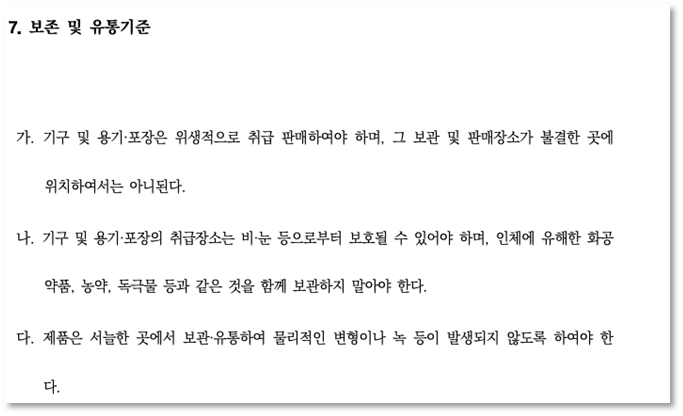
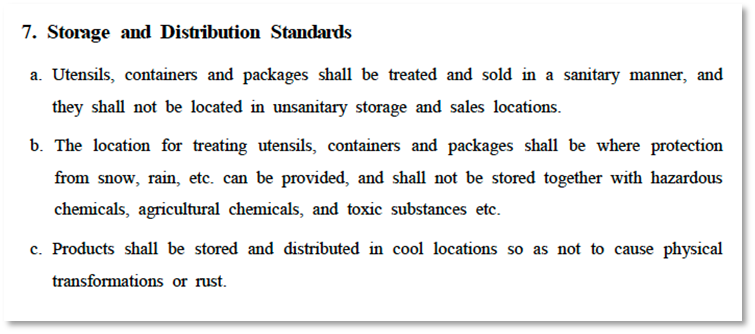
Storage and Distribution Standards (Section II,7 of [3]):
4. Summary Table
Food contact materials | General legislation applicable to hygiene | Specific legislation applicable to hygiene |
Glass | Article 3 of [1] Article 2 of [2] Annex 1 of [2] | None |
Wood & Metal | None |
5. References
1. Food Sanitation Act - Issued on 01 Apr 2025
https://www.law.go.kr/법령/식품위생법
2. Enforcement Decree of Food Sanitation Act – Issued on 10 Jan 25
https://www.law.go.kr/LSW//lsSc.do?menuId=1&subMenuId=15&tabMenuId=81&query=식품위생법%20시행규칙#AJAX
3. Standards and Specification for Utensils, Containers and Packages – Revised on 21 June 2024
https://various.foodsafetykorea.go.kr/fsd/#/ext/Document/CP
Was this article helpful?