
Hygiene Standards for FCM
- 3 Mins to read
- DarkLight
Hygiene Standards for FCM
- 3 Mins to read
- DarkLight
Article summary
Did you find this summary helpful?
Thank you for your feedback
Hygiene Standards for FCM
Malaysia

The below version control table serves to document all updates made to the report. The purpose is to ensure the information is always accurate and up-to-date.
| Version Number | Content Creation Date | Publishing Date | Section(s) Updated & Reason(s) for Update |
|---|---|---|---|
| V0 | 09 July 2024 | 12 July 2024 | N/A (new report) |
| V1 | 08 May 2025 | 03 June 2025 | All content has been reviewed and is still accurate. No updates were needed. |
Disclaimers
A) At RegASK, we are committed to providing our clients with the most up-to-date and accurate information on regulatory requirements and compliance. To ensure the highest level of accuracy and relevance, we regularly review and update our e-guidebooks at least twice per year to reflect the latest regulatory developments in the market. (Please contact us if you wish to activate this feature.) In the meantime, our RegAlerts service is designed to keep our clients notified of any regulatory updates that may impact their business.
B) The contents on this platform are exclusively intended for the use of RegASK and its authorized representatives. All materials herein are confidential and the sole property of RegASK. Any reproduction, distribution, or display of this content to others is strictly prohibited without the express written consent of RegASK.
1. Overview of Regulatory Standards of Food Contact Materials (including Hygiene)
In Malaysia, there are no specific regulations solely focused on the hygiene standards of food contact materials. However, the Food Regulations 1985 [1] and the Food Hygiene Regulations 2009 (FHR 2009) [2] offer the most relevant guidance for packaging requirements and hygiene standards. While the FHR 2009 [2] doesn't directly address food contact materials, it outlines hygienic food handling practices that indirectly ensure the cleanliness of these materials.
2. Regulatory Requirements on Hygiene Standards for Food Contact Materials
2.1 General Standards for Hygiene Requirements
The Food Hygiene Regulation 2009 (FHR 2009) [2] outlines the requirement for food protection in Chapter 2. These regulations include:
- Regulation 35. Handling of food, appliances, etc.
- Regulation 36. Preparing, packing, and serving food
- Regulation 37. Storage, exposure, or display of food for sale
- Regulation 38. Storage of food
Food Hygiene Regulation 2009 [2] defines “clean” as:

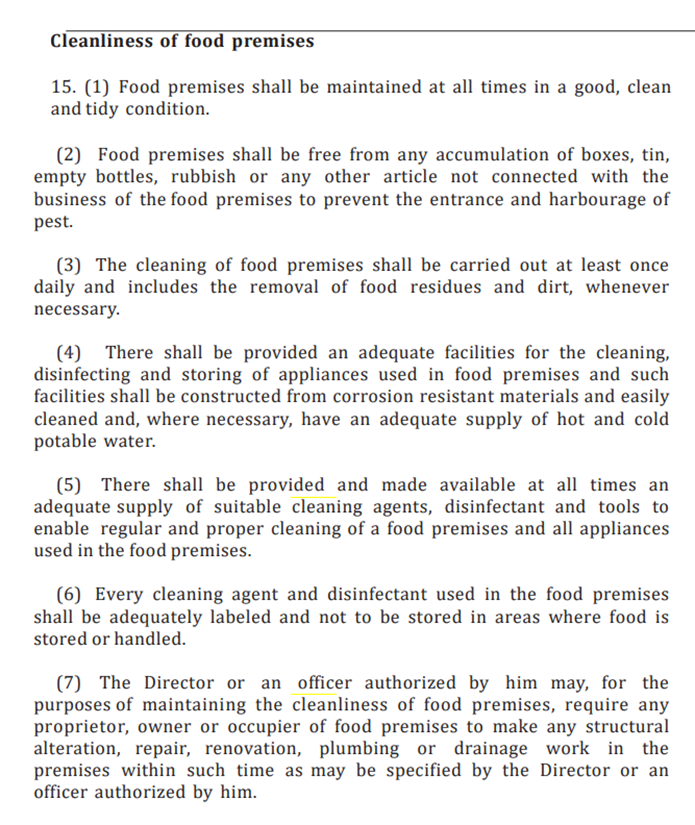
Regulation 15 of the FHR 2009 outlines the requirements for keeping food premises clean as below:
Regulation 11(1) of FHR 2009 outlines the general duties of food premises proprietors, owners, and occupiers.
Furthermore, [Regulation 56 Carriage of Food] in the Food Hygiene Regulation 2009 (FHR 2009) [2] specifies hygiene practices for both food transporters and the vehicles used to carry food.
The Food Hygiene Regulation 2009 [Reg.9(1)] also mentioned that all food premises involved in the manufacturing of food shall provide and make available a Food Safety Assurance Programme (PJKM). PJKM is a well-documented system of well-planned practices and guarantees that any particular type of food will not harm consumers when consumed. Any type of food safety program e.g. Food Safety is the Responsibility of the Industry (MeSTI), GMP, HACCP, 1SO22000 can be implemented by food industries.
While Malaysia doesn't have dedicated regulations solely for food contact material hygiene, manufacturers bear the primary responsibility for ensuring the safety and hygiene of their products' packaging materials.
For imported food, the Food Hygiene Regulation (FHR) 2009 serves as a valuable reference, although it doesn't directly apply. The FHR focuses on hygiene within Malaysian food businesses. However, foreign manufacturers must still comply with the Food Act 1983 and Food Regulations 1985, which ensure food safety and quality for imported goods.
2.2 Specific Hygiene Requirements per Type of Food Contact Materials
2.2.1 Liquor Bottles (B2C): Glass
Glass materials intended to be in contact with food do not have specific hygiene requirements, they must comply with the general requirement presented in point 1.
2.2.2 Casks and Barrels (B2B): Wood, Metal
Wood and metal materials (such as casks and barrels) intended to be in contact with food do not have specific hygiene requirements, they must comply with the general requirement presented in point 1.
3. Summary Table
Food contact materials | General legislation applicable to hygiene | Specific legislation applicable to hygiene |
General |
|
|
Glass | ||
Wood |
4. References
1. Food Regulations 1985 Update December 2023 (PUA 209_2020) thereunder (PDF attached below)
https://hq.moh.gov.my/fsq/peraturanperaturan-makanan-1985
2. Food Hygiene Regulations 2009 thereunder (PDF attached below)
https://hq.moh.gov.my/fsq/peraturanperaturan-kebersihan-makanan-2009
Was this article helpful?