
Hygiene Standards for FCM
- 6 Mins to read
- DarkLight
Hygiene Standards for FCM
- 6 Mins to read
- DarkLight
Article summary
Did you find this summary helpful?
Thank you for your feedback
Hygiene Standards for FCM
Australia

The below version control table serves to document all updates made to the report. The purpose is to ensure the information is always accurate and up-to-date.
| Version Number | Content Creation Date | Publishing Date | Section(s) Updated & Reason(s) for Update |
|---|---|---|---|
| V0 | 02 July 2024 | 03 July 2024 | N/A (new report) |
| V1 | 22 May 2025 | 05 June 2025 | All content has been reviewed and is still accurate. No updates were needed. |
Disclaimers
A) At RegASK, we are committed to providing our clients with the most up-to-date and accurate information on regulatory requirements and compliance. To ensure the highest level of accuracy and relevance, we regularly review and update our e-guidebooks at least twice per year to reflect the latest regulatory developments in the market. (Please contact us if you wish to activate this feature.) In the meantime, our RegAlerts service is designed to keep our clients notified of any regulatory updates that may impact their business.
B) The contents on this platform are exclusively intended for the use of RegASK and its authorized representatives. All materials herein are confidential and the sole property of RegASK. Any reproduction, distribution, or display of this content to others is strictly prohibited without the express written consent of RegASK.
1. Overview of Regulatory Standards of Food Contact Materials (including Hygiene)
Food Standards Australia New Zealand (FSANZ) [1] develops the shared food standards for Australia and New Zealand. The standards together make up the Australia New Zealand Food Standards Code (FSC) [2]. Within the FSC, there are standards relating to food safety in Chapter 3 of the FSC [3]. These apply to Australia only.
The food safety standards are principles-based and not prescriptive since it is expected that the relevant hygiene requirements, both during food production and in relation to food contact materials and packaging processes, would be covered by a suitable quality system.
Some general hygiene guidance is provided in Chapter 3 standards [3], as described below, and can be applied to the packaging process. Manufacturers can apply a ‘suitable’ hygiene standard, based on a domestic Australian system or any appropriate overseas system, provided the requirements in the FSC are met. The summary below describes this in detail.
2. Regulatory Requirements on Hygiene Standards for Food Contact Materials
2.1 General Standards for Hygiene Requirements
For Australian manufacturers, there are six national food safety standards (Figure 1):
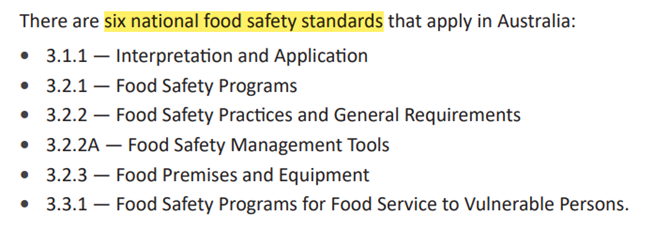 Figure 1: National food safety standards from [4].
All food businesses need to meet these standards within Chapter 3 of the FSC [3]:
- Standard 3.1.1 – Interpretation and application
- Standard 3.2.2 - Food Safety Practices and General Requirements
- Standard 3.2.3 - Food Premises and Equipment
The FSC is enforced in all Australian jurisdictions through state and territory Food Acts [5] (Figure 2):
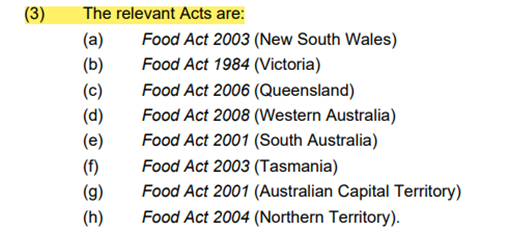
Figure 2: State and territory Food Acts from [5] (Note 1 (3) in Division 4).
A list of the relevant food enforcement contacts for the states and territories is available [6]. The local enforcement body ensures that a food manufacturer within their specific geographical jurisdiction complies with both the national (i.e., FSC) and local (state/territory Food Act and any other requirements mandated by local city councils) requirements. In many cases, businesses require a license for food premises. The requirements and rules vary between the jurisdictions and are generally based on the ‘risk’ category of the food. It should be noted that businesses manufacturing, blending, and storing most alcohol products, including beverages, must also hold a separate Excise Licence. Information on this is covered in the Tax Policy report.
The local authority will advise individual businesses on suitable Food Safety Plans (high-risk food businesses, which do not include manufacture or repacking/blending of alcoholic beverages) or systems under a relevant quality program. FSANZ does not automatically adopt international standards, as described in a policy statement [7]. However, many domestic businesses adopt international standards (ISO, Codex, etc.) in their facilities to enable ease of exporting food products. Locally, some retail vendors prefer a HACCP system for food suppliers. Therefore, the overseas client should consider a suitable overseas quality system as long as the local requirements under the FSC [3] are met for importation, namely (Figure 3):
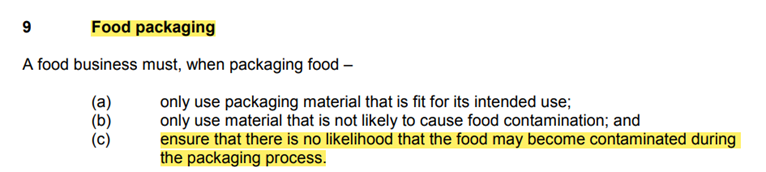
Figure 3: Food packaging processes from clause 3.2.2-9 of ref [8]
Further regulatory details pertaining to food contact materials and potential toxicants leaching into foods are covered in the Food Contact Materials report.
2.2 Specific Hygiene Requirements per Type of Food Contact Materials
In the absence of specific domestic hygiene requirements for the packaging of alcoholic beverages, the Australian Wine Research Institute [9] has a GMP guideline [10] for wine growers which outlines suggested packaging operations (in guideline section 3.8.8). This is lengthy and will not be reproduced here. It covers general aspects such as the selection of bottles and other containers, including closures, and physical packaging procedures under GMP. There is no similar industry guideline covering whisky and other spirits.
2.2.1 Liquor Bottles (B2C): Glass
The businesses’ vendor assurance program for packaging materials should ensure that bottles and closures are suitable for food use. In addition, all container/closure components should be inspected upon arrival for cleanliness and for any defects and should be stored in such a way as to ensure they remain suitable for food use until they enter the food packaging system during production.
Where required, bottles should be cleaned and/or sanitized before filling. There is no approved list of bottle sanitizers. The requirements in Figure 3 apply. In addition, any approved cleaning agents for foods would also potentially apply to bottles, particularly in relation to any residues remaining on bottles after cleaning. Schedule 18 of the FSC [11] includes a table for permitted bleaching agents, washing, and peeling agents for various foods. Although not explicitly applied to packaging components, this list may be relevant to sanitizers.
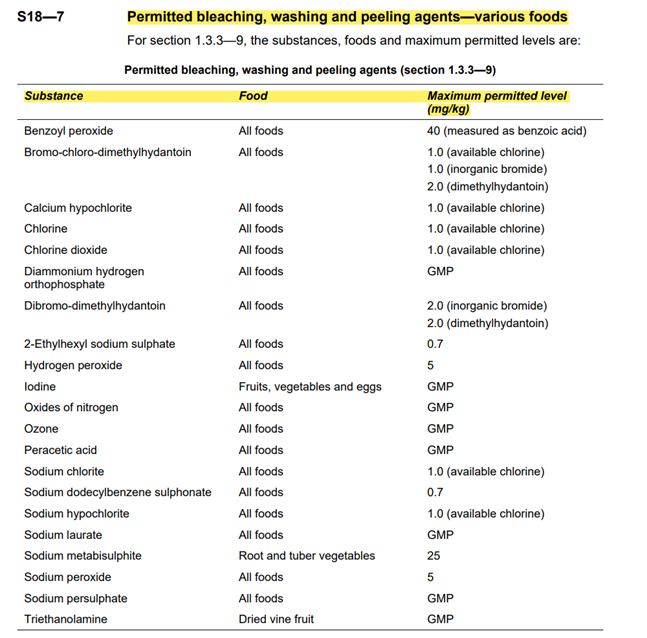 Figure 4: Permitted washing and bleaching agents from clause S18-7 of ref [11]
Otherwise, commercially available sanitizers for bottles may be applied, provided the relevant food quality system permits use for food packaging component washing and/or sanitizing. Typically, this means such chemicals should be suitable for food use.
2.2.2 Casks and Barrels (B2B): Wood, Metal
Any casks or barrels for bulk imports of whisky or other spirits destined for B2B sales, for blending or repackaging into retail units should ensure that:
(1) the casks/barrels/bulk containers are suitable for food use and are cleaned with sanitizers suitable for food use (refer to information for bottles in Section 2.2.1 above), and
(2) are of materials suitable for importation to Australia, particularly in relation to the wooden components. For the latter, refer to import conditions in Australia's Alcoholic Beverages guidebook, Section 7.
2.3 Other Hygienic Rules
Not applicable.
3. Summary Table
Food contact materials | General legislation applicable to hygiene | Specific legislation applicable to hygiene |
Bottles and closures | Food Standards Code [2] | Chapter 3 Standards [3] and any suitable quality system for the manufacturing site. |
Casks and barrels (B2B) | As above and any import restrictions on barrel/cask components. |
4. References
1. Food Standards Australia New Zealand homepage
https://www.foodstandards.gov.au/about-us
2. Australia New Zealand Food Standard Code (FSC) available from the landing page
https://www.foodstandards.gov.au/food-standards-code/legislation
3. Chapter 3 of the FSC, available from here
https://www.foodstandards.gov.au/food-standards-code/legislation#Foodsafetystandards(Australiaonly)
4. Safe Food Australia ‘A guide to the food safety standards’ 4th Edition, February 2023
PDF attached below
5. Standard 1.1.1 – Structure of the Code and general provisions
https://www.legislation.gov.au/F2015L00383/latest/downloads
6. FSANZ list of state and territory enforcement contacts, available here
https://www.foodstandards.gov.au/contact/food-enforcement-contacts
7. FSANZ policy on adoption of overseas standards
8. Standard 3.2.2 – Food safety practices and general requirements
https://www.legislation.gov.au/F2008B00576/latest/downloads
9. Australian Wine Research Institute homepage
10. The Code of Good Manufacturing Guidance for the Australian Grape and Wine Industry. Second edition
PDF attached below
11. Schedule 18 – Processing aids
https://www.legislation.gov.au/F2015L00452/latest/downloads
Was this article helpful?