
Hygiene Standards for FCM
- 4 Mins to read
- DarkLight
Hygiene Standards for FCM
- 4 Mins to read
- DarkLight
Article summary
Did you find this summary helpful?
Thank you for your feedback
Hygiene Standards for FCM
USA

The below version control table serves to document all updates made to the report. The purpose is to ensure the information is always accurate and up-to-date.
| Version Number | Content Creation Date | Publishing Date | Section(s) Updated & Reason(s) for Update |
|---|---|---|---|
| V0 | 26 June 2024 | 27 June 2024 | N/A (new report) |
| V1 | 30 May 2025 | 04 June 2025 | All content has been reviewed and is still accurate. No updates were needed. |
Disclaimers
A) At RegASK, we are committed to providing our clients with the most up-to-date and accurate information on regulatory requirements and compliance. To ensure the highest level of accuracy and relevance, we regularly review and update our e-guidebooks at least twice per year to reflect the latest regulatory developments in the market. (Please contact us if you wish to activate this feature.) In the meantime, our RegAlerts service is designed to keep our clients notified of any regulatory updates that may impact their business.
B) The contents on this platform are exclusively intended for the use of RegASK and its authorized representatives. All materials herein are confidential and the sole property of RegASK. Any reproduction, distribution, or display of this content to others is strictly prohibited without the express written consent of RegASK.
1. Overview of Regulatory Standards of Food Contact Materials (including Hygiene)
The general hygiene and good manufacturing practice requirements for all food products, packaging, and contact surfaces are described in 21 CFR 117, Current Good Manufacturing Practice, Hazard Analysis, and Risk-Based Preventive Controls for Human Food [1].
These regulations are subdivided into the following parts:
Subpart A-General Provisions
- 117.3 Definitions.
- 117.4 Qualifications of individuals who manufacture, process, pack, or hold food.
- 117.5 Exemptions.
- 117.7 Applicability of subparts C, D, and G of this part to a facility solely engaged in the storage of unexposed packaged food.
- 117.8 Applicability of subpart B of this part to the off-farm packing and holding of raw agricultural commodities.
- 117.9 Records required for this subpart.
Subpart B-Current Good Manufacturing Practice
- 117.10 Personnel.
- 117.20 Plant and grounds.
- 117.35 Sanitary operations.
- 117.37 Sanitary facilities and controls.
- 117.40 Equipment and utensils.
- 117.80 Processes and controls.
- 117.93 Warehousing and distribution.
- 117.95 Holding and distribution of human food by-products for use as animal food.
- 117.110 Defect action levels.
Subpart C-Hazard Analysis and Risk-Based Preventive Controls
- 117.126 Food safety plan.
- 117.130 Hazard analysis.
- 117.135 Preventive controls.
- 117.136 Circumstances in which the owner, operator, or agent in charge of a manufacturing/processing facility is not required to implement a preventive control.
- 117.137 Provision of assurances required under § 117.136(a)(2), (3), and (4).
- 117.139 Recall plan.
- 117.140 Preventive control management components.
- 117.145 Monitoring.
- 117.150 Corrective actions and corrections.
- 117.155 Verification.
- 117.160 Validation.
- 117.165 Verification of implementation and effectiveness.
- 117.170 Reanalysis.
- 117.180 Requirements applicable to a preventive controls qualified individual and a qualified auditor.
- 117.190 Implementation records required for this subpart.
Subpart D-Modified Requirements
- 117.201 Modified requirements that apply to a qualified facility.
- 117.206 Modified requirements that apply to a facility solely engaged in the storage of unexposed packaged food.
Subpart E-Withdrawal of a Qualified Facility Exemption
Subpart F-Requirements Applying to Records That Must Be Established and Maintained
Subpart G-Supply-Chain Program
Subparts C and G do not apply for alcoholic beverages at a facility that meets the following two conditions:
- the facility is required to obtain a permit from, register with, or obtain approval of a notice or application from the Secretary of the Treasury as a condition of doing business in the United States, or is a foreign facility of a type that would require such a permit, registration, or approval if it were a domestic facility; and
- the facility is required to register as a facility because it is engaged in manufacturing, processing, packing, or holding one or more alcoholic beverages.
2. Regulatory Requirements on Hygiene Standards for Food Contact Materials
2.1 General Standards for Hygiene Requirements
The guidance for the sanitation of containers used to hold food and beverages as well as the equipment used to manufacture them are found in 21 CFR 117, Subpart B, Good Manufacturing Practice [1].
2.2 Specific Hygiene Requirements per Type of Food Contact Materials
2.2.1 Liquor Bottles (B2C): Glass
Glass packaging for food and beverages has been in use for over one hundred years and therefore is considered to be generally recognized as safe (GRAS). Glass food-safe packaging is divided into three groups:
- Type, I, borosilicate glass,
- Type II, treated soda-lime glass, and
- Type III, soda-lime glass.
The standards for the three types of glass are found at United States Pharmacopeia USP <660>.
2.2.2 Casks and Barrels (B2B): Wood, Metal
From the FDA perspective, the materials that come in contact with a food or beverage during manufacturing are regulated under 21 CFR 117.40.
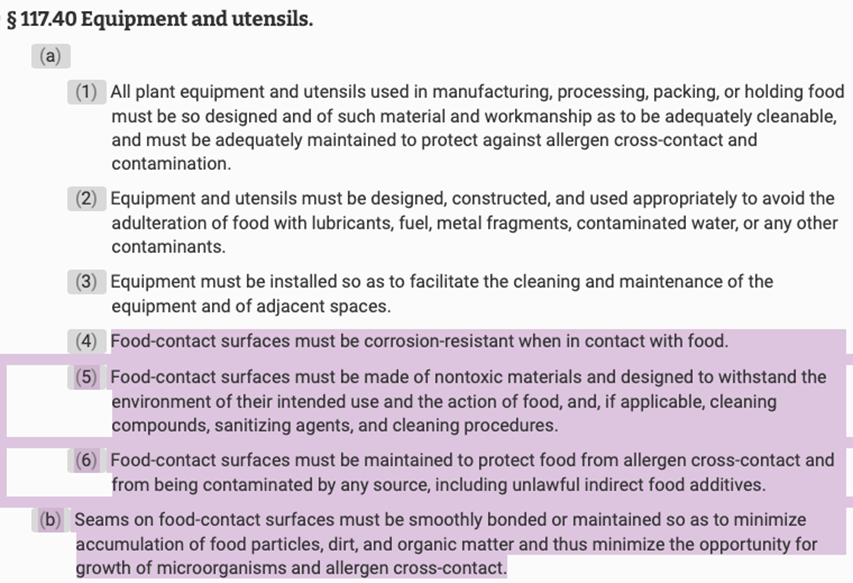
Specificities of other food contact materials may be described in the individual substance authorization (please refer to the report on Packaging Requirements for Food Contact Materials in the USA for the link to individual specifications).
2.3 Other Hygienic Rules
The Trade and Tax Bureau (TTB) regulates alcoholic beverages, and the manufacture of whiskey requiring aging in oak barrels, charred or not, aged or not. The specifics can be found in 27 CFR 5.141 [2] and depend on the type of whisky.
3. Summary Table
Food contact materials | General legislation applicable to hygiene | Specific legislation applicable to hygiene |
All types | 21 CFR 117 - Current Good Manufacturing Practice, Hazard Analysis and Risk-Based Preventive Controls for Human Food. | 21 CFR 117.40 - Subpart B, Good Manufacturing Practice.
|
4. References
1. 21 CFR PART 117—CURRENT GOOD MANUFACTURING PRACTICE, HAZARD ANALYSIS, AND RISK-BASED PREVENTIVE CONTROLS FOR HUMAN FOOD
https://www.ecfr.gov/current/title-21/part-117
2. 27 CFR Part 5 Subpart I - Subpart I—Standards of Identity for Distilled Spirits
https://www.ecfr.gov/current/title-27/part-5/subpart-I
Was this article helpful?