
Hygiene Standards for FCM
- 5 Mins to read
- DarkLight
Hygiene Standards for FCM
- 5 Mins to read
- DarkLight
Article summary
Did you find this summary helpful?
Thank you for your feedback
Hygiene Standards for FCM
EU

The below version control table serves to document all updates made to the report. The purpose is to ensure the information is always accurate and up-to-date.
| Version Number | Content Creation Date | Publishing Date | Section(s) Updated & Reason(s) for Update |
|---|---|---|---|
| V0 | 20 June 2024 | 24 June 2024 | N/A (new report) |
| V1 | 20 May 2025 | 30 May 2025 | Full review for relevancy & update to references |
Disclaimers
A) At RegASK, we are committed to providing our clients with the most up-to-date and accurate information on regulatory requirements and compliance. To ensure the highest level of accuracy and relevance, we regularly review and update our e-guidebooks at least twice per year to reflect the latest regulatory developments in the market. (Please contact us if you wish to activate this feature.) In the meantime, our RegAlerts service is designed to keep our clients notified of any regulatory updates that may impact their business.
B) The contents on this platform are exclusively intended for the use of RegASK and its authorized representatives. All materials herein are confidential and the sole property of RegASK. Any reproduction, distribution, or display of this content to others is strictly prohibited without the express written consent of RegASK.
1. Overview of Regulatory Standards of Food Contact Materials (including Hygiene)
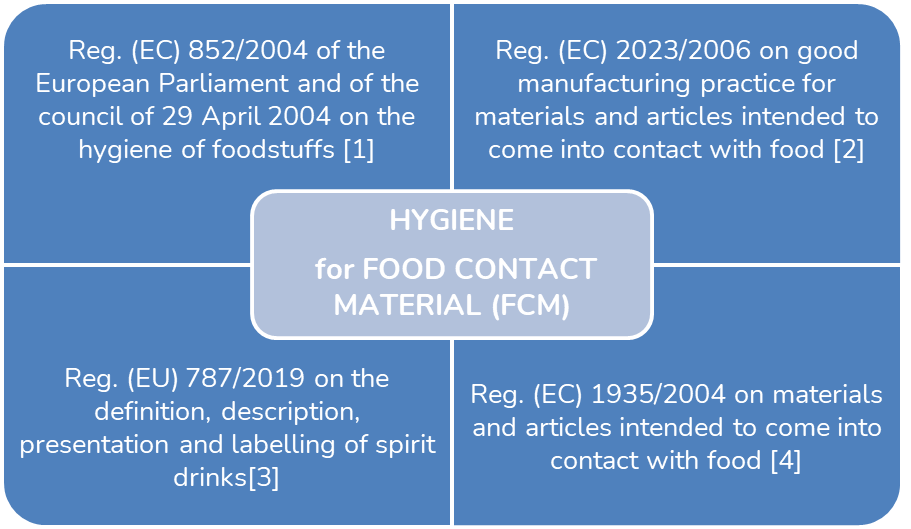
In the European Union (EU), the relevant general EU laws on hygiene standards for food contact materials are below:
- Commission Regulation (EC) No 852/2004 of the European Parliament and of the Council of 29 April 2004 on the hygiene of foodstuffs [1].
- Commission Regulation (EC) 2023/2006 of 22 December 2006 on good manufacturing practices for materials and articles intended to come into contact with food [2].
- Commission Regulation (EC) No 1935/2004 of the European Parliament and of the Council of 27 October 2004 on materials and articles intended to come into contact with food and repealing Dir. 80/590/EEC and Dir. 89/109/EEC [4].
In addition, some relevant provisions are established by :
- Commission Regulation (EU) 787/2019 of the European Parliament and of the Council of 17 April 2019 on the definition, description, presentation, and labeling of spirit drinks, the use of the names of spirit drinks in the presentation and labeling of other foodstuffs, the protection of geographical indications for spirit drinks, the use of ethyl alcohol and distillates of agricultural origin in alcoholic beverages [3].
2. Regulatory Requirements on Hygiene Standards for Food Contact Materials
2.1 General Standards for Hygiene Requirements
Regulation (EC) 852/2004 [1] is the main general EU Regulation on hygiene for food and includes requirements for FCM. CHAPTER X establishes general provisions applicable to the wrapping and packaging of foodstuffs which are the following:
- Material used for wrapping and packaging is not to be a source of contamination.
- Wrapping materials are to be stored in such a manner that they are not exposed to a risk of contamination.
- Wrapping and packaging operations are to be carried out so as to avoid contamination of the products. Where appropriate and in particular in the case of cans and glass jars, the integrity of the container's construction and its cleanliness is to be assured.
- Wrapping and packaging material re-used for foodstuffs is to be easy to clean and, where necessary, to disinfect.
Materials and articles, including active and intelligent materials and articles, shall be manufactured in compliance with good manufacturing practices set by Regulation (EC) 2023/2006 [2].
There are no other general hygiene standards established at the EU level for food contact materials.
2.2 Specific Hygiene Requirements per Type of Food Contact Materials
Even if not strictly related to the hygiene requirements for FCM, a provision relevant to food safety is the prohibition for spirit drinks to be held with a view to sale or be placed on the market in containers fitted with closing devices covered by lead-based capsules or lead-based foil as provided by art. 17 Reg. (EU) 2019/787[3]. Regulation (EC) 1935/2006[4] provides the possibility to adopt special measures for a group of materials that may be in contact with foods, but currently only some materials are regulated (eg. plastic, ceramics).
2.2.1 Liquor Bottles (B2C): Glass
There are no specific hygiene requirements set at the EU level at the moment. However, there are some requirements that have been established at the national level by some Member States and which are to be taken into account in the absence of EU provisions. Another potentially relevant reference (not law binding) is the position paper on food contact material released by Glass for Europe [5] which is the trade association for Europe’s flat glass sector.
2.2.2 Casks and Barrels (B2B): Wood, Metal
Wood:
As for wood, there are no harmonized hygiene requirements on the use of wood in contact with food established at the EU level. However, there are some requirements that have been established at the national level by some Member States and which are to be taken into account in the absence of EU provisions (eg. France [6]).
Other relevant information may be found among the standards and technical documents [7] released by the International Organization of Vine and Wine (OIV), even if not directly addressed to spirit drinks and whiskey. If the wood surface is treated such as with coating or biocide, then specific testing may apply.
Metal:
As for metals, the situation is similar: there are no hygiene requirements that are currently established at the EU level, but there are some national provisions that have to be taken into account in the absence of EU provisions.
2.3 Other Hygienic Rules
International food standards of the Codex Alimentarius [8] which outline the fundamental principles of food hygiene for all production sectors can be taken into account as reference.
3. Summary Table
Food contact materials | General legislation applicable to hygiene | Specific legislation applicable to hygiene |
Glass | Regulation (EC) 852/2004 [1] | No specific EU provision; national provisions are to be considered where existing. |
Wood | No specific EU provision; national provisions are to be considered where existing. | |
Metal | No specific EU provision except for the prohibition of lead-based capsules and lead-based foil; national provisions are to be considered where existing. |
4. References
1. (EC) No 852/2004 of the European Parliament and of the council of 29 April 2004 on the hygiene of foodstuffs
https://eur-lex.europa.eu/legal-content/EN/TXT/?uri=CELEX%3A02004R0852-20210324
2. Regulation (EC) 2023/2006 of 22 December 2006
https://eur-lex.europa.eu/legal-content/GA/TXT/?uri=celex:32006R2023
3. Regulation (EU) 787/2019 of the European Parliament and of the Council of 17 April 2019
https://eur-lex.europa.eu/legal-content/EN/TXT/?uri=CELEX%3A02019R0787-20240513
4. Regulation (EC) 1935/2004 of the European Parliament and of the Council of 27 October 2004
https://eur-lex.europa.eu/legal-content/EN/TXT/?uri=CELEX%3A02004R1935-20210327
5. Position paper on food contact materials – Glass for Europe April 2019
https://glassforeurope.com/food-contact-materials/
6. French Information Note 2012-93 have established some requirements for wood materials in contact with food
7. Standards and technical documents released by the International Organization of Vine and Wine (OIV)
https://www.oiv.int/what-we-do/standards
8. Codex Alimentarius – International food standards – General Principles of Food Hygiene
Was this article helpful?