
Hygiene Standards for FCM
- 9 Mins to read
- DarkLight
Hygiene Standards for FCM
- 9 Mins to read
- DarkLight
Article summary
Did you find this summary helpful?
Thank you for your feedback
Hygiene Standards for FCM
China

The below version control table serves to document all updates made to the report. The purpose is to ensure the information is always accurate and up-to-date.
| Version Number | Content Creation Date | Publishing Date | Section(s) Updated & Reason(s) for Update |
|---|---|---|---|
| V0 | 2 Feb 2024 | 28 Feb 2024 | N/A (new report) |
| V1 | 21 April 2025 | 21 May 2025 | Updates to references |
Disclaimers
A) At RegASK, we are committed to providing our clients with the most up-to-date and accurate information on regulatory requirements and compliance. To ensure the highest level of accuracy and relevance, we regularly review and update our e-guidebooks at least twice per year to reflect the latest regulatory developments in the market. (Please contact us if you wish to activate this feature.) In the meantime, our RegAlerts service is designed to keep our clients notified of any regulatory updates that may impact their business.
B) The contents on this platform are exclusively intended for the use of RegASK and its authorized representatives. All materials herein are confidential and the sole property of RegASK. Any reproduction, distribution, or display of this content to others is strictly prohibited without the express written consent of RegASK.
1. Overview of Regulatory Standards of Food Contact Materials (including Hygiene)
According to the “Food Safety Law of P.R.C” [1], food-related products shall comply with laws, regulations, and national standards for food safety. The food contact materials belong to the food-related products. So the food contact materials shall comply with corresponding general standards and product standards.
Here is the regulatory framework for the food contact materials:
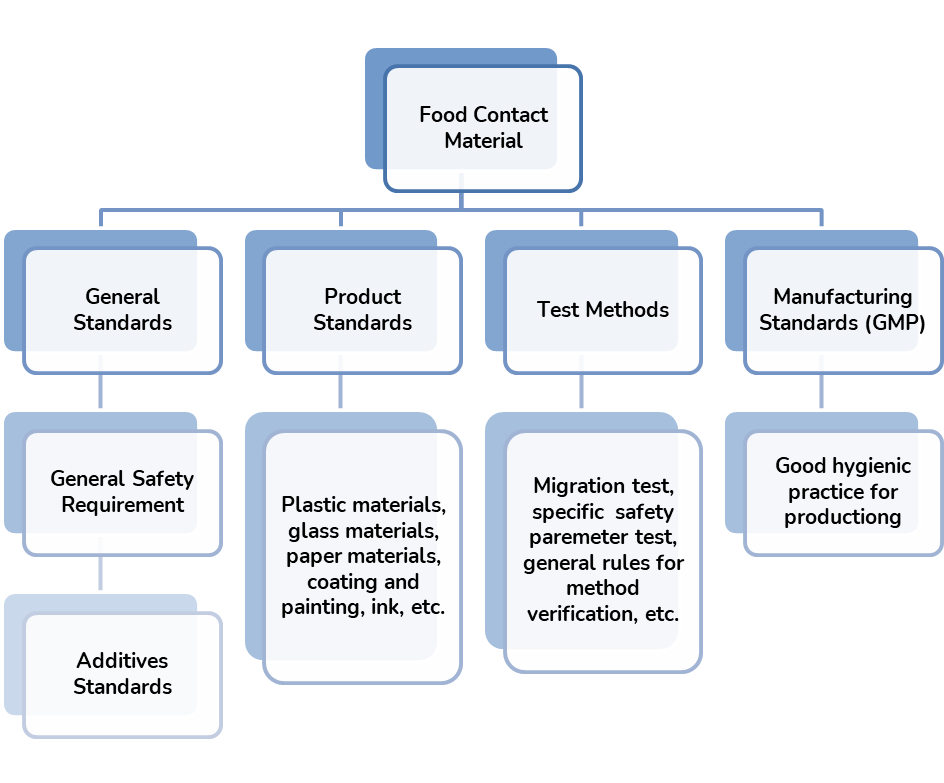 For import products, the general standards and product standards are mandatory standards. While the test methods and GMP standards are for reference, however, we recommend following those standards methods or requirements.
The hygiene standards are covered in general standards and product standards. The hygiene standard is a mandatory requirement - whether B2C or B2B, compliance should be ensured.
2. Regulatory Requirements on Hygiene Standards for Food Contact Materials
2.1 General Standards for Hygiene Requirements
The general standard for food contact materials is: GB 31603-2015 National Standard for Food Safety General Hygienic specification for the production of food contact materials and products [12] and GB/T 23887-2009 General Good Manufacturing Practice for food packaging containers and materials factories [13]:
Product standard | Scope of application |
GB 31603-2015 National Standard for Food Safety General Hygienic specification for the production of food contact materials and products [12] | This standard specifies the basic health requirements and management guidelines for the production of food contact materials and products, from raw materials procurement, processing, packaging, storage, and transportation of all aspects of the site, facilities, and personnel. This standard applies to the production of various types of food contact materials and products. If it is necessary to formulate special hygiene norms for certain types of food contact materials and products, this standard should be taken as the basis. |
GB/T 23887-2009 General Good Manufacturing Practice for food packaging containers and materials factories [13] | This standard specifies the basic requirements of the factory environment, plant and facilities, equipment, personnel, production and processing process and control, health management, quality management, documents and records, complaint handling and product recalls, product information, and publicity guidance of food packaging containers and materials production enterprises. This standard is applicable to food packaging containers and materials manufacturers. |
2.1.1 Good Hygienic Practice
As per good hygiene practice of production according to GB 31603-2015 National Standard for Food Safety General Hygienic specification for the production of food contact materials and products [12] and GB/T 23887-2009 General Good Manufacturing Practice for food packaging containers and materials factories [13], for food packaging, the following hygiene requirements on production, storage, and transportation shall apply:
- The production process should ensure that the final product does not harm human health and does not cause changes in food characteristics. The use or production of toxic and harmful substances should be avoided, and if it is impossible to avoid, effective measures should be taken to eliminate or reduce their harm to ensure that the product meets the requirements of relevant national laws, regulations, and standards.
- The key links affecting product safety in the production process should be defined by the hazard analysis method, and the corresponding control measures should be established.
- The key control links should be strictly monitored, the relevant documents of the control measures should be implemented, such as the ingredients (feeding) table, post-operation procedures, etc., and traceability records should be established.
- In the production process, measures should be taken to identify, prevent, and eliminate the risk of contamination and prevent cross-contamination of foreign objects, including but not limited to blades, non-productive glass, fragile plastics, wood, and other materials easily confused with packaging materials.
- Containers, tools, and equipment used for packaging, storage, and handling shall be kept clean and shall not pollute the products; The packaging method should be able to effectively prevent secondary pollution.
- Appropriate storage and transportation conditions should be selected according to the physical and chemical characteristics of the product, and effective measures should be taken to prevent the pollution of toxic and harmful substances. Protection should be strengthened during storage and transportation to prevent damage and contamination of finished products.
- The shelf life of the product should be formulated according to the characteristics of the product and the requirements of relevant national laws, regulations, and standards. Finished products should be marked with inspection status, and unqualified products should be stored separately, and clearly marked.
- The products stored in the warehouse should be checked regularly, and temperature and humidity records should be recorded if necessary.
- The means of transport (such as vehicles, containers, etc.) should be clean, dry, and protected against rain.
2.1.2 Microbial Limit
For all food contact materials, regardless if they are intended for B2C or B2B, the microbial limit shall comply with GB 14934-2016 National Standard for Food Safety Disinfect food (drinking) utensils [9].
Table 2-1 Microbial Limit for Disinfect Food (drinking) Utensils
Parameters | Limit | Test Method | |
Coliform bacteria | Fermentation method /(/50 cm°) | Not Detected | GB 14934-2016 Appendix B |
Paper method /(/50 cm*) | Not Detected | ||
Salmonella (/50 cm) | Not Detected | GB 14934-2016 Appendix C | |
2.1.3 Detergent Residues
If chemical disinfection is used in the disinfected or cleaning process, the amount of detergent residue shall comply with GB 14934-2016 National Standard for Food Safety Disinfect food (drinking) utensils [9].
Table 2-2 amount of detergent residue when chemical disinfection is used
Parameters | Limit | Test Method |
Free residual chlorine /(mg/100 cm*) ≤ | 0.03 | GB/T 5750.11-2006 Chapter 1 |
Anionic synthetic detergent (as sodium dodecyl benzene sulfonate)/(mg/100 cm*) | Not Detected | GB/T 5750.4-2006 Chapter 10 |
2.2 Specific Hygiene Requirements per Materials (examples)
2.2.1 Liquor Bottles (B2C)
In addition to the general hygiene requirements presented in point 1 above, the following requirements apply to glass.
Glass:
The glass packaging shall comply with GB 4806.5-2016 Food Safety National Standard glass products [4]. The specific requirement for hygiene is listed in the following table:
Table 2-3 Specific Hygiene Requirements for Glass
Parameters | Storage tank/(mg/L) | Big hollow products/ (mg/L) | Small hollow products / (mg/L) | Oral margin requirements (mg/L) |
Lead (Pb) ≤ | 0.5 | 0.75 | 1.5 | 4.0 |
cadmium (Cd) ≤ | 0.25 | 0.25 | 0.5 | 0.4 |
2.2.2 Casks and Barrels (B2B): Wood, Metal
In addition to the general hygiene requirements presented above, the following requirements apply to wood and metal.
The wood packaging shall comply with GB 4806.12-2022 National Standard for Food Safety Bamboo and wood materials and products for food contact [5], while the metal packaging shall comply with GB 4806.9-2023 National Standard for Food Safety Metallic materials and products for food contact [6]. The specific requirement for hygiene is listed below:
Wood:
Table 2-4 Migrant Parameters for Wood
Parameters | Regulatory Limit |
Total migration (a )/(mg/dm2) ≤ | 10 |
Methanal/(mg/kg) ≤ | 15 |
Sulfur dioxide/(mg/kg) ≤ | 10 |
Pentachlorophenol and its salt (calculated as pentachlorophenol)/( μg/kg) ≤ | 0.15 |
Remark: Only applicable to bamboo and wood materials and products for food contact using paints, adhesives, and/or inks.
Table 2-5 Residue Parameters for Wood
Parameters | Regulatory Limit |
Probenazole/(mg/kg) ≤ | 1.2 |
O-phenylphenol/(mg/kg) ≤ | 4.8 |
Imazalil/(mg/kg) ≤ | 0.4 |
Biphenyl/(mg/kg) ≤ | 0.6 |
The additives shall comply with GB 9685-2016 National Standard for Food Safety Standard for the use of additives for food contact materials and products [3].
Wood materials and products used for food contact with materials such as paint, ink, and (or) adhesives shall also meet the provisions of the corresponding national food safety standards such as paint, ink, and (or) adhesives: GB 4806.14-2023 Food Safety National standard ink for food contact materials and products [8], and GB/T 33320-2016 Adhesives for food packaging materials and containers [10].
Metal:
Table 2-6 Content Requirements for Impurity Elements in Metal Substrates and Metal Coatings
Metal Substrates and Metal Coatings | Impurity Elements | Content (Mass Fraction)/% |
Stainless steel | Arsenic (As) | ≤ 0.01 |
Cadmium (Cd) | ≤ 0.01 | |
Lead (Pb) | ≤ 0.01 | |
Thin steel plate for food packaging | Arsenic (As) | ≤ 0.03 |
Cadmium (Cd)+ Lead (Pb) | ≤ 0.01 | |
Aluminum and aluminum alloy materials | Arsenic (As) | ≤ 0.01 |
Cadmium (Cd)+ Lead (Pb)+ Mercury (Hg) | ≤ 0.01 | |
Metal substrate and metal coating except for stainless steel, thin steel plate for food packaging, aluminum, and aluminum alloy materials | Arsenic (As) | ≤ 0.03 |
Cadmium (Cd) | ≤ 0.01 | |
Lead (Pb) | ≤ 0.01 |
Table 2-7 Parameters on Migration of Impurity Elements
Parameters | Regulatory Limit |
Arsenic (As)/(mg/kg) ≤ | 0.002 |
Cadmium (Cd)/(mg/kg) ≤ | 0.002 |
Lead (Pb)/(mg/kg) ≤ | 0.01 |
Stibium (SB)/(mg/kg) ≤ | 0.04 |
Table 2-8 Parameters on Alloying Element Migration
Parameters (a) | Regulatory Limit |
Aluminum (AI) (b)/(mg/kg) ≤ | 1 |
Chromium (Cr)/(mg/kg) ≤ | 0.25 |
Cobaltco (Co)/(mg/kg) ≤ | 0.02 |
Copper (Cu)/(mg/kg) ≤ | 4 |
Manganese (Mn)/(mg/kg) ≤ | 2.0 |
Molybdenum (Mo)/(mg/kg) ≤ | 0.12 |
Nickel (Ni)/(mg/kg) ≤ | 0.14 |
Tin (Sn) /(mg/kg) ≤ | 100 |
Zinc (Zn)/(mg/kg) ≤ | 5 |
Remarks:
- When the material composition is known, the element to be measured can be determined based on the material composition.
- For uncoated aluminum and aluminum alloy materials and products, the index is 5 mg/kg.
- Not suitable for tinned steel containers.
The additives shall comply with GB 9685-2016 National Standard for Food Safety Standard for the use of additives for food contact materials and products [3].
Metal materials and products used for food contact with materials such as paint, ink, and (or) adhesives shall also meet the provisions of the corresponding national food safety standards such as paint, ink, and (or) adhesives: GB 4806.14-2023 Food Safety National standard ink for food contact materials and products [8], and GB/T 33320-2016 Adhesives for food packaging materials and containers [10].
The amount of tin transferred to food in tinned steel containers shall meet the requirements of GB 2762-2022 National Standard for Food Safety Limit of contaminants in food [11]: Tin (Sn) ≤ 150 mg/kg (under beverage category, ONLY limited to food packaged in tinned sheet steel containers).
2.3 Other Hygienic Rules
The test method shall use the national or industry-standard methods. If another non-standard method is used, the method verification is necessary. The verification needs to follow the GB 31604.59-2023 National Standard for Food Safety General Rules for verification of chemical analysis methods for food contact materials and products [7].
3. Summary Table
Food contact materials | General legislation applicable to hygiene | Specific legislation applicable to hygiene |
Glass | GB 4806.1-2016 National Standard for Food Safety General safety requirements for food contact materials and products [2]. GB 9685-2016 National Standard for Food Safety Standard for the use of additives for food contact materials and products [3]. GB 4806.14-2023 Food Safety National standard ink for food contact materials and products [8]. GB/T 33320-2016 Adhesives for food packaging materials and containers [10]. GB 31603-2015 National Standard for Food Safety General Hygienic specification for the production of food contact materials and products [12]. GB/T 23887-2009 General Good Manufacturing Practice for food packaging containers and materials factories [13]. GB 14934-2016 National Standard for Food Safety Disinfect food (drinking) utensils [9]. | GB 4806.5-2016 Food safety national standard glass products [4]. |
Wood | GB 4806.12-2022 National Standard for Food Safety Bamboo and wood materials and products for food contact [5] | |
Metal | GB 4806.9-2023 National Standard for Food Safety Metallic materials and products for food contact [6] |
4. References
1. Food Safety Law of the People’s Republic of China
https://www.samr.gov.cn/zw/zfxxgk/fdzdgknr/fgs/art/2023/art_6bff4ef87291497fa72949e1fc88efb5.html
2. GB 4806.1-2016 National Standard for Food Safety General safety requirements for food contact materials and products
https://sppt.cfsa.net.cn:8086/db?type=2&guid=D81D6399-32A6-4782-97E0-822496BDBF8C
PDF attached below
3. GB 9685-2016 National Standard for Food Safety Standard for the use of additives for food contact materials and products
https://sppt.cfsa.net.cn:8086/db?type=2&guid=AF786A76-DF3E-4611-9117-6013965E43A5
PDF attached below
4. GB 4806.5-2016 Food safety national standard glass products
https://sppt.cfsa.net.cn:8086/db?type=2&guid=BE91E716-8C39-4A8A-94D7-4077BB83EEEF
PDF attached below
5. GB 4806.12-2022 National Standard for Food Safety Bamboo and wood materials and products for food contact
https://sppt.cfsa.net.cn:8086/db?type=2&guid=BC2324BC-ED68-41C2-AD89-9D2B0D54F508
PDF attached below
6. GB 4806.9-2023 National Standard for Food safety Metallic materials and products for food contact
https://sppt.cfsa.net.cn:8086/db?type=2&guid=0AA5AA19-933F-4475-A70B-CB1B95D25ADD
PDF attached below
7. GB 31604.59-2023 National Standard for Food Safety General Rules for verification of chemical analysis methods for food contact materials and products
https://sppt.cfsa.net.cn:8086/db?type=2&guid=12197C1E-32D2-47EC-BB8D-21DC7D3BC726
PDF attached below
8. GB 4806.14-2023 Food safety National standard ink for food contact materials and products
https://sppt.cfsa.net.cn:8086/db?type=2&guid=80810610-69C4-4A3E-9250-E2CFFC76F72E
PDF attached below
9. GB 14934-2016 National Standard for Food Safety Disinfect food (drinking) utensils
https://sppt.cfsa.net.cn:8086/db?type=2&guid=1488AEF0-6644-41EA-88D1-9D99305C0265
PDF attached below
10. GB/T 33320-2016 Adhesives for food packaging materials and containers
http://c.gb688.cn/bzgk/gb/showGb?type=online&hcno=B0EEE402378EFD60E8840BDEAE5781E6
PDF attached below
11. GB 2762-2022 National Standard for Food Safety Limit of contaminants in food
https://sppt.cfsa.net.cn:8086/db?type=2&guid=3989AF03-4750-415C-9CAE-271604C35B59
PDF attached below
12. GB 31603-2015 National Standard for Food Safety General Hygienic specification for the production of food contact materials and products
https://sppt.cfsa.net.cn:8086/db?type=2&guid=5E3BE799-6682-46FC-9D8A-1EC00965F6B7
PDF attached below
13. GB/T 23887-2009 General Good Manufacturing Practice for food packaging containers and materials factories
https://openstd.samr.gov.cn/bzgk/gb/newGbInfo?hcno=7FDBFC5D5D06A42DAC769690F87E6868&refer=outter
PDF attached below
Was this article helpful?