
Health Certificate Requirements for Importing Yeast for Fermented Food
- 6 Mins to read
- DarkLight
Health Certificate Requirements for Importing Yeast for Fermented Food
- 6 Mins to read
- DarkLight
Article summary
Did you find this summary helpful?
Thank you for your feedback
Health Certificate Requirements for Importing Yeast for Fermented Food
Malaysia

The below version control table serves to document all updates made to the report. The purpose is to ensure the information is always accurate and up-to-date.
| Version Number | Content Creation Date | Publishing Date | Section(s) Updated & Reason(s) for Update |
|---|---|---|---|
| V0 | 05 Jan 2024 | 16 Oct 2024 | N/A (new report) |
Disclaimers
A) At RegASK, we are committed to providing our clients with the most up-to-date and accurate information on regulatory requirements and compliance. To ensure the highest level of accuracy and relevance, we regularly review and update our e-guidebooks at least twice per year to reflect the latest regulatory developments in the market. (Please contact us if you wish to activate this feature.) In the meantime, our RegAlerts service is designed to keep our clients notified of any regulatory updates that may impact their business.
B) The contents on this platform are exclusively intended for the use of RegASK and its authorized representatives. All materials herein are confidential and the sole property of RegASK. Any reproduction, distribution, or display of this content to others is strictly prohibited without the express written consent of RegASK.
1. Is a health certificate or certificate of free sale required by authorities for the import of yeasts?
i. Health certificate
In Malaysia, a health certificate for food products or food ingredients is an official document for export purposes, issued to ensure that the exported food product and food contact material comply with the requirements of the importing country [1].
Malaysia Ministry of Health (MOH), Food Safety and Quality (FSQ) Division is the focal agency responsible for food safety and has imposed specific import requirements on health certificates relating to drugs and drug residues [2], and certificate of analysis (CoA) [3] for the importation of specific products such as milk products, meat, edible meat offal, poultry, edible poultry offal, shrimps, prawns, etc. into Malaysia.
The above is on top of the Veterinary Health Certificate (VHC) requirement by the Department of Veterinary Services Malaysia (DVS) for animal and animal products.
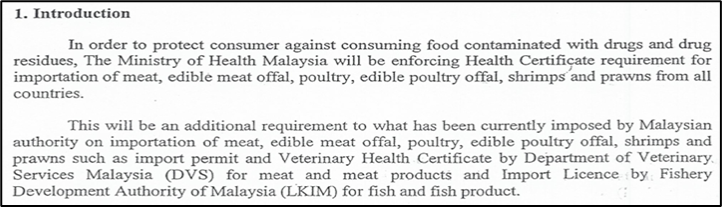
Section 4: Health Certificate format
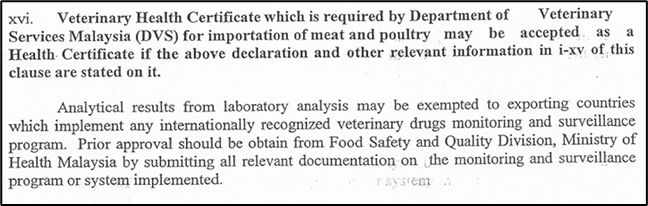
Figure 1: Excerpt from Malaysia MOH FSQ Guideline on Health Certificate Requirement [2]
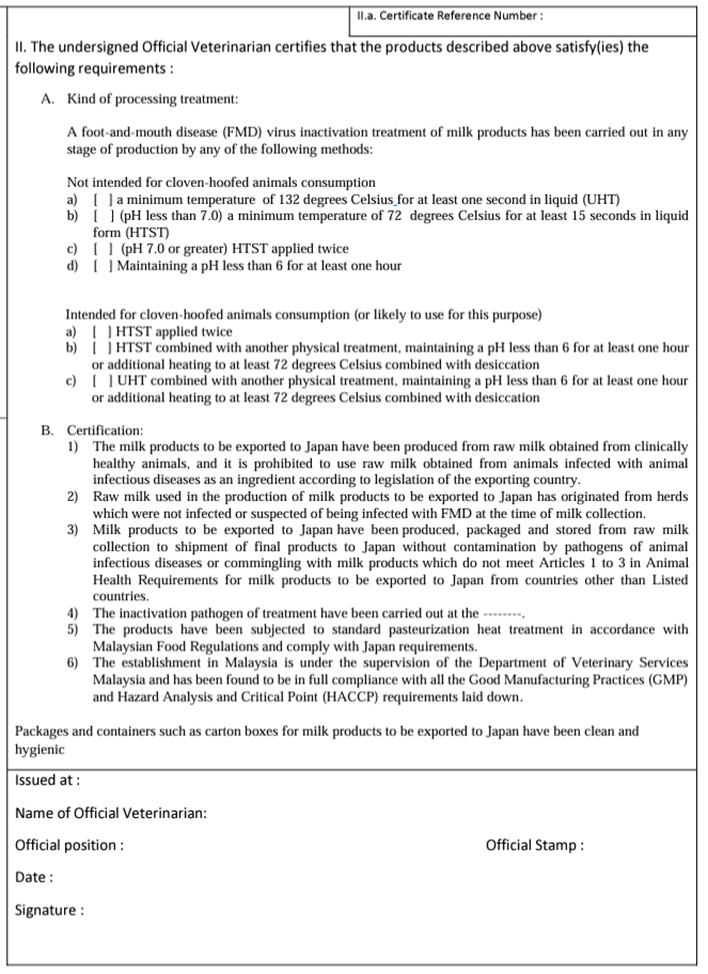
An example of a Veterinary Health Certificate is provided in Annex 1.
In summary, there are various health certificates to be applied for depending on the food categories in question and destination country:
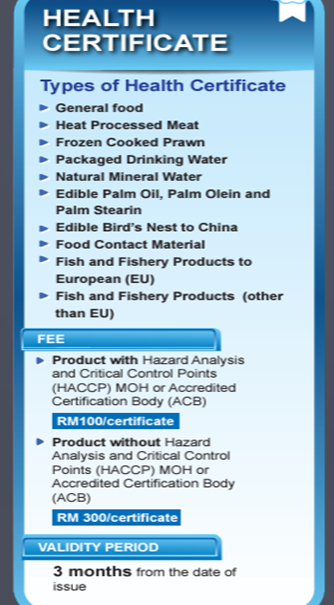
Figure 2: Screenshot from MOH FSQ Guide on Certificates for Food Product Export [2]
ii. Certificate of Free Sale
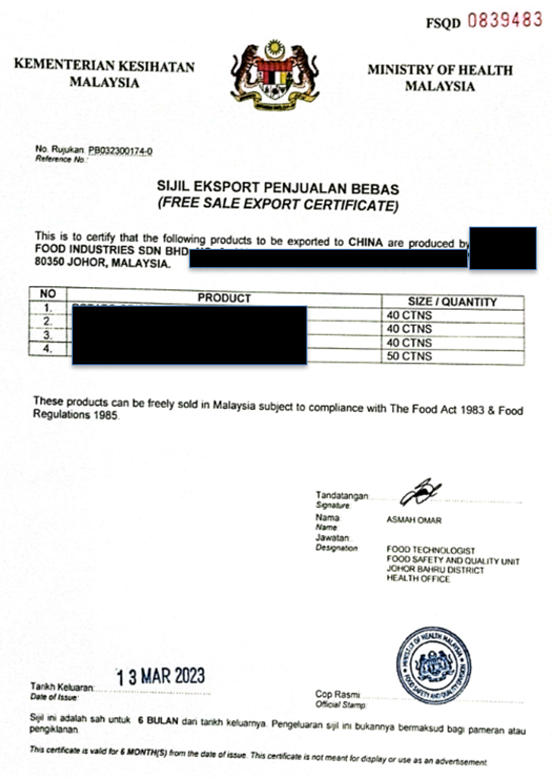
In the Malaysian context, a Certificate of Free Sale or Free Sale Certificate for food products and/or food ingredients is an official document issued by MOH FSQ for export purposes, to ensure the food products to be exported comply with the Food Act 1983 and Food Regulations 1985 [4].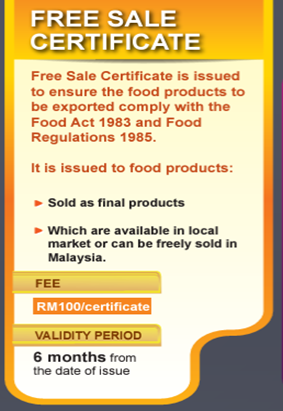
Figure 3: Screenshot from MOH FSQ Guide on Certificates for Food Product Export [4]
Unlike health certificates, there is only one type of free sale certificate that applies to all food product categories intended for export out of Malaysia.
An example of a free sale certificate issued by MOH FSQ is given in Annex 2.
iii. Food and Food Ingredients Importation requirements into Malaysia
The importation of food products into Malaysia is regulated by Malaysia Customs, Malaysia MOH, and the Malaysian Quarantine and Inspection Services (MAQIS) established under the Ministry of Agriculture and Agro-Based Industry Malaysia as a Department to provide integrated services relating to quarantine, inspection, and enforcement relating to food and for matters related to it.
The general importation documents including import declaration, bill of lading or air waybill, commercial invoice, packing list, etc. [5], and additionally for food products or food ingredients import, the trader or importer, has to register with Malaysia MOH to access Food Safety Information System of Malaysia (FoSIM) to give prior notice of import or make an inquiry on examination level of a particular food item to MAQIS. Food ingredients such as non-GMO yeast intended for further processing into finished food products in the importing country are still required to register with MOH for import declaration in FoSIM.
There are additional import documentation required for specific food products, such as meat products, cheeses, seaweed, etc. detailed in the Guideline on Health Certificate Requirement [2] and Additional Document Requirements for Importing Specific Food Products [3]. These additional import documentation include health certificates and certificates of analysis.
For non-GMO yeast or yeast in general, a health certificate or certificate of free sale is not required since it does not fall under the positive lists of food products and ingredients requiring additional import documentation, beyond the standard list of documents required by Customs.
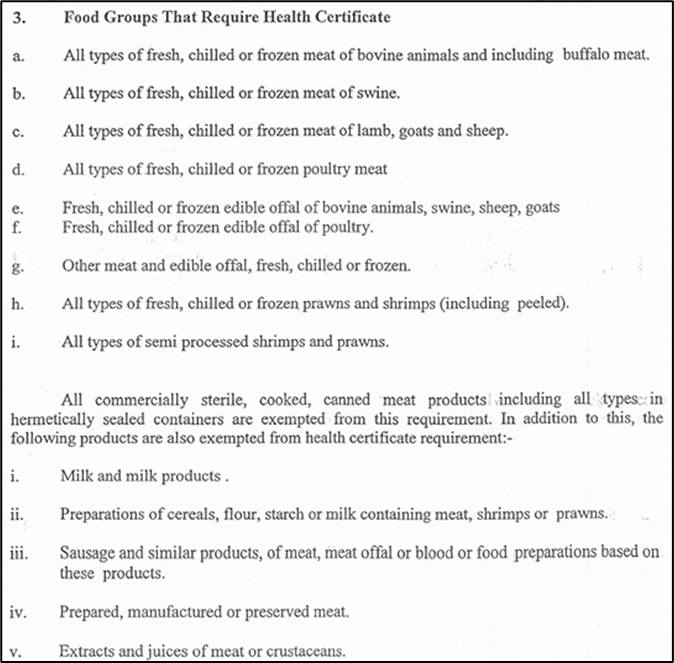
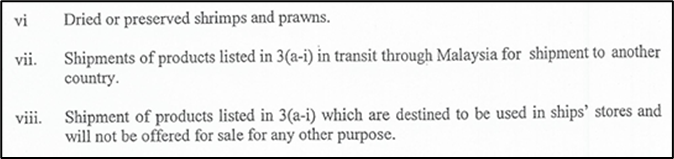
Figure 4: Excerpt from Guideline on Health Certificate Requirement [2]
2. If yes, whose responsibility is it to provide the health certificate/certificate of free sale?
Although the specified yeast product is not required by law to provide the health certificate or certificate of free sale, it is dependent on the importer’s internal policy on whether they require such documents from their trading partner (i.e., exporting party).
When mandated by law, it is the responsibility of the exporter (or consignor) involved in the trading transaction with the importer to provide the health certificate or certificate of free sale. For instances where the consignor is not the manufacturer but a third-party trader, the manufacturer shall assist the consignor who will be applying for these certificates, by furnishing the required factory and product supporting documents, while the consignor will provide the required transportation details to their local governing authority. This is also dependent on the exporting country’s procedure for these certificate applications which differs by country.
3. If yes, do these certificates need to be validated/issued by the authority of the country of origin of the products or can the manufacturer write the certificate himself?
Health Certificates and Certificates of Free Sale must be issued by the authority of the country of origin, as detailed in Section 1 as these are official documents for export purposes. This has been specifically prescribed by MOH FSQ for health certificates (refer to the below excerpt), and for free sale certificates, it is also evident based on Malaysia’s certificate format issued to local food exporters shown in the Section 1.
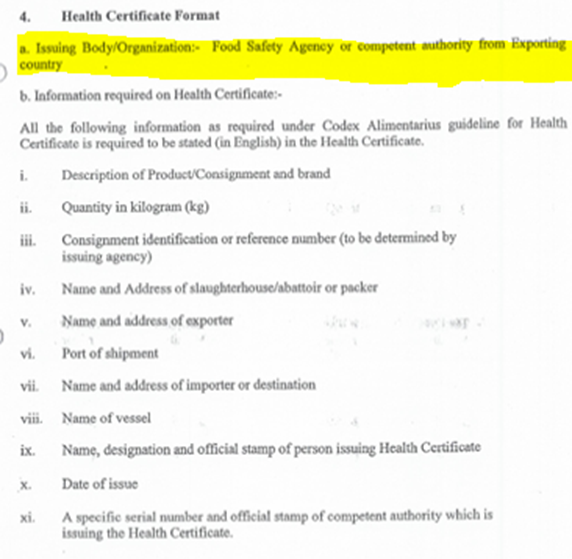
Figure 5: Excerpt from Guideline on Health Certificate Requirement [2]
Certificates written by the manufacturer or trader themselves are not recognized by MOH FSQ (for general food products) and DVS (for animal and animal products), given that the broad purpose is to certify that the imported food product or food ingredient is safe and meets safety standards of the exporting country.
Conclusion
- In Malaysia, the importation of yeast as a food product or food ingredients intended for the further production of fermented food/drinks locally does not require a health certificate or certificate of free sale issued by the governing authority of the exporting country, unlike specific food products like meat and milk products specified by MOH FSQ and DVS to furnish these documents. Such documents are official documents issued by the relevant agency regulating the product categories.
- There is also standard import documentation prescribed by Malaysia Customs for the importer as part of the importation process, and prior account registration with Malaysia MOH for import declaration in FoSIM.
- Where a health certificate or certificate of free sale is required for specific food products (excluding yeast), the consignor or exporter is responsible for providing the document to the importer, since the application is performed by the exporter with the relevant authority of the exporting country.
- Both the health certificate and certificate of free sale are official documents and must be issued by the authority of the exporting country.
4. References
1. Malaysia MOH FSQ Guide on Food Export Requirements
http://fsq.moh.gov.my/v6/userfiles/file/c48bb5595981beb8eb877f30ba4b7e6d.pdf
2. Guideline on Health Certificate Requirement BKKM PPI1/2005
http://fsis2.moh.gov.my/UploadFosim/BULETTIN/200815094629B3558Lampiran_Garispanduan%20HC.pdf
3. ADDITIONAL DOCUMENT REQUIREMENTS FOR IMPORTING SPECIFIC FOOD PRODUCTS (UPDATED 29 NOVEMBER 2023)
http://fsis2.moh.gov.my/fosimv2/BUL/frmBulletinBoardDetail.aspx?id=5726
4. MOH FSQ Guide on Certificates for Food Product Export
http://fsq.moh.gov.my/v6/userfiles/file/24d6387b37821adbdb1de9bd4fd02d84.pdf
5. Malaysia National Trade Repository website on Documentary Requirements
http://mytraderepository.customs.gov.my/en/pd/Pages/doc_req.aspx
6. DVS Malaysia template on VHC format for dairy products exported to Japan
ANNEX 1: Example of VHC issued for dairy products exported from Malaysia into Japan [6]
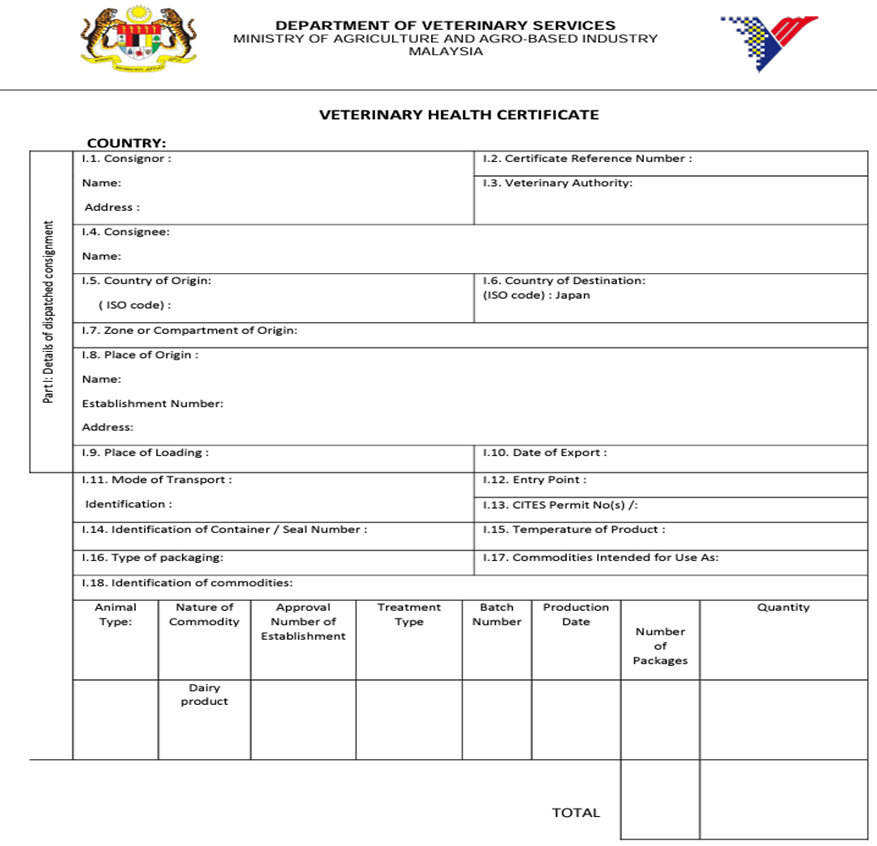
ANNEX 2: Example of free sale certificate issued by MOH FSQ
Was this article helpful?