
Trehalose in Food and as Processing Aid (Japan)
- 3 Mins to read
- DarkLight
Trehalose in Food and as Processing Aid (Japan)
- 3 Mins to read
- DarkLight
Article summary
Did you find this summary helpful?
Thank you for your feedback
Trehalose in Food and as Processing Aid
Japan

This section provides a regulatory assessment for the use of Trehalose in Food and as a Processing Aid in Japan.
| Version Number | Content Creation Date | Publishing Date | Section(s) Updated & Reason(s) for Update |
|---|---|---|---|
| V0 | 19 Dec 2023 | 6 Nov 2024 | N/A (new report) |
Disclaimers
A) At RegASK, we are committed to providing our clients with the most up-to-date and accurate information on regulatory requirements and compliance. To ensure the highest level of accuracy and relevance, we regularly review and update our e-guidebooks at least twice per year to reflect the latest regulatory developments in the market. (Please contact us if you wish to activate this feature.) In the meantime, our RegAlerts service is designed to keep our clients notified of any regulatory updates that may impact their business.
B) The contents on this platform are exclusively intended for the use of RegASK and its authorized representatives. All materials herein are confidential and the sole property of RegASK. Any reproduction, distribution, or display of this content to others is strictly prohibited without the express written consent of RegASK.
1. Use of Trehalose in Food
In Japan, food law is mainly governed by the Food Sanitation Act (Act No. 233 of 1947) [1], wherein the Ministry of Health, Labour and Welfare (MHLW) is the competent authority responsible for the safety of foods. Under this Act, substances intentionally ingested by humans (excluding pharmaceuticals) are classified into 2 categories: “food ingredients” and “food additives”. In general, food ingredients are defined as providing a nutritional purpose whereas food additives are typically used to provide a technical effect.
Trehalose is classified as a food additive and is currently included in the list of authorized food additives [2] with no specific restrictions for use [3]. This is interpreted that trehalose can be used in all foods according to Good Manufacturing Practice (“GMP”).
The MHLW commonly establishes compositional specifications for the authorized food additives. However, such specifications are not present for some ‘old’ food additives of which uses were approved based on their history of use. Such ‘old’ food additives (commonly called “Existing Food Additives”) were grandfathered from the current pre-market safety assessment and approval system. At the time of this work, no compositional specification has been established for trehalose, as an Existing Food Additive [4]. This would mean that food business operators may determine an appropriate specification although such specification must be stringent and comprehensive enough to ensure the safety and hygiene of the trehalose.
2. Use of trehalose as a drying aid for yeast intended to be used for beer and wine-making
As described in the previous section, trehalose can be used in all foods according to GMP. Yeasts intended for beer and wine making are classified as a “food (ingredient)” in Japan, and therefore the use of trehalose in yeasts would be allowed if it is used according to GMP.
Diammonium phosphate, used as a buffer, may fall under the definition of a processing aid in the EU, as defined in Article 3.2 (b) of the main Regulation (EC) No 1333/2008 on food additives [1]:

However, processing aids are excluded from the scope of this Regulation, and there is no general European legislation regarding compliance of processing aids in generic food/beverages. Some specific European legislations for certain foods exist and include the list of processing aids allowed for such foods, such as for lactoproteins (Directive (EU) 2015/2203 [2] (see screenshot below) and fruit juice (Directive 2001/112/CE [3]).
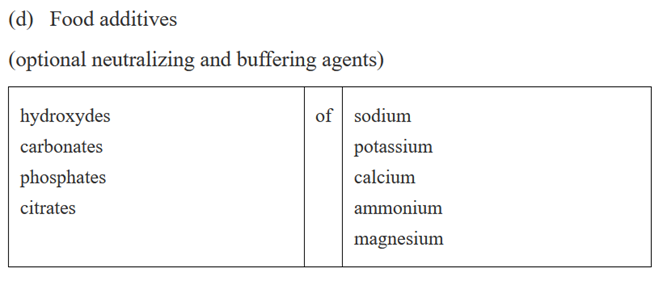
In addition, in the EU, it is the responsibility of the business operators to ensure food processed with processing aids is safe, applying the general food safety requirements defined in Article 14 of the general food safety requirements Regulation (EC) No 178/2002 [4].
Conclusion
- In Japan, trehalose is regulated as a food additive and is authorized for use in all foods according to GMP. No compositional specification has been established by the MHLW, and food business operators may determine an appropriate specification that is stringent and comprehensive enough to ensure the safety and hygiene of the trehalose.
- Since there is no specific restriction for the use of trehalose, its use in yeast as a drying aid would be allowed if it is used according to GMP.
3. References
1. Food Sanitation Act (Act No. 233 of 1947) (in English)
https://www.japaneselawtranslation.go.jp/en/laws/view/3687
2. List of Existing Food Additives (in English)
https://www.ffcr.or.jp/en/tenka/list-of-existing-food-additives/list-of-existing-food-additives.html
3. Standards for Use of Food Additives (in English)
https://www.ffcr.or.jp/en/upload/Standards%20for%20Use%20Nov.7%2C2023.pdf
4. Database of Japan's Standards and Specifications for Food Additives, 9th edition (JSFA9), D. Monographs: List (in English)
https://dfa25.nihs.go.jp/jssfa/list.php
Was this article helpful?