
Remaining Shelf Life for Imported Food Products - Ethiopia
- 2 Mins to read
- DarkLight
Remaining Shelf Life for Imported Food Products - Ethiopia
- 2 Mins to read
- DarkLight
Article summary
Did you find this summary helpful?
Thank you for your feedback
Remaining Shelf Life for Imported Food Products
Ethiopia

The below version control table serves to document all updates made to the report. The purpose is to ensure the information is always accurate and up-to-date.
| Version Number | Content Creation Date | Publishing Date | Section(s) Updated & Reason(s) for Update |
|---|---|---|---|
| V0 | 7 Nov 2023 | 23 Oct 2024 | N/A (new report) |
Disclaimers
A) At RegASK, we are committed to providing our clients with the most up-to-date and accurate information on regulatory requirements and compliance. To ensure the highest level of accuracy and relevance, we regularly review and update our e-guidebooks at least twice per year to reflect the latest regulatory developments in the market. (Please contact us if you wish to activate this feature.) In the meantime, our RegAlerts service is designed to keep our clients notified of any regulatory updates that may impact their business.
B) The contents on this platform are exclusively intended for the use of RegASK and its authorized representatives. All materials herein are confidential and the sole property of RegASK. Any reproduction, distribution, or display of this content to others is strictly prohibited without the express written consent of RegASK.
1. Minimum shelf life remaining when food products arrive in the destination country
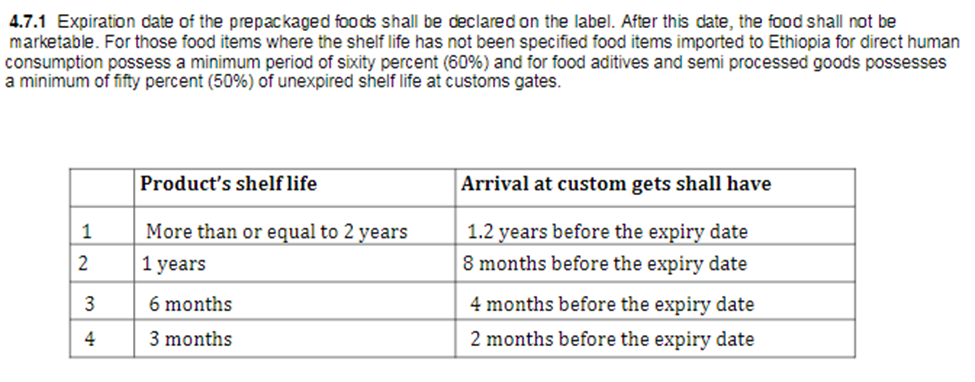
Requirements for the labeling of food in Ethiopia are laid down in Standard CES 73: 2013. In this standard, Article 4.7.1 specifies that food items intended for direct human consumption that do require a shelf life must enter the country with a minimum of 60% of its shelf life remaining. Food additives and semi processed goods must enter with minimum 50% of shelf life:
2. Minimum shelf life remaining of food products sold in the country
As seen above, it is not authorized to sell a product who has passed its shelf life. However, there is no minimum set for food products sold in the country.
Note: the following products do not require to have an indication of shelf life:
- fresh fruits and vegetables, including potatoes which have not been peeled, cut or similarly treated;
- wines, liquor wines, sparkling wines aromatized wines, fruit wines and sparkling fruit wines;
- beverages containing 10% or more by volume of alcohol;
- bakes or pastry cooks; given the nature of their contents, are normally consumed within 24 hours of their manufacture
- vinegar
- confectionary products consisting of flavored and/or colored sugars; and
- chewing gum.
3. Food industry guidelines/best practices for remaining shelf-life rules
There are no industry guidelines on minimum remaining shelf life for products sold in the country.
Conclusion
- Ethiopian legislation sets the following minimum remaining shelf life for products when they enter the country:
- Food items intended for direct human consumption: minimum 60% shelf life remaining.
- Food additives and semi processed goods: 50% of shelf life remaining.
- There is no legal criteria nor industry guidelines regarding minimum shelf life for product sold in the country.
4. References
1. CES 73: 2013 General standards for prepackaged foods - Labelling
Was this article helpful?