
Packaging Requirements for FCM
- 12 Mins to read
- DarkLight
Packaging Requirements for FCM
- 12 Mins to read
- DarkLight
Article summary
Did you find this summary helpful?
Thank you for your feedback
Packaging Requirements for FCM
India

The below version control table serves to document all updates made to the report. The purpose is to ensure the information is always accurate and up-to-date.
| Version Number | Content Creation Date | Publishing Date | Section(s) Updated & Reason(s) for Update |
|---|---|---|---|
| V0 | 06 Mar 2025 | 26 Mar 2025 | N/A (new report) |
Disclaimers
A) At RegASK, we are committed to providing our clients with the most up-to-date and accurate information on regulatory requirements and compliance. To ensure the highest level of accuracy and relevance, we regularly review and update our e-guidebooks at least twice per year to reflect the latest regulatory developments in the market. Please contact us if you would like to activate this feature. In the meantime, our RegAlerts service is designed to keep our clients notified of any regulatory updates that may impact their business.
B) The contents on this platform are exclusively intended for the use of RegASK and its authorized representatives. All materials herein are confidential and the sole property of RegASK. Any reproduction, distribution, or display of this content to others is strictly prohibited without the express written consent of RegASK.
1. Overview of Relevant Regulatory Standards for Food Contact Materials
The primary authority regulating food contact material used for alcoholic beverages in India is the Food Safety and Standards Authority of India (FSSAI) under the Food Safety and Standards Act, 2006 [1].
Food Safety and Standards Act, 2006 [1] is the main act for food safety including for food contact material requirements. In addition, the following specific standards apply:
- Food Safety and Standards (Packaging) Regulations, 2018 [2] laying down the requirements for materials used in food packaging to ensure they are safe, suitable, and do not contaminate food, including guidelines on the type of packaging materials and labeling requirements. It includes:
- Requirement for specific migration limits of substances from plastic materials intended to be in contact with articles of food (Table 1)
- List of standards addressing Paper and board materials intended to come in contact with food products (Schedule I)
- List of standards addressing Metal and Metal Alloys intended to come in contact with food products (Schedule II)
- List of standards addressing Plastic Materials intended to come in contact with food products (Schedule III)
- Food Safety and Standards (Contaminants, Toxins, and Residues) Regulations, 2011 [3] laying down the permissible limits for contaminants, toxins, and residues in food products to ensure food safety and prevent health hazards.
The primary objective of packaging requirements for food contact materials (FCMs) is to ensure the safety, quality, and integrity of food products while also protecting human health. This includes a range of considerations designed to prevent harmful interactions between the food and the packaging material. Packaging also ensures that there is no change in sensory properties or composition of food when packed. The general and specific requirements concerning packaging materials and regulations also prescribe overall migration and specific migration limits of contaminants for plastic packaging materials. The regulations specify the suggestive list of packaging materials for different food product categories. As per these regulations, the packaging materials used for packing or storing the food products shall conform to the Indian Standards provided in the schedules.
2. General Standards for Food Contact Materials
The Food Safety and Standards (Packaging) Regulations, 2018 [2], established under the Food Safety and Standards Act, 2006, lays down comprehensive guidelines to ensure the safety and suitability of packaging materials intended for food products. These regulations are designed to prevent contamination, protect food integrity, and safeguard consumer health.
Food contact materials (FCMs) play a critical role in ensuring the safety and quality of food and beverages. In India, the Food Safety and Standards Authority of India (FSSAI) mandates strict compliance for FCMs to protect public health. These materials include coatings, metals, plastics, glass, and other substances that come in direct contact with food or beverages. The regulations emphasize safety, non-toxicity, and compliance with defined standards to prevent any adverse impact on food quality.
General Requirements:
- Safety and non-toxicity
- Food contact materials must be made from substances proven safe for human health.
- They must not transfer harmful chemicals, toxins, or impurities to the food or beverage they come into contact with.
- Compliance with Standards
- Materials must adhere to Indian Standards (IS) or internationally recognized standards approved by FSSAI.
- Examples include BIS (Bureau of Indian Standards) guidelines or ISO standards.
- Labeling of Packaging
- Clear and mandatory labeling is required to identify food-grade materials.
- Labels also ensure traceability throughout the supply chain.
- Migration Testing
- Migration testing is mandatory to ensure that substances from packaging or materials do not transfer into food at levels harmful to health.
- Testing protocols include specific and overall migration limits for chemicals.
Source: Regulation 4(1)(a) to 4(2), 4(3), 4(4), 4(6), 4(7), 4(8) - "Packaging materials used for packing or storing the food shall be of food grade quality."[2]
3. Specific Requirements per Type of Food Contact Materials
Food contact materials (FCMs) encompass a variety of materials for alcoholic beverages such as coating and materials (glass bottles, metal cans, caps/stoppers). To ensure the safety and quality of food, specific requirements are established for each material type. These requirements are focused on controlling contamination, preventing the migration of harmful substances, and maintaining food hygiene standards. The FSS packaging standard specifies migration limits, labeling, and safety requirements for food packaging materials. [2]
3.1 Glass Bottle
Glass containers intended to come into contact with food products are widely used due to their non-reactive nature, durability, and ability to preserve the quality and safety of food and beverages. Glass is considered one of the safest materials for food contact as it does not leach harmful substances, alter the taste, or impact the chemical composition of the food. To ensure the safety and hygiene of glass containers, specific regulatory requirements must be met, [4] including material quality, surface finish, and migration limits for substances like lead and cadmium in glass coatings (decorated/colored). These standards are crucial to maintain food safety and consumer health.
Glass containers intended to come in contact with food products [4]:
- As far as possible, they shall be free from blisters, mold marks, stones, and chippings, and as far as possible shall be free from cords, seeds, and other visible defects.
- They shall have a smooth surface without cracks, pinholes, and sharp edges.
- The sealing surface shall be free from hairline cracks and prominent seam marks. No specific migration limits are set for glass as it is typically inert and non-reactive with food. However, for decorated or colored glass, lead and cadmium migration levels to be monitored could pose a health risk [4].
3.2 Metal can
For metal cans used as food contact materials, importers/manufacturers must ensure that food contact materials comply with the relevant BIS standards which specify the hygiene standards and regulate the contamination from metals and coatings used in the tin containers for packaging.
Metals and Metal alloys intended to come in contact with the container [2]:
- A utensil or container made of the following materials or metals, when used in the preparation, packaging, and storing of food shall be deemed to render it unfit for human consumption:
- containers that are rusty
- enameled containers that have become chipped and rusty
- copper or brass containers that are not properly tinned
- Appropriate grades of metal and metal alloys where applicable shall be used for packing or storing food products.
- Metal and metal alloys used for the manufacturing of containers for packing or storing the food products shall conform to either of the Indian Standards specifications as provided in Schedule – II.
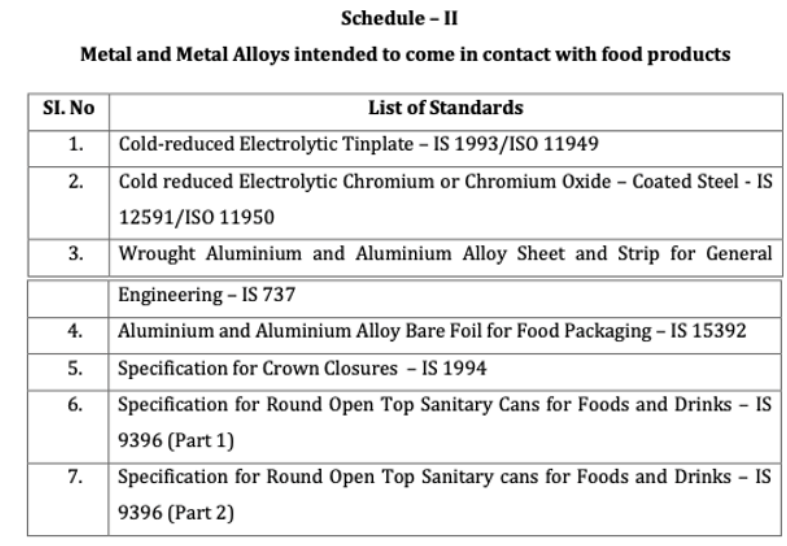 Source: Ref [4]
These standards must be purchased by the manufacturer. They can be obtained from the relevant standards organizations such as BIS, FSSAI, or others. Manufacturers typically need to buy individual copies of the standards through official channels, either online or through direct contact with the organizations.
Requirements for coating
These requirements for coating are primarily concerned with ensuring the safety of the materials that come into direct contact with food to prevent contamination and maintain food quality. The coatings used on metal cans must be safe and non-toxic.[6] The materials should not release harmful substances into food during storage or use. The coatings should not impart undesirable odors, tastes, or colors to the food. The raw materials used in coatings (such as resins, solvents, or additives) should comply with FSSAI’s safety criteria and should be approved for use in food packaging. [4]
Epoxy-based coatings are commonly used, but the FSSAI has issued specific guidelines regarding the use of epoxy resins that contain BPA (Bisphenol A). FSSAI does not always publish individual chemical migration limits, they refer to international norms for chemicals like BPA. According to EFSA and FDA guidelines, the migration limit for BPA is usually set at 0.05 mg/kg of food or beverage (as per European and FDA regulations). [4]
Migration limit for metal
The overall migration from metal cans into food must not exceed 60 mg/kg of food or 10 mg/dm² of the packaging surface in contact with the food. For certain metals, specific migration limits are defined to ensure food safety [3]:
- Lead (Pb): Maximum migration limit of 0.01 mg/kg.
- Cadmium (Cd): Maximum migration limit of 0.002 mg/kg.
- Tin (Sn): Maximum migration limit of 100 mg/kg for inorganic tin.
- Chromium (Cr): Maximum migration limit of 0.25 mg/kg.
- Nickel (Ni): Maximum migration limit of 0.02 mg/kg.
- Mercury (Hg): Maximum migration limit of 0.005 mg/kg of food.
- Arsenic (As): Maximum migration limit of 0.01 mg/kg
3.3 Caps/stoppers (Plastics, Metal) [5]
3.3.1 Plastic
Caps and stoppers made of plastic polymers, as per Schedule III of FSSAI guidelines, must adhere to specific standards outlined by the Bureau of Indian Standards (BIS). These standards aim to control the transfer of harmful substances into food during storage, packaging, and transportation [3]. The design and functionality of the plastic cap must be free from sharp edges or defects, and it should ensure an airtight or leak-proof seal to protect the food product.
a) List of authorized plastics substances or banned substances:
FSSAI (Food Safety and Standards Authority of India) regulates the use of plastics in food contact materials through the Food Safety and Standards (Packaging) Regulations, 2018. The regulation specifies authorized substances for food-grade plastics, as well as substances that are prohibited for use in food packaging and food contact materials.
Authorized substances are those that are considered safe for food contact, based on migration testing and other safety evaluations. These materials must comply with FSSAI's guidelines for migration limits, ensuring that they do not release harmful substances into food. [4]
Sl. No | Plastic |
1 | Polyethylene (PE) |
2 | Polypropylene (PP) |
3 | Polyethylene Terephthalate (PET or PETE) |
4 | Polystyrene (PS) |
5 | Polyvinyl Chloride PVC |
6 | Polycarbonate (PC) |
7 | Acrylic (PMMA) |
8 | Polyamide (PA) |
9 | Ethylene Vinyl (EV) |
10 | Polylactic Acid (PLA) |
11 | Cellulose-Based Plastics (e.g., Cellophane) |
Certain plastics and substances are banned or restricted for use in food contact materials due to concerns over toxicity, migration of harmful chemicals, or environmental impact. [7]
Sl. No | Restricted Plastics |
1 | Polyvinyl Chloride (PVC) with Plasticizers |
2 | Polystyrene Foam (Expanded Polystyrene - EPS) |
3 | BPA (Bisphenol A) in Polycarbonate |
4 | Melamine |
5 | PVC with Certain Additives |
6 | Polyurethane (PU) |
7 | Formaldehyde-based Resins |
8 | Non-Food-Grade Plastics (General) |
9 | Asbestos in Plastics |
10 | Certain Phthalates and Heavy Metals |
Migration limit: The migration limit defined for plastic materials listed below as per the FSSAI standard, however, the prescribed overall migration limit of 60mg/kg or 10mg/dm2 when tested as per IS 9845 with no visible color migration applies to all the plastic material [7].
Plastic materials intended to come in contact with food products [4]
- Plastic materials used for the manufacturing of containers for packing or storing the food products shall conform to either of the Indian Standards specifications as provided in Schedule – III: Provided that plastic bottles shall be packed in colorless, transparent, and tamper-proof bottles or containers made of polyethylene (PE) conforming to IS: 10146 or polyvinyl chloride (PVC) conforming to IS: 10151 or polyalkylene terephthalate (PET and PBT) conforming to IS: 12252 or polypropylene (PP) conforming to IS: 10910 or food grade polycarbonate conforming to IS: 14971 or polystyrene conforming to IS: 10142 or sterile glass bottles only. The transparency of a container shall not be less than 85 percent in light transmittance.
- All packaging materials of plastic origin shall pass the prescribed overall migration limit of 60mg/kg or 10mg/dm2 when tested as per IS 9845 with no visible color migration [7].
- Plastic materials and articles shall not release the substances in quantities exceeding the specific migration limits listed in Table 1.
Table 1: Requirement for specific migration limits of substances from plastic materials intended to be in contact with articles of food
| Sl. No | Substance | Maximum Migration Limit (mg/kg) |
| 1 | Barium | 1.0 |
| 2 | Cobalt | 0.05 |
| 3 | Copper | 5.0 |
| 4 | Iron | 48.0 |
| 5 | Lithium | 0.6 |
| 6 | Manganese | 0.6 |
| 7 | Zinc | 25.0 |
- Pigments or Colorants for use in plastics in contact with food products and drinking water shall conform to IS: 9833. [7]
- Products made of recycled plastics including carry bags shall not be used for packaging, storing, carrying, or dispensing articles of food.
Below is a list of standards for plastic materials used for food contact as outlined in Schedule III of the FSSAI packaging regulations:
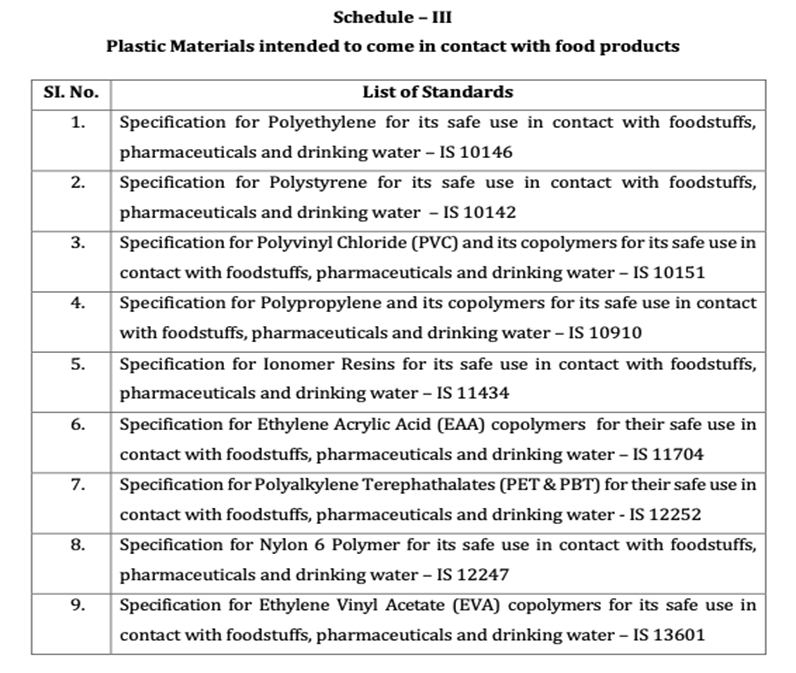
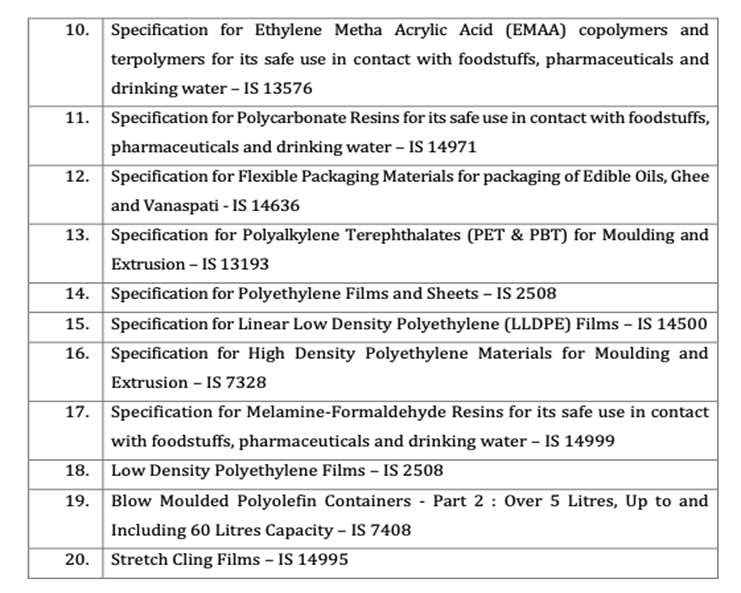
These standards collectively ensure the safety, quality, and compliance of plastic materials used in the packaging, storage, and transportation of food products.
Reference Source (Schedule III):
These standard specifications cover materials used to manufacture caps and stoppers for safe food contact applications.
- Specification for Polyethylene for safe use in food contact – IS 10146
- Specification for Polypropylene and its copolymers – IS 10910
- Specification for High-Density Polyethylene (HDPE) – IS 7328
- Specification for Polycarbonate Resins – IS 14971
- Specification for Polyvinyl Chloride (PVC) – IS 10151
3.3.2 Metal
Metal Containers: Tinplate cans made of low carbon mild steel of 99.75% purity, coated with tin with easy open ends are used. These tinplate containers are either 3-piece or 2-piece containers. They are lacquered internally to prevent corrosion [6].
Migration limit: same as point 3.2 above.
4. Summary
Food contact materials - General legislation applicable
1. Food Safety and Standards Act, 2006
- The overarching framework for food safety and standards in India.
- Regulates food contact materials under the mandate to ensure food is safe, hygienic, and free from contaminants.
2. Food Safety and Standards (Packaging) Regulations, 2018
- Comprehensive legislation setting out requirements for materials and articles in contact with food.
- Focuses on safety, migration testing, and labeling of packaging materials.
Specific legislation applicable [6]
The specific legislation applicable to Food Contact Materials (FCM) in India is governed under the Food Safety and Standards Act, 2006, which serves as the primary framework for ensuring food safety. In addition, the Food Safety and Standards (Packaging) Regulations, 2018 provide detailed guidelines and standards specifically for food packaging materials to ensure they are safe, non-toxic, and suitable for food contact.
Specific Legislation Applicable to FCMs
Material Type | Applicable Legislation/Standards | Key Provisions |
Plastics | FSS (Packaging) Regulations, 2018; IS 9833: List of Additives for Plastics | Specifies limits for overall and specific migration of plastic components into food. |
Paper and Board | IS 15495: Guidelines for Food Grade Paper and Board | Only food-grade inks and adhesives are permitted. Prohibits the use of harmful chemicals. |
Glass | FSS (Packaging) Regulations, 2018; IS 1993: Glass Containers for Packaging | Must be free from cracks, blisters, and chips. Lead and cadmium migration levels are to be monitored for colored or decorative glass. |
Metal and Metal Alloys | FSS (Packaging) Regulations, 2018; IS 15392: Containers for Packaging; IS 9845: Determination of Overall Migration | Ensures materials do not corrode or release heavy metals such as lead, tin, and cadmium. |
Ceramics | IS 13620: Ceramic Tableware in Contact with Food | Limits for migration of lead and cadmium in glazes. |
Coatings and Varnishes | FSS (Packaging) Regulations, 2018; BIS Standards for specific coatings | Restricts the migration of substances from coatings applied to FCMs. |
Printing Inks | Draft Printing Ink Standards (Proposed by FSSAI) | Non-toxic and food-safe inks only. Prohibits heavy metals and primary aromatic amines in printing. |
5. References
1. Food Safety and Standards Act, 2006
https://www.fssai.gov.in/cms/food-safety-and-standards-regulations.php
2. Food Safety and Standards (Packaging) Regulations, 2018
https://www.fssai.gov.in/upload/uploadfiles/files/Gazette_Notification_Packaging_03_01_2019.pdf
3. Food Safety and Standards (Contaminants, Toxins, and Residues) Regulations, 2011
https://fssai.gov.in/upload/uploadfiles/files/Guidance_Note_Metal_13_03_2020.pdf
4. Food Safety and Standards (Packaging) Regulations, 2022
https://www.fssai.gov.in/upload/uploadfiles/files/Compendium_Packaging_Regulations_05_06_2022.pdf
5. IS 1394: 2016: Guidelines for metal containers used for packaging food
https://standardsbis.bsbedge.com/BIS_SearchStandard.aspx?keyword=metal%20containers&id=0
6. Metal caps
https://www.icpe.in/icpefoodnpackaging/pdfs/14_beverages.pdf
7. Plastics
IS 9833: 2018: List of permissible additives for use in plastics in contact with food
BIS Home - Bureau of Indian Standards
IS 9845: 1998: Determination of overall migration of constituents of plastics into food
BIS Home - Bureau of Indian Standards
8. Metal - Aluminum and aluminum alloy bare foil for food packaging - Specification
Was this article helpful?