
Packaging Requirements for FCM
- 4 Mins to read
- DarkLight
Packaging Requirements for FCM
- 4 Mins to read
- DarkLight
Article summary
Did you find this summary helpful?
Thank you for your feedback
Food Contact Materials (FCM)
Singapore

The below version control table serves to document all updates made to the report. The purpose is to ensure the information is always accurate and up-to-date.
| Version Number | Content Creation Date | Publishing Date | Section(s) Updated & Reason(s) for Update |
|---|---|---|---|
| V0 | 09 July 2024 | 15 July 2024 | N/A (new report) |
| V1 | 02 May 2025 | 17 June 2025 | Overall review & update based on 2025 insights (e.g.: addition of the Singapore Food Safety and Security Act (FSSA)). |
Disclaimers
A) At RegASK, we are committed to providing our clients with the most up-to-date and accurate information on regulatory requirements and compliance. To ensure the highest level of accuracy and relevance, we regularly review and update our e-guidebooks at least twice per year to reflect the latest regulatory developments in the market. Please contact us if you would like to activate this feature. In the meantime, our RegAlerts service is designed to keep our clients notified of any regulatory updates that may impact their business.
B) The contents on this platform are exclusively intended for the use of RegASK and its authorized representatives. All materials herein are confidential and the sole property of RegASK. Any reproduction, distribution, or display of this content to others is strictly prohibited without the express written consent of RegASK.
Overview of Relevant Regulatory Standards
The Sale of Food Act* [1] is the framework legislation on food in Singapore to ensure that food for sale is safe and suitable for human consumption, including food contact articles. Food safety regulatory standards pertaining to food contact materials are stipulated in the Food Regulations [2], the subsidiary legislation.
The Sale of Food Act applies to imported food for sale in Singapore.
* The Singapore Food Safety and Security Act (FSSA) [3] was passed in the Singapore Parliament in January 2025. While the FSSA has not yet come into effect, it would consolidate and amend food safety legislation in Singapore, including the eventual repeal of the Sale of Food Act. The implementation of the FSSA would be in phases, with a full transition expected in 2028.
That said, the core principles of Singapore’s food safety framework remain intact. Provisions from the Sale of Food Act that ensure that food in Singapore is safe and suitable for human consumption will continue to be relevant and will be incorporated into the FSSA.
Regulatory Requirements on Food Contact Materials (Including Coatings and Materials)
1. General Requirements
Section 2 of the Sale of Food Act defines [1]:
“Food contact article means the whole or any part of any utensil, machinery, instrument, device, apparatus, container, appliance or article that is used, or that is designed or intended for use, in or in connection with the handling of food, but does not include any pipe, water fitting, apparatus or appliance used for the supply of water by the Public Utilities Board.”
[PENDING COMMENCEMENT] Section 3 of the Food Safety and Security Act defines [3]:
“Food contact article means the whole or any part of any utensil, machinery, instrument, device, apparatus, packaging, appliance or article that (a) is used, or that is designed or intended for use, in or in connection with the handling of food, and (b) has or may have direct contact with food when it is used, in or in connection with the handling of food, but does not include any pipe, water fitting, apparatus or appliance used for the supply of water by the Public Utilities Board."
In addition, Section 143 of the Food Safety and Security Act defines [3]:
“A hazardous food contact article means a food contact article that, if used for the purpose for which it was designed or intended to be used, would (a) render or be likely to render food unsuitable; or (b) put another food contact article, or would be likely to put another food contact article, in such a condition that, if the other food contact article were used for the purposes for which it was designed or intended to be used, the other food contact article would render, be likely to render, food unsuitable."
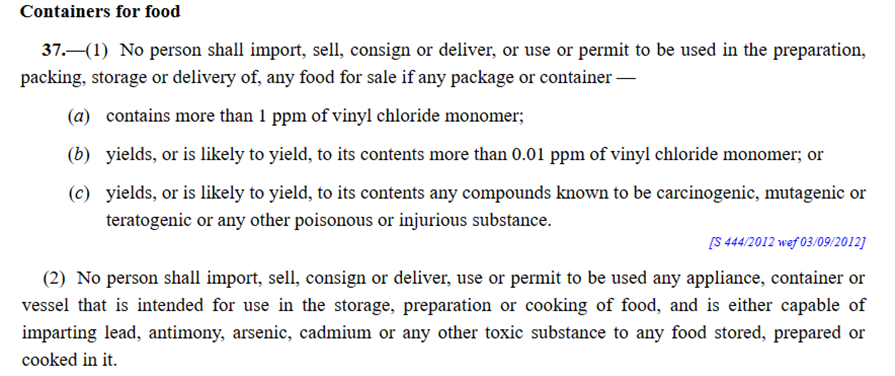
Based on Regulation 37(1) and 37(2) of the Food Regulations [2], “containers for food” should not:
- Contain more than 1 ppm of vinyl chloride monomer;
- Yield, or is likely to yield, to its contents more than 0.01 ppm of vinyl chloride monomer;
- Yield, or is likely to yield, any compounds known to be carcinogenic, mutagenic or teratogenic, or any other poisonous or injurious substance;
- Be capable of imparting lead, antimony, arsenic, cadmium, or any other toxic substance to any food stored, prepared, or cooked in it.
Regulation 37(3) on prescribed restrictions on the use of ceramic food ware has been excluded from this report on the presumption that such material is not used for alcoholic drinks.
“Container” is defined in Regulation 2 of the Food Regulations as any form of packaging of food for sale as a single item, whether by way of wholly or partly enclosing the food or by way of attaching the food to some other article and in particular includes a wrapper or confining band.
Note that, in principle, it is the responsibility of the food manufacturer and trader to ensure that the food contact articles used for storing or for commercial packing of their food do not migrate any harmful substances into the food.
2. Specific Requirements per Type of Food Contact Materials
Based on Regulations 37(4) of the Food Regulations [2], lead piping shall not be used for the conveyance of beer, cider, or other beverages or liquid food.

3. Summary Table
Food contact materials | General legislation applicable | Specific legislation applicable |
All types of materials | Food Regulations [2] | None |
Alcoholic beverage packaging |
4. References
https://sso.agc.gov.sg/Act/SFA1973#pr2A-
https://sso.agc.gov.sg/SL/SFA1973-RG1?DocDate=20230904&ProvIds=P1III-#pr37-
3. Food Safety and Security Act
https://sso.agc.gov.sg/Act/FSSA2025/Uncommenced/20250502161636?DocDate=20250206&WholeDoc=1
Was this article helpful?