
Regulatory Assessment of Pea Protein for Animal Feed/Pet Food
- 7 Mins to read
- DarkLight
Regulatory Assessment of Pea Protein for Animal Feed/Pet Food
- 7 Mins to read
- DarkLight
Article summary
Did you find this summary helpful?
Thank you for your feedback
Pea Protein for Animal Feed/Pet Food
Australia - August 2023

This section provides a regulatory assessment for the use of Pea Protein in Animal Feed/Pet Food in Australia.
1. Overview of How Animal Feed/Pet Food is Regulated in Australia
In Australia, the Australian Pesticide and Veterinary Medicines Authority (APVMA) regulates agricultural and veterinary chemical (agvet) products. Agvet chemical products cannot be legally manufactured, imported, supplied, sold, or used in Australia unless they are either:
- Registered by the APVMA or;
- Exempt from registration (excluded) and meet any other relevant requirements.
With respect to animal feed and pet food, the APVMA regulates direct-fed microbial, nutritional, or digestive feedstocks and pet foods unless the product falls into the category of Excluded Nutritional or Digestive (END) products. Most animal feeds and pet foods fall under this exclusion, provided certain requirements are met. To be excluded, an animal feed/pet food product must be one that is fed to, and voluntarily consumed by, an animal and meets specified requirements in relation to all four tests (for ingredients, manufacturing, labeling, and claims) that are described below.
Test 1: Ingredients
The product must not contain certain ingredients, such as antibiotics and hormones:
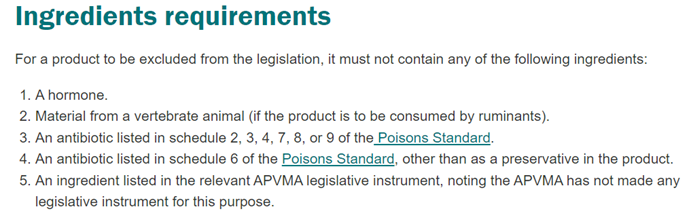 Figure 1. Excerpt from APVMA webpage on Stockfeed and Petfood regulation [1]There is no positive list of permitted ingredients. However, all ingredients must be either a substance of plant or animal origin that is edible by an animal OR on one of the specified lists.

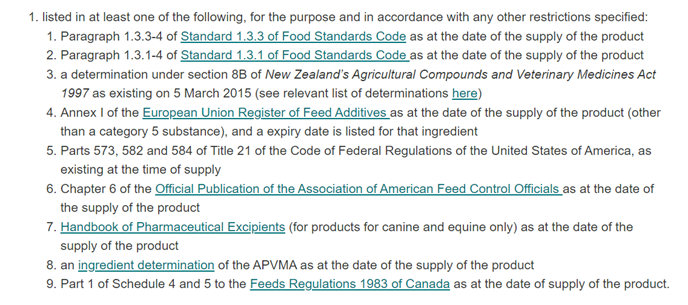 Figure 2. Excerpt from APVMA webpage on Stockfeed and Petfood regulation [1]
It should be noted that the ingredient test applies to ALL ingredients in a product formulation for the product to be classified as an END. The regulatory status of the pea protein under this requirement will be discussed in section 2.
Test 2: Manufacturing system
For a product to be excluded from the legislation, the product must be manufactured under an appropriate QA system. This applies to finished products, not the individual ingredients.
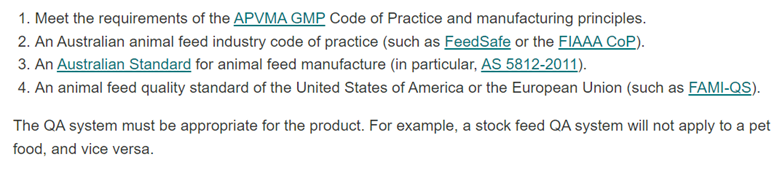 Figure 3. Excerpt from APVMA webpage on Stockfeed and Petfood regulation
Test 3: Product claims
 Figure 4. Excerpt from APVMA webpage on Stockfeed and Petfood regulation
Test 4: Product labeling
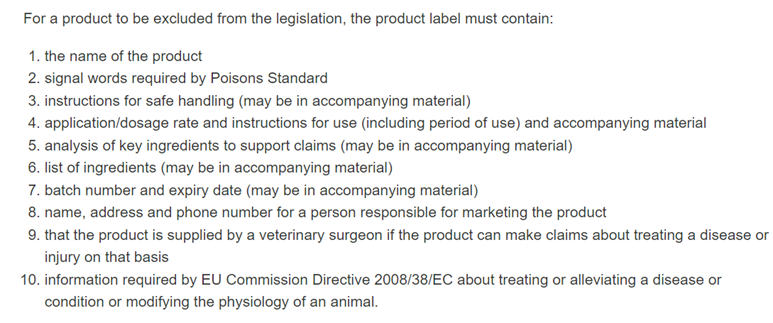 Figure 5. Excerpt from APVMA webpage on Stockfeed and Petfood regulation
Companies selling animal feed and pet food products (i.e. finished end-use products) can apply the above tests to ascertain if their product qualifies as an END. There is also a decision tool [2] for this purpose.
For a product that does not qualify as END due to not meeting all four of the tests, the APVMA has a registration self-assessment tool [3] which provides information on the appropriate regulatory pathway. The self-assessment tool requires users to know the health benefit or pest control claims of the product purpose or function of the product using the label which has the ingredient list. Alternatively, pre-application assistance is provided by the APVMA to give assistance in preparing or making an application to the APVMA. A separate pre-application assistance application is required per product or active constituent application made to the APVMA with the exception of a new product containing a new active constituent.
Irrespective of whether the finished product is an END or is not excluded from the registration requirements of the APVMA, the permitted use of the pea protein would be considered to be the same. As such, the ingredient is not expected to be therapeutically active but instead functions as a nutritional component of animal feed or pet food.
Additional notes regarding pet foods (companion animals)
Specific to pet food, the pet food industry in Australia is self-regulated. Most companies join the Pet Food Industry Association of Australia (PFIAA) and follow their voluntary standards. There is information available online regarding the selection of ingredients and the voluntary standards on manufacturing, hygienic production, and marketing practices [4]. It is worth noting that there is no Australian equivalent of overseas bodies such as AAFCO (Association of American Feed Control Officials) and FEDIAF (European Pet Food Industry). PetFAST [5] is a voluntary recall system and is a joint initiative of PFIAA and the Australian Veterinary Association (AVA). This system is only accessible by veterinarians with no option for consumers to make reports of adverse events.
The PFIAA, AVA, the Australian Government, and various other stakeholders have been campaigning for mandatory regulation of pet foods in Australia. In 2018, the Australian Senate undertook an inquiry regarding possible regulatory approaches to ensure the safety of local and imported pet food products. Information on the status of the inquiry is available online [6]. The outcome of the review following the government's response is ongoing. Irrespective of the outcome (i.e. the recommendation to make pet food standards obligatory), this should not have an impact on the regulatory status of the pea protein ingredient.
2. Permitted Use of Pea Protein in Animal Feed/Pet Food
Pea protein is permitted for use in both animal feed and pet food. The permission for use is under a number of provisions as described below:
- It is a substance of plant origin that is edible by an animal (see Figure 2).
- It is included in the list of diluents and carriers in the Agricultural and Veterinary Chemicals Code Ingredient Determination 2015 [7]. This piece of legislation allows these ingredients to be used for that purpose in END products. It should be noted that this does not restrict its use for the same function in non-END products. This permission does not restrict the use of the pea protein for other purposes.
.png)
Figure 6. Excerpt from Part 8 of the Agricultural and Veterinary Chemicals Code Ingredient Determination 2015
- It is also noted on the provided product specifications that the ingredient complies with the AAFCO and European Union regulations which are on the Australian list of permissions for ingredients in END products (see Figure 2).
No maximum limit for the use of pea protein has been defined for Australia. It would be reasonable to apply any suitable limits from relevant overseas jurisdictions. Alternatively, the upper limit could be set based on the technological function of the pea protein in the finished product, for example as a protein source or as a diluent or carrier.
3. Applicable Specifications for Pea Protein (Local and/or International Standards)
There are no local specifications for the pea protein. Australia does not mandate that ingredients used in animal feed and pet food need to meet the standards required for human foods. The use of any of the international standards relevant to the product use, such as FAMI-QS (Feed Additives and Pre-mixtures Quality System)*, would be appropriate. The Australian standards [4] are currently voluntary and are mostly concerned with the hygiene standards of animals providing meat for pet food. Processed pet food does not have any legislation covering the applicable standards with respect to processing or standards.
*Notes:
FAMI-QS is a global quality and feed safety management system for specialty feed ingredients [8]. It has been adopted for Australia-New Zealand through the strategic agreement of cooperation with the Feed Ingredients and Additives Association of Australia (FIAAA), which is the peak national body representing the Australian animal feed additive and ingredient importers, resellers, and manufacturers [9].
4. Legal Name of the Pea Protein on Business-to-business (B2B) and Business-to-consumer (B2C) labels
For B2B product labeling, the name 'pea protein' would be the most appropriate.
For B2C labels, it is not mandatory in most Australian jurisdictions to include the names of all ingredients on pet food labels since the details can be included in the information provided with the product. The name 'pea protein' would be appropriate if the manufacturer wishes to include the ingredient on the label, which is preferable. Recent trends for natural or healthy pet foods have seen more pet food companies include a full list of ingredients on B2C labels.
Conclusion
- In Australia, pea protein is permitted as an ingredient for use in pet food and animal feed. The majority of the end-use products are regulated as Excluded Nutritional or Digestive (END) products which do not require registration with the regulator, the APVMA. The use of pea protein is based on the permission to use a substance of plant origin that is edible by an animal.
- There are no maximum limits for use and no local specifications for pea protein. The amount used should be based on the amount required to fulfill whichever technological function the pea protein is intended to perform in the end-use product. Any internationally recognized specifications relevant to the use (i.e. in animal feed or pet food) would be appropriate to apply in Australia, including EU and US standards.
- The name 'pea protein' is suitable for both B2B and B2C labels. While it is permitted to include an ingredient list with the product information, and not necessarily on the product label for B2C products, there is a growing trend from consumers for full ingredient lists due to a preference for natural and healthy pet food options.
5. References
1. APVMA webpage: 'Stockfeed and petfood regulation'
http://apvma.gov.au/node/13021
2. APVMA decision flowchart for END products
3. APVMA Registration Self-Assessment Tool
http://apvma.gov.au/node/10666
4. PFIAA webpage: ' Pet food standards'
https://pfiaa.com.au/pet-food-standards/
5. Australian Veterinary Association 'Petfast' information page
https://www.ava.com.au/library-resources/other-resources/petfast/report/
6. Australian Government Senate Committee on 'Regulatory approaches to ensure the safety of pet
7. Agricultural and Veterinary Chemicals Code Ingredient Determination 2015
https://www.legislation.gov.au/Details/F2015L00785
8. FAMI-QS homepage
9. FAMI-QS/FIAAAA certification for Australia-New Zealand
Was this article helpful?