
Regulatory Assessment of Pea Protein for Animal Feed/Pet Food
- 7 Mins to read
- DarkLight
Regulatory Assessment of Pea Protein for Animal Feed/Pet Food
- 7 Mins to read
- DarkLight
Article summary
Did you find this summary helpful?
Thank you for your feedback
Pea Protein for Animal Feed/Pet Food
New Zealand - August 2023

This section provides a regulatory assessment for the use of Pea Protein in Animal Feed/Pet Food in New Zealand.
1. Overview of How Animal Feed/Pet Food is Regulated in New Zealand
In New Zealand, the Ministry for Primary Industries (MPI) regulates Agricultural Compounds and Veterinary Medicines (ACVM) under the Agricultural Compounds and Veterinary Medicines Act 1997 [1]. ACVMs are agricultural compounds that include veterinary medicines and other products for use in animals. Section 2 (1) of the Act provides the definition of these types of products.
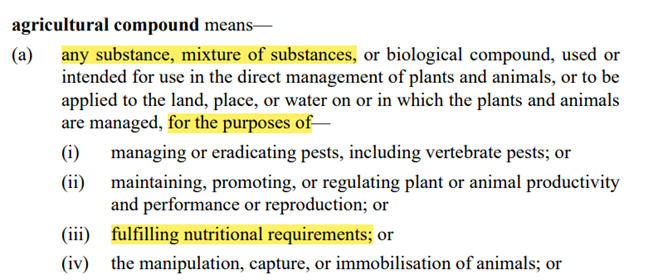
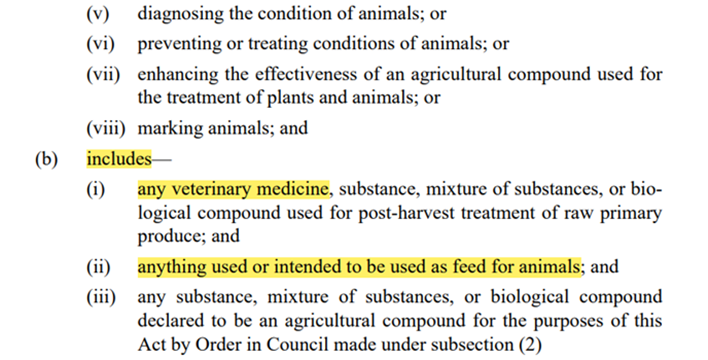 Figure 1a. Excerpt from Section 2(1) of the ACVM Act
 Figure 1b. Excerpt from Section 2(1) of the ACVM ActClasses of ACVM relevant to animals include the following as underlined in yellow:
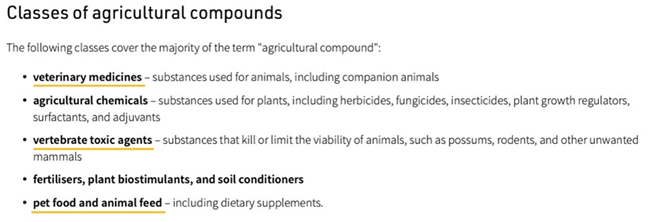 Figure 2. Excerpt from MPI webpage on “What is an ACVM” [2]
The ACVM (Exemptions and Prohibited Substances) Regulations 2011 [3] describe exemptions and prohibitions in relation to compounds and products covered under the ACVM jurisdiction. Under these regulations, Schedule 2 includes a list of agricultural compounds that can be imported, manufactured, sold, or used as agricultural compounds without registration. This exemption includes animal feed and other substances defined as Oral Nutritional Compounds (ONCs).

Figure 3a. Excerpt from Item 22 of Schedule 2 on agricultural compounds exempted from registration
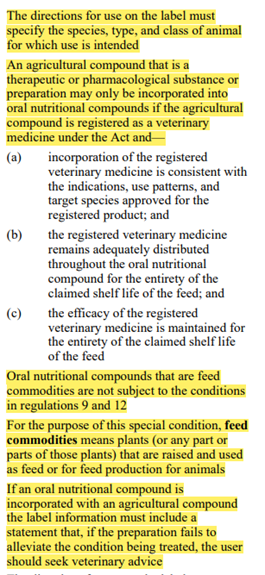 Figure 3b. Excerpt from Item 22 of Schedule 2 on conditions related to the exemption
The above conditions mean that any product that includes a therapeutic/pharmacological substance that is then incorporated into an ONC is not exempt from registration of the former component.
Oral Nutritional Compounds (ONCs) are defined as follows:
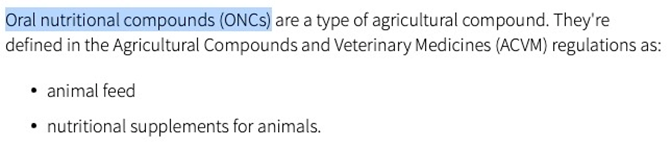
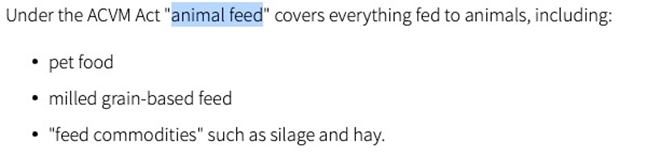


Figure 4a. Excerpt from MPI webpage on 'Defining pet food, animal feed, and nutritional supplements [4]
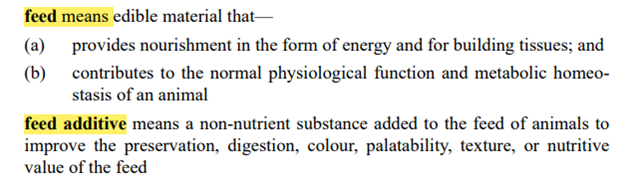
Figure 4b. Excerpt from Regulation 3 of the ACVM (Exemptions and Prohibited Substances) Regulations 2011
At the ingredient level, there is no positive list of permitted ingredients for ONCs. The Regulations [3] have a list of substances that are not permitted in any ACVM product. Section 8B of the Act permits for publication of a list of substances considered to be Generally Recognised As Safe (GRAS) that are permitted for use as or in an agricultural compound, and therefore need not be registered. Such a register [5] was previously published and is still applied in Australia for exempt (END) product ingredients, but this register no longer applies in New Zealand [6]. Instead, the 'general fit for purpose' (Regulation 7) requirements apply.
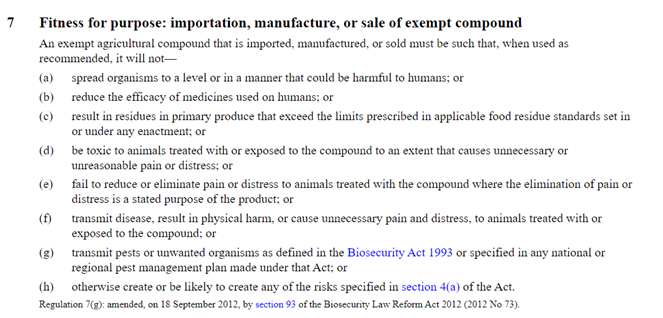
Figure 5. Excerpt from Regulation 7 of the ACVM (Exemptions and Prohibited
Substances) Regulations 2011The MPI has published a Notice which outlines the requirements for agricultural compounds which are exempt from registration [7] and also a guideline on obligations under the Act [8]. Both of these documents provide useful information for manufacturers of end-use products. Companies are able to seek advice from the MPI about the status of their products under the Act in a Class Determination against the exempt categories of Schedule 2 of [3]. The class determination service can be used to find out whether a Trade Name Product (end-use product) requires registration before it can be imported, manufactured, sold, or used in New Zealand. The company can opt instead to undertake its own assessment (self-determination). Information and forms are available on the MPI website [9].
In summary:
- Pet food and animal feed are 'ONCs' that are considered ACVM and therefore must comply with the Act [1]
- As ONCs, these are authorized under the Act via an exemption from registration, under the Regulations [3]
- An ONC is not exempt from registration if it falls under any of the following cases which then likely require it to be registered as a veterinary medicine
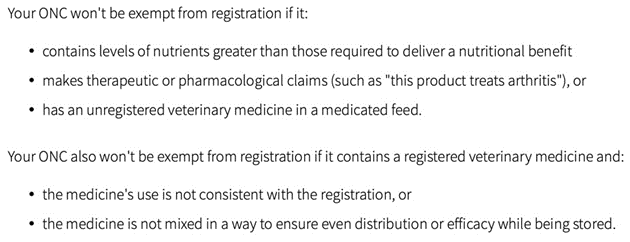
Figure 6. Excerpt from MPI webpage on 'Requirements for pet food, animal feed,
and nutritional supplements [10]- Irrespective of whether the finished product is an ONC or is not excluded from the registration requirements of the MPI, the permitted use of an ingredient such as pea protein would be considered to be the same. As such, the ingredient is not expected to be therapeutically active but instead, functions as a nutritional component of the animal feed or pet food.
2. Permitted Use of Pea Protein in Animal Feed/Pet Food
The pea protein ingredient is permitted for use in both animal feed and pet food. While there is no positive list of ingredients allowed to be used in ONC products, pea protein is not on the prohibited list from the Regulations.
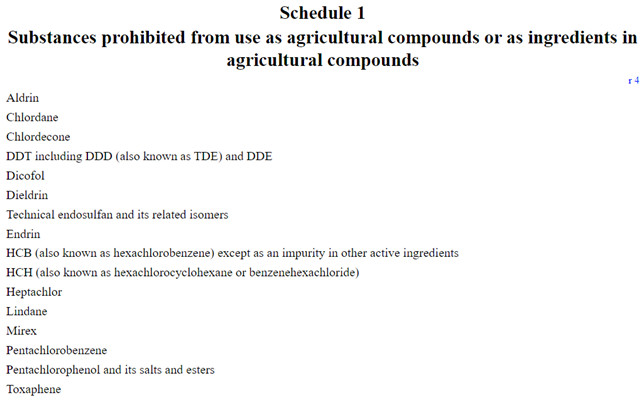
Figure 7. Excerpt from Schedule 1 of ACVM (Exemptions and Prohibited Substances)
Regulations 2011In addition, pea (scientific name: Pisum sativum) did not appear in the list of plants not to be used in oral and topical goods from Schedule 3 in a superseded version of the Regulations [11]. Changes to the Regulations were made, including the removal of Schedule 3 (see Figure 8), and now the 'general fit for purpose' (Regulation 7) applies (see Figure 5).
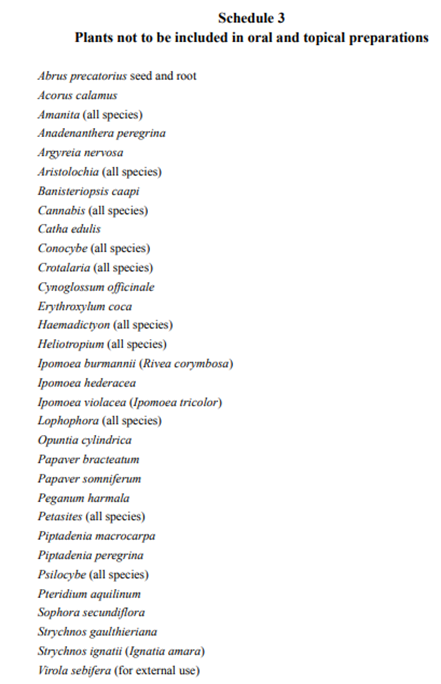
Figure 8. Excerpt from Schedule 3 of ACVM (Exemptions and Prohibited Substances)
Regulations 2011 (old version, now rescinded)Pea protein is a substance of plant origin that is edible by an animal. It is also noted on the provided product specifications that the ingredient complies with the AAFCO and European Union regulations. Therefore, there is no impediment to the use of pea protein for pet foods and animal feed in New Zealand.
No maximum limit for the use of pea protein has been defined for New Zealand. It would be reasonable to apply any suitable limits from relevant overseas jurisdictions. Alternatively, the upper limit could be set based on the technological function of the pea protein in the finished product, for example as a protein source or as a diluent or carrier.
3. Applicable Specifications for Pea Protein (Local and/or International Standards)
There are no local specifications for the pea protein. New Zealand does not mandate that ingredients used in animal feed and pet food need to meet the standards required for human foods, only that they meet the 'fit for purpose' test. The use of any of the international standards relevant to the product use, such as FAMI-QS (Feed Additives and Pre-mixtures Quality System), would be appropriate. Alternatively, any other recognized international standard could be used.
4. Legal Name of the Pea Protein on Business-to-business (B2B) and Business-to-consumer (B2C) labels
For B2B product labeling, the name 'pea protein' would be the most appropriate.
For B2C labels for end-use products (ONCs: pet food and animal feed), only the active ingredients have to appear on product labels (see Figure 9). If the pea protein is being used as an active ingredient, then the name 'pea protein' on the ingredient listing would be suitable for B2C labels. Note that there is no restriction on including the name in the ingredient list on products where the pea protein is not being used as an active ingredient.
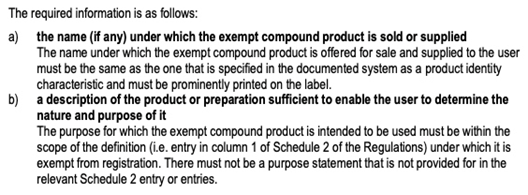
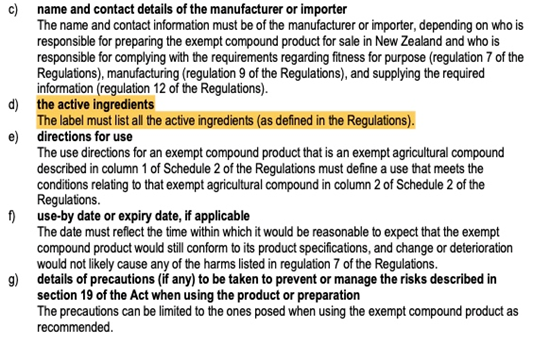
Figure 9a. Excerpt from Section 2.1.2(2) of the ACVM Notice: Agricultural Compounds Exempt from Registration. Requirements for conditions of exemption [7]

Figure 9b. Excerpt from Section 3 of the ACVM (Exemptions and Prohibited
Substances) Regulations 2011 [3]
Conclusion
- In New Zealand, pea protein is permitted as an ingredient for use in pet food and animal feed. The majority of the end-use products are regulated as Oral Nutritional Compounds (ONCs). These products do not require registration with the regulator, the MPI, provided they comply with the requirements set out in the Regulations [3]. These are summarized in Section 1.
- The use of pea protein is based on the absence of any prohibition since there is no positive list of ingredients used in ONC products. In addition, pea protein is a substance of plant origin that is edible by an animal.
- There are no maximum limits for use and no local specifications for pea protein. The amount used should be based on the amount required to fulfill whichever technological use the pea protein is intended to perform in the end-use product. Any internationally recognized specifications relevant to the use (i.e. in animal feed or pet food) would be appropriate to apply in New Zealand.
- The name 'pea protein' is suitable for both B2B and B2C labels. Only active ingredients are required to be listed on labels for ONC products. However, this does not restrict the manufacturer of animal feed or pet food from including pea protein on the list of ingredients.
5. References
1. Agricultural Compounds and Veterinary Medicines Act 1997
https://www.legislation.govt.nz/act/public/1997/0087/latest/whole.html#DLM414583
2. MPI webpage ‘What is an ACVM’
https://www.mpi.govt.nz/agriculture/agricultural-compounds-vet-medicines/what-acvm/
3. ACVM (Exemptions and Prohibited Substances) Regulations 2011
https://www.legislation.govt.nz/regulation/public/2011/0327/latest/whole.html#DLM3982848
4. MPI webpage 'Defining pet food, animal feed, and nutritional supplements'
5. Determination under section 8B of New Zealand’s Agricultural Compounds and Veterinary Medicines Act 1997 as existing on 5 March 2015.
6. MPI webpage '(ACVM) registers and lists'
https://www.mpi.govt.nz/agriculture/agricultural-compounds-vet-medicines/acvm-registers-and-lists/
7. ACVM Notice: Agricultural Compounds Exempt from Registration. Requirements for conditions of exemption, 16 July 2020
8. ACVM guideline (July 2020) - Obligations under the ACVM Regulations Statutory obligations for agricultural compounds exempt from registration under ACVM (Exemptions and Prohibited Substances) Regulations 2011
9. MPI webpage 'Class determinations and self-determinations under the ACVM Act 1997'
10. MPI webpage 'Requirements for pet food, animal feed, and nutritional supplements'
11. ACVM (Exemptions and Prohibited Substances) Regulations 2011. OLD VERSION, now rescinded
https://www.legislation.govt.nz/regulation/public/2011/0327/20.0/whole.html#DLM3982848
Was this article helpful?