
Regulatory Assessment for Use of Xylanase in Food
- 2 Mins to read
- DarkLight
Regulatory Assessment for Use of Xylanase in Food
- 2 Mins to read
- DarkLight
Article summary
Did you find this summary helpful?
Thank you for your feedback
Xylanase in Food
Malaysia - August 2023

This section provides a regulatory assessment for the use of Xylanase in Food in Malaysia.
1. Regulatory Status of Xylanase for Use in Foods
In Malaysia, food products and their ingredients must comply with the Malaysia Food Regulations 1985 and its amendments [1, 2].
According to Regulation 25, enzymes are classified as food conditioners with the following definition:
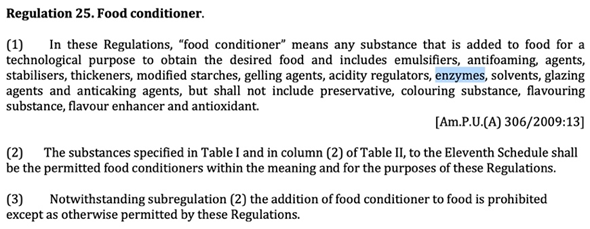
Figure 1. Excerpt from Regulation 25 of the Malaysia Food Regulations 1985
Section 4 of the Eleventh Schedule of the Food Regulations provides a list of enzymes permitted as food conditioners in Malaysia as shown below:
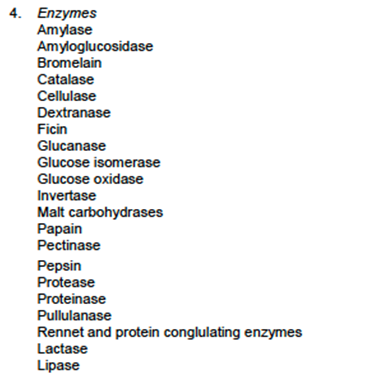
Figure 2. Excerpt from Schedule 11 of the Malaysia Food Regulations 1985
Xylanase is currently not in the above permitted list, therefore, in principle, it should not be present in food products as part of the product formulation.
It is possible to apply for the inclusion of Xylanase in the permitted list. However, it involves applying for amendments of Food Regulations, which may take more than 2 years.
2. Permitted use of Xylanase in the manufacturing process of dextrose monohydrate for use in foods
The standard for Dextrose monohydrate can be found in Regulation 122, which prescribes the definition, finished product specification, and composition (permitted use of preservatives).
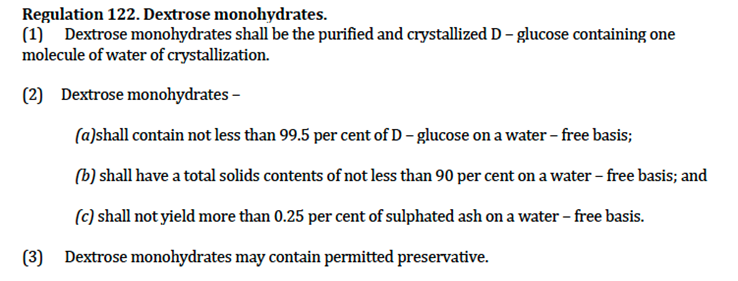
Figure 3. Excerpt from Regulation 122 of the Malaysia Food Regulations 1985
The above regulation does not specify the manufacturing requirements. This implies that the company can apply any appropriate manufacturing/processing method, as long as the specifications stated in Regulation 122 are met.
Enzymes are commonly used as ‘processing aids’ in food production, and for such purposes, the Malaysia Food Regulations do not provide an exhaustive list of permitted processing aids [3]. In principle, substances used as processing aids shall conform to the CODEX Guidelines on Substances Used as Processing Aids (CAC/GL 75-2010) [4].
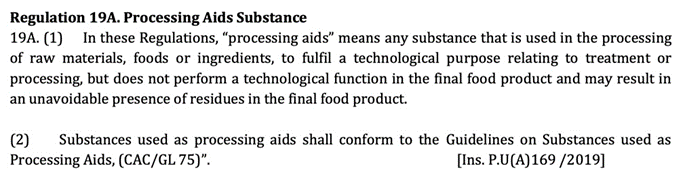
Figure 4a. Excerpt from Regulation 19A of the Malaysia Food Regulations 1985
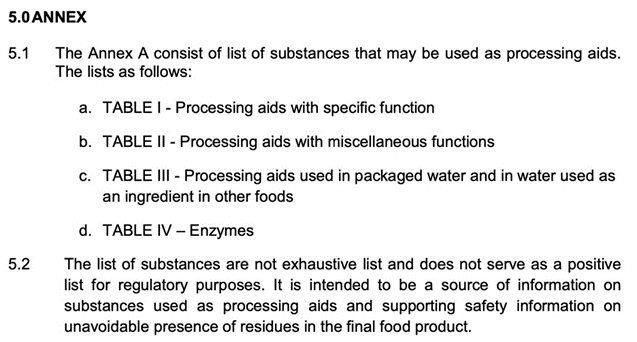
Figure 4b. Excerpt from Clause 5 of the Malaysia Guidelines on Safe Use of Processing Aids [3]
Specific for the intended use of Xylanase in the manufacturing process of dextrose monohydrate, it is possible provided the following conditions are met:
- It is used as a processing aid, under conditions of good manufacturing practice (GMP) and will be removed towards the end of the manufacturing process. Any unavoidable presence of residue in the final product should not be high enough to perform a technological function in the product. In addition, any derivative of the substance remaining in the food should be reduced to the extent reasonably achievable and should not pose any health risk.
- It should be food grade and ideally conform to the Joint FAO/WHO Expert Committee on Food Additives (JECFA) specifications, if available. For example, Xylanase produced from Bacillus Subtilis [5].
Conclusion
- Xylanase is not listed in the Eleventh Schedule’s list of permitted enzymes, therefore, in principle, it should not be part of the finished product composition.
- Notwithstanding, it is possible to use Xylanase as a processing aid in the manufacturing process of Dextrose monohydrate, provided it is removed at the end of the manufacturing process, and the amount of any unavoidable residue should not be high enough to perform a technological function or pose any health risk.
- It is advisable to use only food-grade Xylanase, which conforms to the applicable specifications of identity and purity such as JECFA specifications.
3. References
1. Malaysia Food Regulation 1985 and the Schedules
http://fsq.moh.gov.my/v6/xs/page.php?id=72
2. Food (Amendment) (No 4) Regulations 2020
http://fsq.moh.gov.my/v6/xs/page.php?id=38
3. Malaysia Guidelines on the Safe Use of Processing Aids
http://fsq.moh.gov.my/v6/xs/page.php?id=441000631
4. CODEX Guideline on Substances used as Processing Aids
5. JECFA Specifications Xylanase from Bacillus subtilis expressed in Bacillus subtilis
https://www.fao.org/fileadmin/user_upload/jecfa_additives/docs/Monograph1/Additive-489.pdf
Was this article helpful?