
Recyclability Logos on Product Labels for Food and Beverages
- 5 Mins to read
- DarkLight
Recyclability Logos on Product Labels for Food and Beverages
- 5 Mins to read
- DarkLight
Article summary
Did you find this summary helpful?
Thank you for your feedback
Recyclability Logos for Foods and Beverages
Brazil

The below version control table serves to document all updates made to the report. The purpose is to ensure the information is always accurate and up-to-date.
| Version Number | Content Creation Date | Publishing Date | Section(s) Updated & Reason(s) for Update |
|---|---|---|---|
| V0 | May 2nd, 2023 | 18 January 2024 | N/A (new report) |
Disclaimer
At RegASK, we are committed to providing our clients with the most up-to-date and accurate information on regulatory requirements and compliance. To ensure the highest level of accuracy and relevance, we regularly review and update our e-guidebooks at least twice per year to reflect the latest regulatory developments in the market. (Please contact us if you wish to activate this feature.) In the meantime, our RegAlerts service is designed to keep our clients notified of any regulatory updates that may impact their business.
1. General overview of recyclability logos on packaging for food and beverage products
In Brazil, recycling of packaging, including those for the food industry is governed by Law Nº 12.305/2010 [1] instituting the National Solid Waste Policy. This law and its Regulation [2] provide the principles for solid waste disposition, objectives, and instruments, as well as the guidelines for the integrated management of solid waste, including hazardous waste, the responsibilities of the private sector and public authorities, and the applicable economic instruments. According to this policy, companies should make efforts to implement recycling plans together with the public authorities. However, the law nor its regulation do not establish specific rules on the recycling labeling of packaging.
Although there are no mandatory rules for the use of recyclability logos on packaging for food and beverage products, the Brazilian Technical Standards Association (ABNT) has issued voluntary standards that can be observed. These are the following:
- ABNT NBR 13230:2008 [3]. Recyclable plastic containers and packing. This Standard establishes identification symbols for thermoplastic resins, used in plastic packaging and containers manufacturing to support selection and recycling of materials, according to their composition.
- ABNT NBR 15792:2010 [4]. Packaging - Recycling rate - Definition and method of calculation. This Standard establishes definitions and the method for calculating the recycling rate of post-consumer packaging. This Standard also establishes the methods of calculating rates of organic and energy recovery.
- ABNT NBR 16182:2013 [5]. Packaging — Symbology for orientation for selective disposal and materials identification. This Standard defines the symbology for selective packaging disposal, except those that by law require a separate collection, and symbology identification of packaging materials, favoring its post-consumer destination.
It is worth mentioning that ABNT standards are not free of charge and if there is any interest they must be purchased at the ABNT’s store. On average, the above-mentioned standards have a cost between 15 and 25 USD. The interested company must be local since, for registration in the ABNT’s store, tax information is required.
2. Recyclability logos used for the product categories
2.1 List and define the applicable recyclability logos
ABNT NBR 16182:2013 [5] establishes the symbology for orientation for selective disposal and material identifications. However, no definition for the applicable logo is provided by the regulation. The logos are the following:
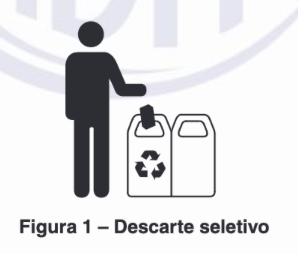
Selective disposal – this logo can be used if the packaging materials are recyclable.
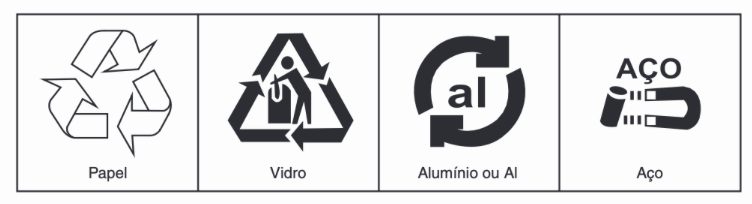
Material identification – these logos can be used for specific materials that are recyclable.
English Translation: 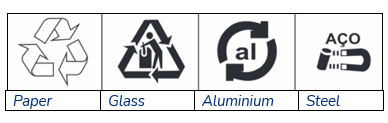
The corresponding identification symbols for thermoplastic resins are established in ABNT NBR 13230:2008 [3] as follows:
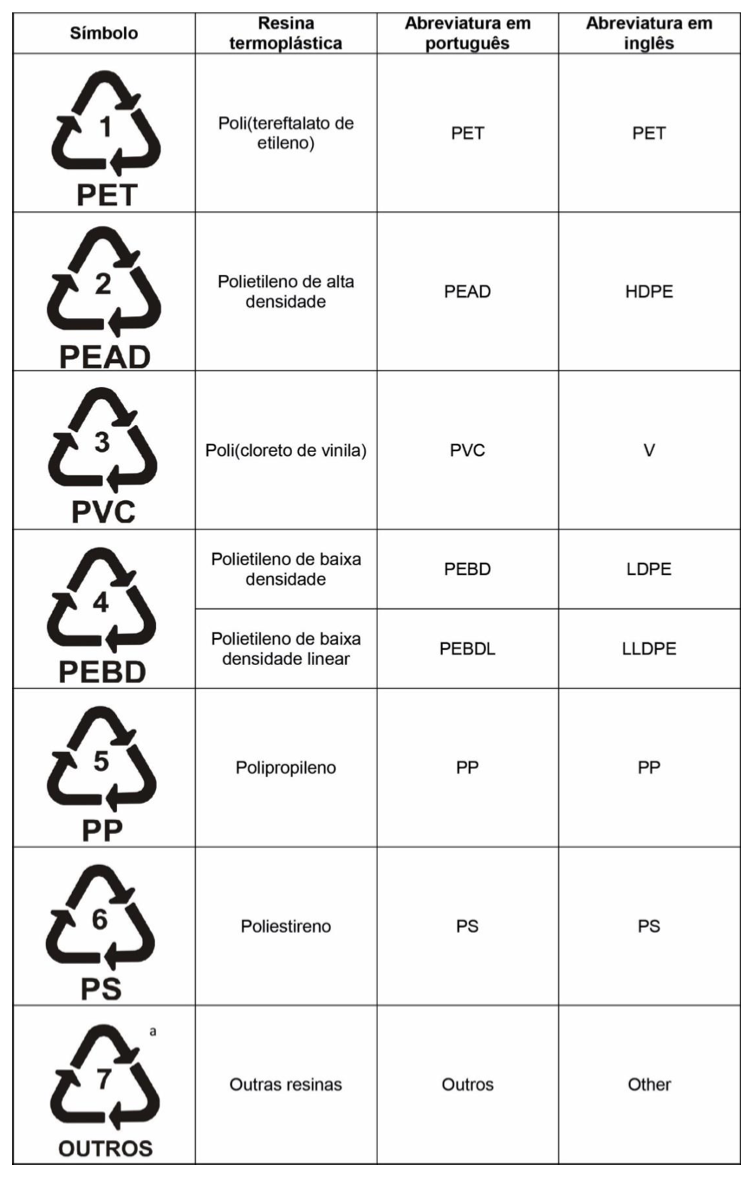
English Translation:
Symbols | Thermoplastic Resins | Abbreviation in Portuguese | Abbreviation in English |
| Polyethylene terephthalate | PET | PET |
| High-density polyethylene | PEAD | HDPE |
| Polyvinyl chloride | PVC | V |
| Low-density polyethylene | PEBD | LDPE |
Linear low-density polyethylene | PEBDL | LLDPE | |
| Polypropylene | PP | PP |
| Polystyrene | PS | PS |
| Other resins | Outros | Other |
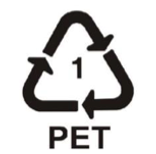
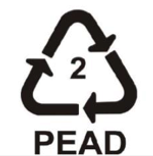
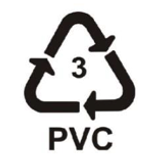
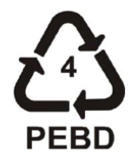
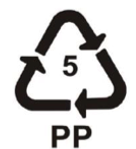
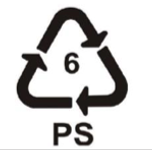
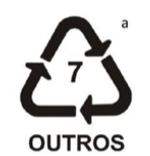
These logos are used for the specific recyclable plastic materials.
It is worth mentioning that there is no national approval or certification required for all these recyclability logos. The use of voluntary logos or information will always be the responsibility of the company.
2.2 Specific labeling requirements for recyclability logos, if any
The health authority in charge of food control, ANVISA, has clarified that in relation to the use of recyclability and material identification logos, it does not carry out such verification, as the ABNT standards are not mandatory requirements. However, the use of these logos must be supported by evidence that demonstrates compliance with the requirements established in the standard (packaging certification, etc.). All the voluntary information, including logos, shall be in Portuguese.
In addition, any information described on the food product label shall comply with general food labeling rules, and in the absence of specific rules, such information shall not be contrary to the general labeling principles, i.e. the information on the packaging shall not be confusing or misleading to the true nature of the food.
On the other hand, the Brazilian Packaging Association (ABRE) has issued the Environmental Labelling Guidelines for Packaging [6] which clarify the following points on recycling packaging for industries:
- The term “recyclable” shall be used as an attribute of packaging that, by means of a specific system, can be effectively diverted from the final destination of urban solid waste and processed and transformed into raw material for other production processes.
- For a package to be labeled as "recyclable”, it is fundamental that a collection and processing infrastructure exists. Self-declaration as recyclable should be limited to Brazilian regions that are already prepared for this. There are currently 25 municipalities in Brazil already implemented [7].
- For products with national distribution, it is recommended to add a disclaimer or to include the company’s contact for further information, that communicates the effective availability of recycling and informs about the disposal options available in each region.
- The term “recyclable” should not be used for packaging that is only recyclable in bench tests/pilot trials, but rather for items that are already effectively being recycled.
Conclusion
- In Brazil, there are recycling guidelines but no specific rules on the recycling labeling of packaging and on the use of recyclability logos.
- The use of recyclability logos in Brazil is voluntary per the applicable voluntary standards.
- There is no national approval or certification required for these recyclability logos.
- The use of recycling logos should be restricted to those Brazilian regions where recycling plans are already implemented.
3. References
1. Law Nº 12.305/2010 instituting the National Solid Waste Policy
http://www.planalto.gov.br/ccivil_03/Leis/L9782.htm
2. Regulation of Law Nº 12.305/2010. National Solid Waste Policy
https://www.planalto.gov.br/ccivil_03/_Ato2019-2022/2022/Decreto/D10936.htm
3. ABNT NBR 13230:2008. Recyclable plastic containers and packing
4. ABNT NBR 15792:2010. Packaging - Recycling rate - Definition and method of calculation
5. ABNT NBR 16182:2013. Packaging - Symbology for orientation for selective disposal and materials identification
6. Environmental Labelling Guidelines for Packaging
http://www.abre.org.br/wp-content/uploads/2012/07/cartilha_rotulagem.pdf
7. Selective 2023: Recyclers publishes list with 25 municipalities classified for Qualification Group
Was this article helpful?