
Overview of Packaging Sustainability Regulations
- 2 Mins to read
- DarkLight
Overview of Packaging Sustainability Regulations
- 2 Mins to read
- DarkLight
Article summary
Did you find this summary helpful?
Thank you for your feedback
Overview of Packaging Sustainability Regulations
Japan

The below version control table serves to document all updates made to the report. The purpose is to ensure the information is always accurate and up-to-date.
| Version Number | Content Creation Date | Publishing Date | Section(s) Updated & Reason(s) for Update |
|---|---|---|---|
| V0 | 25 March 2024 | 28 March 2024 | N/A (new report) |
Disclaimers
A) At RegASK, we are committed to providing our clients with the most up-to-date and accurate information on regulatory requirements and compliance. To ensure the highest level of accuracy and relevance, we regularly review and update our e-guidebooks at least twice per year to reflect the latest regulatory developments in the market. (Please contact us if you wish to activate this feature.) In the meantime, our RegAlerts service is designed to keep our clients notified of any regulatory updates that may impact their business.
B) The contents on this platform are exclusively intended for the use of RegASK and its authorized representatives. All materials herein are confidential and the sole property of RegASK. Any reproduction, distribution, or display of this content to others is strictly prohibited without the express written consent of RegASK.
1. Labeling Requirements
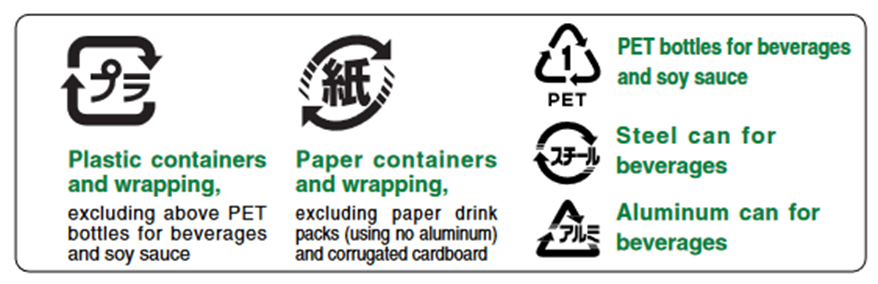
The Act on the Promotion of Effective Utilization of Resources (Act No. 48 of 1991) [1] mandates food business operators to display an appropriate recycle mark on containers and packaging of food products. If the packaging of products is made from plastics, the plastic mark (presented below) must be displayed on the surface of the plastic packaging.
In the case of imported products, it is the importer/distributor who owes this responsibility.
Additional information can be seen in the English brochure published by the Ministry of Economy, Trade and Industry (METI) [2]:
2. Prohibited Use of Packaging
Currently, there is no regulation or upcoming regulatory change that specifically bans the use of single-use plastics in Japan. However, the Japanese government implemented several laws to reduce waste plastics while encouraging the reuse and recycling of plastics.
For example, below is an overview of 1 law that would have high relevance for "Prepared Frozen Foods":
The Act on Recycling Containers and Packaging (Act No. 102 of 1995) [3] is intended to “ensure proper management of waste and effective use of resources” and sets out rules for containers and packaging made from aluminum, steel, glasses, papers, and plastics. This Act mandates (i) business operators that manufacture containers and packaging and (ii) those that sell or import products with containers and packaging to recycle waste containers and packaging depending on the amount that they manufacture or use. This obligation can be fulfilled by paying a recycling fee to the Designated Organization (The Japan Containers and Packaging Recycling Association) which will arrange necessary recycling work on their behalf.
In the case of imported products, it is the importer/distributor of the products who owes this responsibility.
Additional information can be seen in the English brochure published by the METI [2].
3. References
1. Act on the Promotion of Effective Utilization of Resources (Act No. 48 of 1991) (in English)
https://www.japaneselawtranslation.go.jp/ja/laws/view/3819#je_ch7
2. “Containers and Packaging Recycling Law” (in English)
https://www.jcpra.or.jp/Portals/0/resource/association/pamph/pdf/law2003_eng.pdf
3. Act on Recycling Containers and Packaging (Act No. 102 of 1995) (in Japanese)
https://elaws.e-gov.go.jp/document?lawid=407AC0000000112
Was this article helpful?