
Overview of Packaging Sustainability Regulations
- 5 Mins to read
- DarkLight
Overview of Packaging Sustainability Regulations
- 5 Mins to read
- DarkLight
Article summary
Did you find this summary helpful?
Thank you for your feedback
Overview of Packaging Sustainability Regulations
France

The below version control table serves to document all updates made to the report. The purpose is to ensure the information is always accurate and up-to-date.
| Version Number | Content Creation Date | Publishing Date | Section(s) Updated & Reason(s) for Update |
|---|---|---|---|
| V0 | 08 April 2024 | 20 April 2024 | N/A (new report) |
Disclaimers
A) At RegASK, we are committed to providing our clients with the most up-to-date and accurate information on regulatory requirements and compliance. To ensure the highest level of accuracy and relevance, we regularly review and update our e-guidebooks at least twice per year to reflect the latest regulatory developments in the market. Please contact us if you wish to activate this feature. In the meantime, our RegAlerts service is designed to keep our clients notified of any regulatory updates that may impact their business.
B) The contents on this platform are exclusively intended for the use of RegASK and its authorized representatives. All materials herein are confidential and the sole property of RegASK. Any reproduction, distribution, or display of this content to others is strictly prohibited without the express written consent of RegASK.
1. Overview
In addition to the EU requirements for packaging sustainability, the below applies to France:
The main French legal provisions for reducing packaging waste are included in the Environment Code [1]:
- Anti-waste AGEC law [2] provides several targets, including the phase-out use of single-use plastic and better consumer information.
- Extended Producer Responsibility (EPR) scheme [3] applies to several sectors, such as household packed products since 1992 with Citeo [4] as ERP organization, and packed products sold to catering since 2023 (e.g. sold to restaurants or fast food) with Citeo Pro [13] as ERP organization.
2. Mandatory Logos Relating to Sorting Packaging Waste
Food products sold to consumers in France (covered by household packed products EPR) must provide a specific logo relating to waste sorting on their labels. This consists of the Triman logo and the Info-Tri (sorting information) as defined in Article L541-9-3 of the Environment Code [1]. It is mandatory for ALL packaging of products (regardless of whether it can be recycled or not) except for glass drink packaging. In the future, other EPRs, such as packed products sold to catering, may be required to provide these mandatory logos on their labels [3].
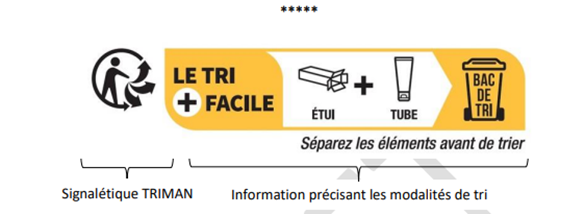
The Triman logo and the Info-Tri logos and pictograms are available on the CITEO website [4] after the registration of the business operator. Note that these logos and pictograms have mandatory minimum height sizes depending on the packaging size, and all these parameters are presented in guidance available on the CITEO website once the business operator is registered.
3. Mandatory Dematerialized Environmental Information
Producers, importers, or those responsible for placing waste-generating products on the market are required to provide consumers with "product sheets of environmental qualities and characteristics" in a dematerialized manner and accessible free of charge (e.g. website), as per Article 13 of the French AGEC law [1] and its implementing Decree 2022-748 [5].
It applies to producers whose turnover exceeds 50 million euros and who market more than 25,000 units. This obligation is planned to be progressively extended to smaller producers until January 1, 2025.
Household packaging (e.g. food packaging) is part of the products affected by this obligation. It needs to include information to consumers about:
- Compostability (uniquely packaging mentioned in the French Order of March 15, 2022, listing packaging and waste compostable [6])
- Presence of recycled material
- Possibility of re-use
- Recyclability
The French Environment Ministry has published a Question and Answer on this topic [7].
4. Environmental Claims
If the products provide environmental claims, the claims must be compliant with the requirements of article 13 of the law AGEC [2]:
- Plastic products and packaging that can only be composted in an industrial unit cannot be labeled "compostable".
- Plastic products and packaging that can be composted in a domestic or industrial composting facility must bear the words "Do not dispose of in the natural environment".
- It is forbidden to use the terms "biodegradable", "environmentally friendly" or any other equivalent wording on a product or packaging.
- When the recycled status of a product is mentioned, the percentage of recycled materials actually incorporated is specified.
In addition, as for all types of claims, it is forbidden for a claim to mislead the consumer. For instance, the claim "without bisphenol A" is not authorized because food contact packaging containing bisphenol A is forbidden on the French market.
The authority DGCCRF has published a guidance document for the use of Environmental claims [8].
5. Prohibited Use of Packaging
Single-use packaging
For all types of packaging, the latest priority of the French government is to encourage business operators to re-use, reduce, and recycle packaging, called “3R”:
- Article 17 of French AGEC Law [2] and Decree no. 2022-507 [9] define the minimum proportion of reused packaging to be marketed annually in France which will enter into application from 1st January 2023.
- Article 7 of French AGEC Law [2] and its implementing Decree “3R” N° 2021-517 [10] set the objective of achieving the end of the marketing of single-use plastic packaging by 2040, by setting targets for the re-use, reduction, and recycling of plastic packaging over the period 2021-2025.
The above targets are encouraged through the EPR scheme (for instance, the Green Dot tax is reduced for packaging integrating recycled content), but the French government analyses more provisions to be implemented in the future to achieve the targets [11].
Single-use plastic items and packaging
Specific single-use plastic items are forbidden by French AGEC Law [2]:
- Since January 1, 2021, among them, straws, single-use cutlery, coffee mixer sticks, tops of cups, tops of boxes made of expanded polyester, sticks for steak, sticks for balloons, confetti, all oxo-degradable plastic products. Since January 1, 2022, among them, non-biodegradable tea bags, all oxo-degradable plastic packaging and bags.
- From January 1, 2025, packaging made wholly or partly of styrenic polymers or copolymers, which cannot be recycled, will be banned.
The French authority has published a Question and Answer to reduce plastic use. [12]
6. Forbidden Component - Food Contact
Please refer to Section 8.5 - Food Contact Materials - of the "General Foods" guidebook for France.
7. References
1. Environment code
2. The French law of February 10, 2020 “AGEC”
https://www.legifrance.gouv.fr/loda/id/LEGIARTI000041554658/2020-02-12/
3. Environment Minister -Q&A of EPR
https://www.ecologie.gouv.fr/cadre-general-des-filieres-responsabilite-elargie-des-producteurs
4. CITEO website for registration
https://www.citeo.com/why-become-citeo-client
5. Decree no. 2022-748 of April 29, 2022 on consumer information on the environmental qualities and characteristics of waste-generating products.
https://www.legifrance.gouv.fr/jorf/id/JORFTEXT000045726094?isSuggest=true
6. Order of 15 March 2022 listing packaging’s and waste compostable
https://www.legifrance.gouv.fr/jorf/id/JORFTEXT000045393787
7. Environment Minister -Q&A on Mandatory dematerialized environmental information
8. DGCCRF guideline on environmental claims
9. Decree 2022-507
https://www.legifrance.gouv.fr/jorf/id/JORFTEXT000045536300
10. Decree 2021-517 “3R”
https://www.legifrance.gouv.fr/loda/id/JORFTEXT000043458675/2021-05-02/
11. Governmental analysis to reduce household packaging
https://www.vie-publique.fr/en-bref/292820-emballages-menagers-quels-cadres-dorganisation
12. Environment Minister – Q&A on fight against plastic pollution
https://www.ecologie.gouv.fr/lutte-contre-pollution-plastique
13. Citeo Pro
Was this article helpful?