
Overview of Packaging Sustainability Regulations
- 8 Mins to read
- DarkLight
Overview of Packaging Sustainability Regulations
- 8 Mins to read
- DarkLight
Article summary
Did you find this summary helpful?
Thank you for your feedback
Overview of Packaging Sustainability Regulations
EU

The below version control table serves to document all updates made to the report. The purpose is to ensure the information is always accurate and up-to-date.
| Version Number | Content Creation Date | Publishing Date | Section(s) Updated & Reason(s) for Update |
|---|---|---|---|
| V0 | 05 April 2024 | 17 April 2024 | N/A (new report) |
Disclaimers
A) At RegASK, we are committed to providing our clients with the most up-to-date and accurate information on regulatory requirements and compliance. To ensure the highest level of accuracy and relevance, we regularly review and update our e-guidebooks at least twice per year to reflect the latest regulatory developments in the market. Please contact us if you wish to activate this feature. In the meantime, our RegAlerts service is designed to keep our clients notified of any regulatory updates that may impact their business.
B) The contents on this platform are exclusively intended for the use of RegASK and its authorized representatives. All materials herein are confidential and the sole property of RegASK. Any reproduction, distribution, or display of this content to others is strictly prohibited without the express written consent of RegASK.
1. Overview
In late November 2022, the EU introduced the draft Packaging and Packaging Waste Regulation (PPWR) repealing Directive 94/62/EC [1] aiming to reduce the environmental impact of packaging materials and foster a circular economy. While the exact legislative details are still being finalized, the final version of the regulation is expected to be officially published by mid-2024, and implementation could start as early as 2025. Key areas of focus include ambitious recycling, reuse targets, and mandatory extended producer responsibility schemes. The proposed targets aim for significant reductions in packaging waste per capita by as much as 5% in 2030, 10% in 2035, and 15% in 2040, across all Member States. However, concerns arise regarding how these targets are calculated, particularly when considering metrics like weight, which may not fully account for recyclability or end-of-life impact.
The EU Packaging Directive 94/62/EC [2] applies to EU-based companies as well as companies importing packaging into the EU. The measures outlined in the regulation apply equally to domestic and imported products.
Post-consumer recycling Material (PCR) is a central concept in the EU Packaging Regulation and plays a crucial role in promoting sustainable practices in the packaging industry.
PCR material is recycled material derived from consumer waste. The EU Packaging Regulation stipulates that by 2030, all plastic-containing packaging must contain a minimum proportion of PCR material. The exact specifications and target proportions for PCR content vary depending on the type of packaging and the materials used. The use of PCR material is a significant step towards a sustainable circular economy. With a clear goal of increasing the proportion of PCR material in packaging, companies are motivated to develop environmentally friendly packaging solutions and improve their recycling practices. The EU Packaging Regulation thus creates incentives for innovation and investments in the circular economy, which can ultimately lead to reduced environmental impacts of the packaging industry.
Extended Producer Responsibility (EPR) [3] is a crucial aspect of the EU Packaging Regulation, which involves the financial participation of manufacturers and distributors of placed on the market packaging. This article aims to cover the costs of collection, sorting, and recycling, while also incentivizing the use of recyclable packaging and PCR. The introduction of environmentally modulated EPR systems will lead to lower fees for eco-friendly packaging, thus driving the development of more sustainable packaging solutions.
Several EPR organizations operate across Europe to facilitate this process, including:
- Der Grüne Punkt (Germany)
- EcoEmbes (Spain)
- Citeo (France)
- FTI (Sweden)
- Afvalfonds Verpakkingen (Netherlands)
- FOST PLUS (Belgium)
- REPAK (Ireland)
- REKOPOL (Poland)
- Sociedade Ponto Verde (Portugal)
- Altstoff Recycling Austrai (Austria)
This financial incentive will make it easier for companies to transition to more environmentally friendly packaging alternatives and make a positive contribution to environmental protection. However, until the EU Packaging Regulation comes into force, the EU Packaging Directive applies, allowing individual EU countries to take measures to reduce the quantity of packaging waste and its environmental impact. This means that there are currently various EPRs for packaging in Europe that must be considered to remain compliant.
The PPWR proposal includes a ban on certain single-use packaging, which will affect some industries, including the food industry, hospitality and gastronomy, and the cosmetics industry.
The ban applies to certain single-use packaging, including:
- Packaging for fresh fruits and vegetables
- Food and beverage packaging in hotels and restaurants
- Small hotel packaging for cosmetic and hygiene items
These measures aim to reduce packaging waste and promote more sustainable packaging choices. The EU Packaging Regulation has the potential to revolutionize how packaging is produced and managed. It will motivate companies to transition to more sustainable solutions and provide consumers with clear labeling of recyclability and PCR content.
2. Labeling Requirements
In the EU, the general principles are laid down for recycling. However, each member state will have variations and different logos/messages and names for their recycling schemes. While specific logos may vary, the overarching message of each recycling scheme is to promote sustainable waste management practices and encourage citizens to participate in recycling efforts to protect the environment.
The Universal Recycling Symbol, also known as the Mobius Loop, symbolizes the cyclical process of reusing and recycling products or materials. It consists of three chasing arrows arranged in a loop, inspired by the Mobius strip. While its use is voluntary, companies that choose to affix the Mobius Loop to their products signal the recyclability of their products or packaging. However, they may be required to provide evidence that their products and packaging are indeed recyclable. This ensures transparency and accountability in promoting recycling efforts.
The significant role that environmental labels on packaging play is informing consumers about product and packaging characteristics. Consumers perceive environmental labels as providing credible and reliable information on environmental quality. This positive perception of environmental labels contributes to enhancing product perception, which could influence their purchasing decisions.
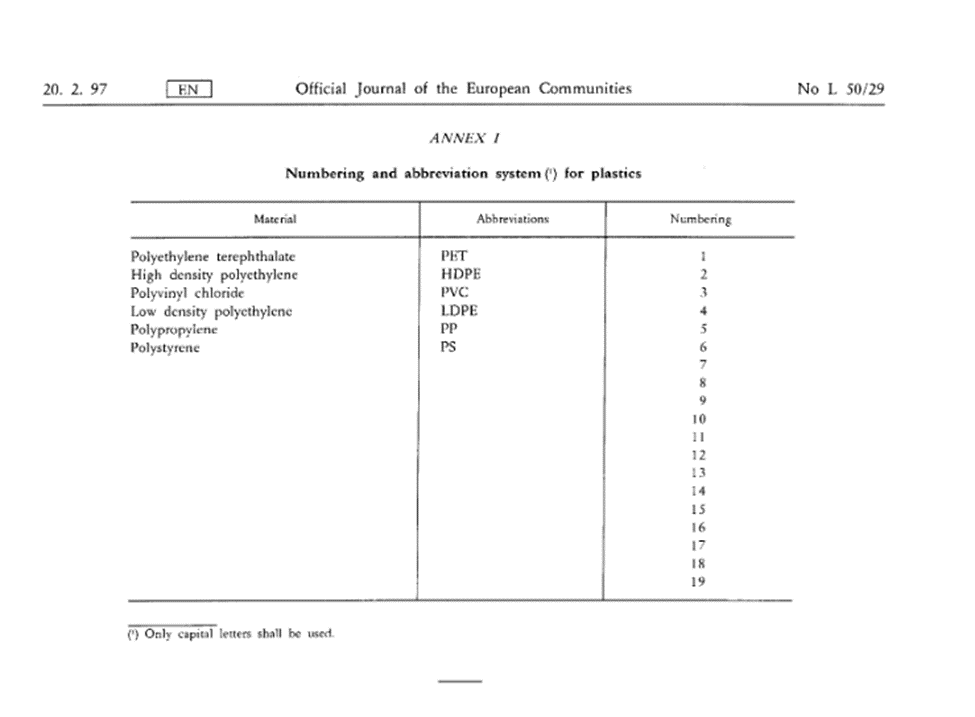
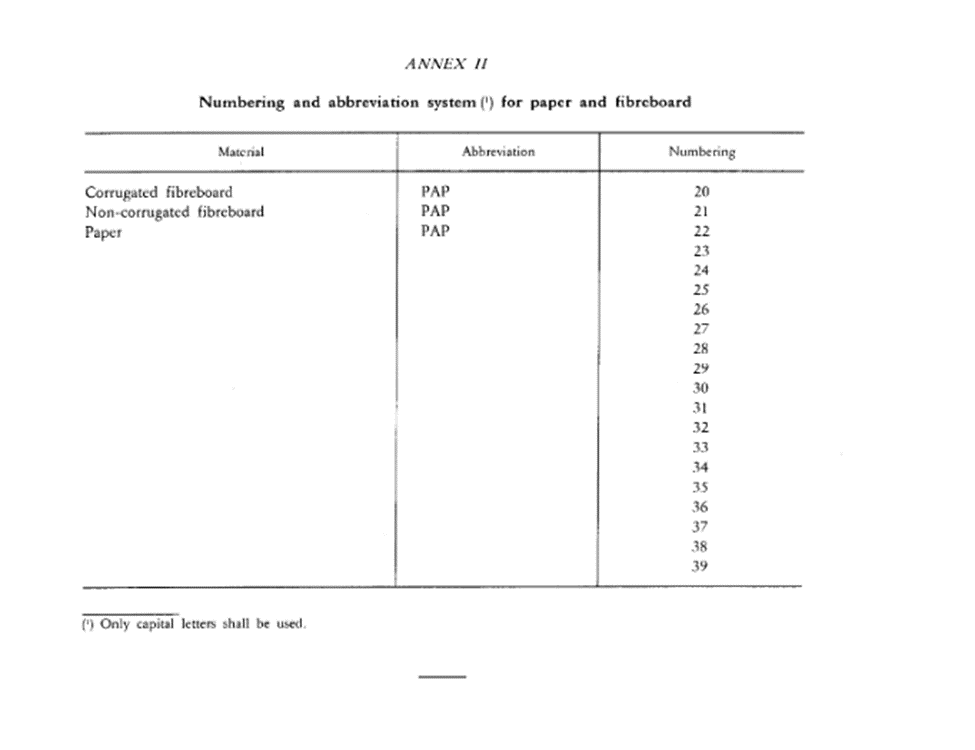
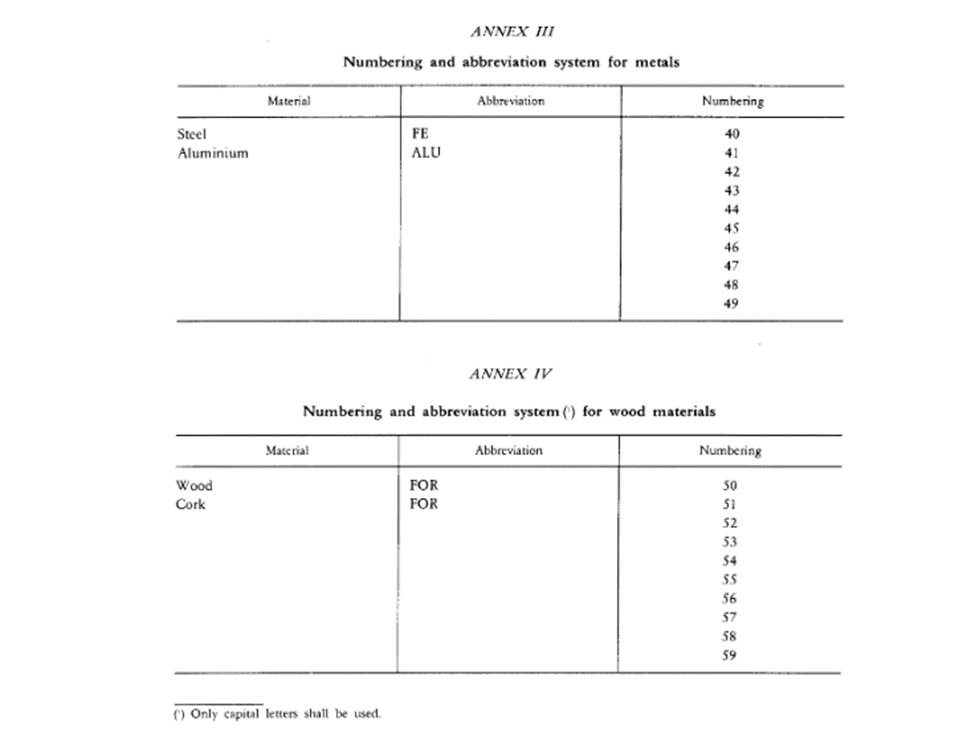
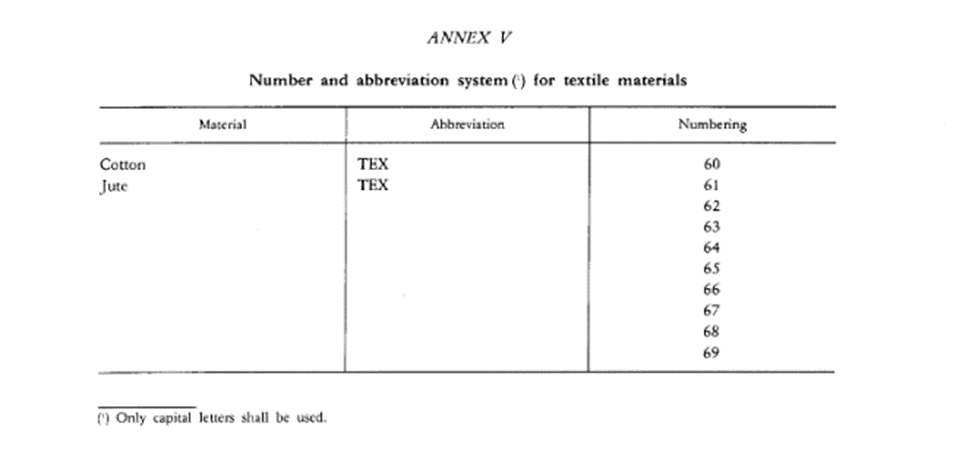
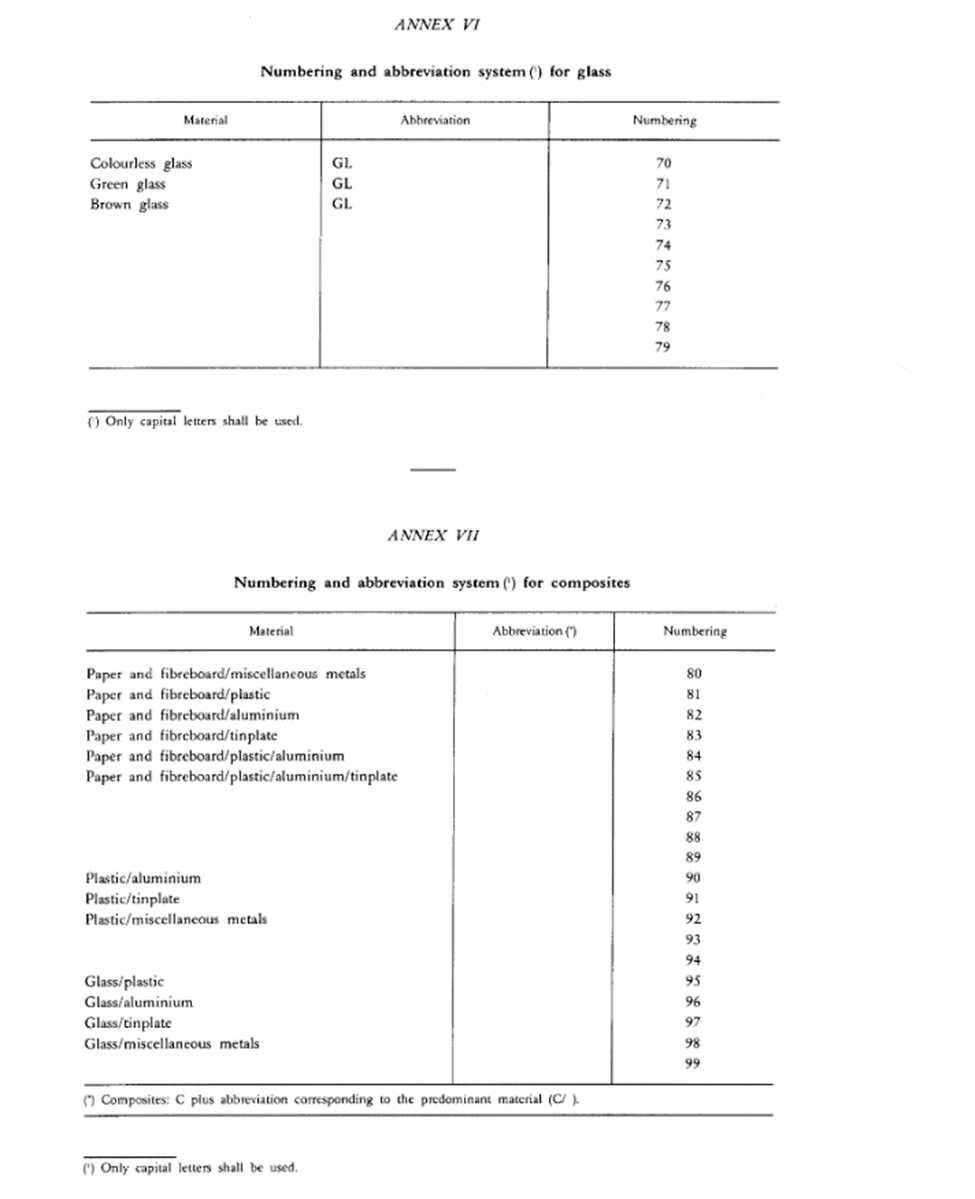
Commission Decision 97/129/EC [4] establishes an Identification System for Packaging Materials, comprising material identification codes for plastics, paper, and other packaging materials. These codes, typically voluntary, consist of abbreviations and numbers indicating the nature of the packaging materials. The primary aim is to facilitate the collection, reuse, and recovery of packaging materials.
The decision's product scope encompasses all packaging and packaging waste regulated by the Packaging and Packaging Waste Directive. This includes various types of packaging materials such as plastic, paper, aluminum, and glass packaging. By providing standardized codes, the decision aims to streamline the management of packaging waste and promote sustainable practices in the packaging industry.
In certain EU countries, like Italy and Bulgaria, the material identification codes established by Commission Decision 97/129/EC have been made mandatory for packaging.
Identification system
Annexes I to VII of the Decision provide the covered categories of packaging material, their abbreviations, and numbering.
Green Dot
 As mentioned previously, the Extended Producer Responsibility (EPR) is an environmental policy that transfers the responsibility for recycling packaging waste from governments to businesses. EU member states must establish EPR schemes for all packaging by 31st December 2024.
Companies can join a Producer Responsibility Organisation (PRO) that will collect, dispose, and recycle waste on their behalf in exchange for a fee. By joining the PRO Europe Member Organization [5], companies earn the right to affix the Green Dot symbol on their packaging.
By using the Green Dot, you are indicating that your packaging waste will be handled by a PRO Europe member organization. The use of Green Dot has become voluntary throughout the EU.
3. Prohibited Use of Packaging
REACH (Registration, Evaluation, Authorization and Restriction of Chemicals) [6] is an EU regulation that governs substances, including chemicals, heavy metals, and pollutants, in most products placed on the EU market, including packaging materials. REACH applies to various packaging materials such as plastic, paperboard, wood, and steel.
Certain substances are restricted by REACH in Annex XVII when used in packaging materials, including Bisphenol P, Dihexyl Phthalate, Cadmium oxide, Boric oxide, and Borate flame. If packaging materials contain excessive amounts of these restricted substances, they cannot be legally imported or sold in the EU market, and non-compliance may lead to heavy fines and product recalls.
Additionally, if products contain substances listed in the Substances of Very High Concern Candidate List (SVHC) [7] at concentrations greater than 0.1%, importers and manufacturers must upload relevant data to the SCIP database [8] and inform clients upon request.
Concerns also extend to food packaging, as certain substances like 4-Nonylphenol, branched and linear, ethoxylated and Dipentyl phthalate (DPP) are on the SVHC Candidate List due to their endocrine-disrupting properties and reproductive toxicity. These substances are commonly found in plasticizers used in polyvinyl chloride (PVC), which is often present in food packaging. Compliance with REACH regulations is crucial for ensuring consumer safety and environmental protection.
4. Control of Single-use Plastics
As presented above, the future Packaging and Packaging Waste Regulation (PPWR) [1] is currently in development and expected to be officially published by mid-2024. One of the measures proposed introduces minimum recycled content “PCR” in plastic packaging from 1 January 2030, and increasing from 1 January 2040. This means that, progressively, the use of single-use plastic packaging will be phased out in the EU.
In addition, while not specific to packaging materials, it’s essential to mention the EU Single-Use Plastics Directive [9] which aims to reduce the impact of certain single-use plastic products on the environment. It bans the sale and use of specific single-use plastic items that are frequently found as litter on European beaches and in oceans. The directive targets products like plastic straws, cutlery, plates, stirrers, cotton buds, and balloon sticks. Additionally, it sets specific measures for the reduction of plastic beverage cups, food containers, and plastic packaging, requiring producers to cover the costs of waste management and cleanup efforts. Furthermore, the directive mandates labeling requirements to inform consumers about the environmental impact of certain products and encourages the development of alternative products made from sustainable materials. The aim is to promote a circular economy, reduce marine pollution, and protect ecosystems.
5. References
1. Proposal REGULATION OF THE EUROPEAN PARLIAMENT AND OF THE COUNCIL on packaging and packaging waste, amending Regulation (EU) 2019/1020 and Directive (EU) 2019/904, and repealing Directive 94/62/EC
EUR-Lex - 52022PC0677 - EN - EUR-Lex (europa.eu)
2. European Parliament and Council Directive 94/62/EC of 20 December 1994 on packaging and packaging waste
Directive - 94/62 - EN - EUR-Lex (europa.eu)
3. Directive (EU) 2018/852 of the European Parliament and of the Council of 30 May 2018 amending Directive 94/62/EC on packaging and packaging waste
Directive - 2018/852 - EN - EUR-Lex (europa.eu)
4. 97/129/EC: Commission Decision of 28 January 1997 establishing the identification system for packaging materials pursuant to European Parliament and Council Directive 94/62/EC on packaging and packaging waste
Decision - 97/129 - EN - EUR-Lex (europa.eu)
EUR-Lex - 02006R1907-20221217 - EN - EUR-Lex (europa.eu)
Candidate List of substances of very high concern for Authorisation - ECHA (europa.eu)
SCIP-Database - ECHA (europa.eu)
9. EU Single-Use Plastics Directive
Single-use plastics – fighting the impact on the environment | EUR-Lex (europa.eu)
Was this article helpful?