
Name Assessment for Syrup Style Sweetener for Coffee
- 2 Mins to read
- DarkLight
Name Assessment for Syrup Style Sweetener for Coffee
- 2 Mins to read
- DarkLight
Article summary
Did you find this summary helpful?
Thank you for your feedback
Name Assessment for Syrup Style Sweetener for Coffee
USA

The below version control table serves to document all updates made to the report. The purpose is to ensure the information is always accurate and up-to-date.
| Version Number | Content Creation Date | Publishing Date | Section(s) Updated & Reason(s) for Update |
|---|---|---|---|
| V0 | 08 June 2023 | 07 May 2024 | N/A (new report) |
Disclaimers
A) At RegASK, we are committed to providing our clients with the most up-to-date and accurate information on regulatory requirements and compliance. To ensure the highest level of accuracy and relevance, we regularly review and update our e-guidebooks at least twice per year to reflect the latest regulatory developments in the market. (Please contact us if you wish to activate this feature.) In the meantime, our RegAlerts service is designed to keep our clients notified of any regulatory updates that may impact their business.
B) The contents on this platform are exclusively intended for the use of RegASK and its authorized representatives. All materials herein are confidential and the sole property of RegASK. Any reproduction, distribution, or display of this content to others is strictly prohibited without the express written consent of RegASK.
1. Regulatory Background on Product Names and Standard of Identity
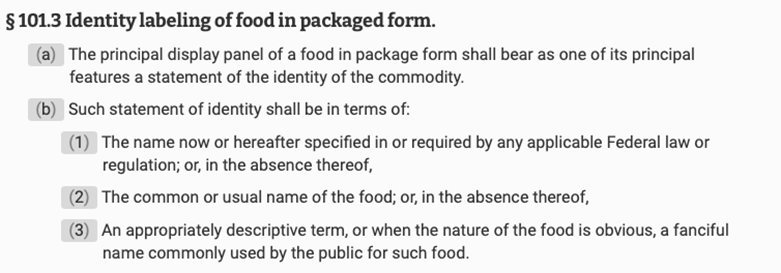
The statement of identity of a food is the name specified by federal law or regulation, or, if no such name is specified, the common or usual name of the food (21 CFR 101.3) [1]:
 (…)
(…)
2. Does the Syrup Standard of Identity Apply to the Coffee Sweetener?
The Code of Federal Regulation lays down specifications for Sweeteners and table sirups (21 CFR 168) [2] which are sub-categorized into:
- Dextrose anhydrous
- Dextrose monohydrate
- Glucose sirup
- Dried glucose sirup
- Lactose
- Cane sirup
- Maple sirup
- Sorghum sirup
- Table sirup
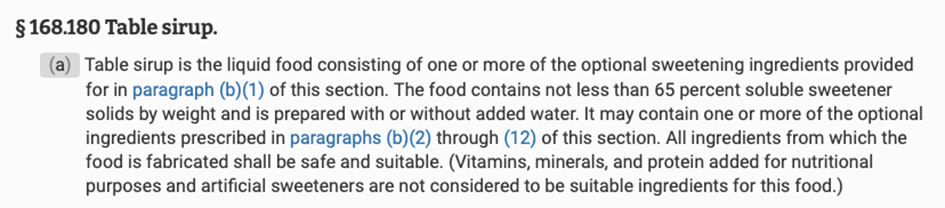
The definition of Table syrup is:
(…)
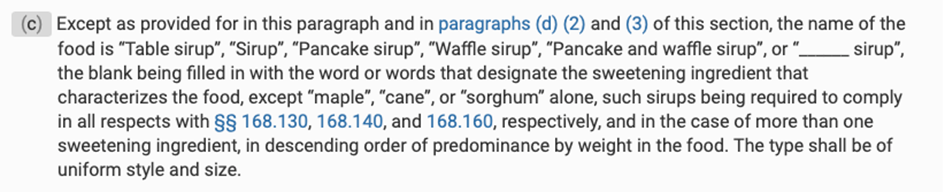
Although the product under consideration is not per se a “table” syrup because it is not a stand-alone product that the final consumer could use as he wishes (e.g. add himself to the coffee), still the use of the word “syrup” or “coffee syrup” would make the product fall under the category “table syrup*”, as it is the case for “pancake syrup” even if it is used as an ingredient in another product (here, coffee).
- The standard of Identity “Table syrup” applies to a product that would be called “syrup” or “coffee syrup”.
- Because the sweetening product for coffee under consideration does not comply with the standard of identity of “Table syrup”, it cannot be called “Syrup” or “coffee syrup”.
* Hereafter “Table sirup” is used to designate the broader category “syrup” as this is the heading of the section of the CFR relevant to “coffee syrup.”
3. Can the Sweetening Product for Coffee be Considered a Non-Standardized Product/Syrup?
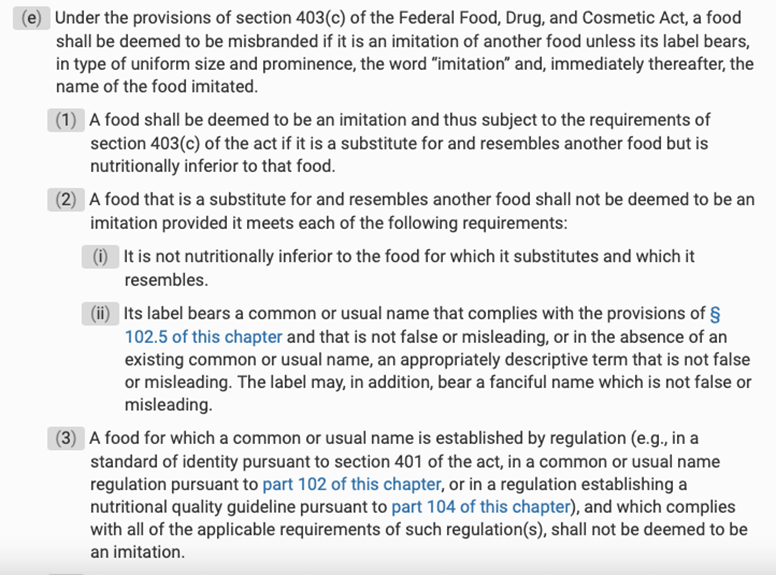
By definition, there is no such thing as a “non-standardized” product for which there is a standard of identity. As per 21 CFR 101.3(e) described above, a food shall be deemed to be misbranded if it is an imitation of another food unless its label bears, in a type of uniform size and prominence, the word “imitation” and, immediately thereafter, the name of the food imitated.
The use of the qualifier “Simple” in front of “syrup” would not prevent a product called “simple syrup” from having to comply with the standard of identity of “Table syrup”.
Conclusion
- A product called “syrup” or “coffee syrup” must comply with the standard of identity of “Table syrup”.
- The sweetening product for coffee under consideration does not comply with the standard of identity of “Table syrup”, it can therefore not be called “Syrup”, “coffee syrup” or “simple syrup”.
- The sweetening product for coffee would be considered a non-standardized product.
4. References
1. 21 CFR 101.3 Identity labeling of food in packaged form
https://www.ecfr.gov/current/title-21/chapter-I/subchapter-B/part-101/subpart-A/section-101.3
2. 21 CFR 160 Sweeteners and table Syrup
https://www.ecfr.gov/current/title-21/part-168
Was this article helpful?