
Methanol Limit in Coffee
- 3 Mins to read
- DarkLight
Methanol Limit in Coffee
- 3 Mins to read
- DarkLight
Article summary
Did you find this summary helpful?
Thank you for your feedback
Methanol Limit in Coffee
USA

The below version control table serves to document all updates made to the report. The purpose is to ensure the information is always accurate and up-to-date.
| Version Number | Content Creation Date | Publishing Date | Section(s) Updated & Reason(s) for Update |
|---|---|---|---|
| V0 | 24 October 2023 | 07 May 2024 | N/A (new report) |
Disclaimers
A) At RegASK, we are committed to providing our clients with the most up-to-date and accurate information on regulatory requirements and compliance. To ensure the highest level of accuracy and relevance, we regularly review and update our e-guidebooks at least twice per year to reflect the latest regulatory developments in the market. (Please contact us if you wish to activate this feature.) In the meantime, our RegAlerts service is designed to keep our clients notified of any regulatory updates that may impact their business.
B) The contents on this platform are exclusively intended for the use of RegASK and its authorized representatives. All materials herein are confidential and the sole property of RegASK. Any reproduction, distribution, or display of this content to others is strictly prohibited without the express written consent of RegASK.
1. Methanol Limit in Food Products
In the US, Methanol, also known as Methyl Alcohol (CH3OH), is an authorized solvent for the extraction of Annatto Extract (21 CFR 73.30), Paprika oleoresin (21 CFR 73.345), Turmeric oleoresin (21 CFR 73.615) and N-Acetyl-L-methionine (21 CFR 172.372).
Not considering spirit beverages, the maximum limit for methanol has been set only for the following food items:
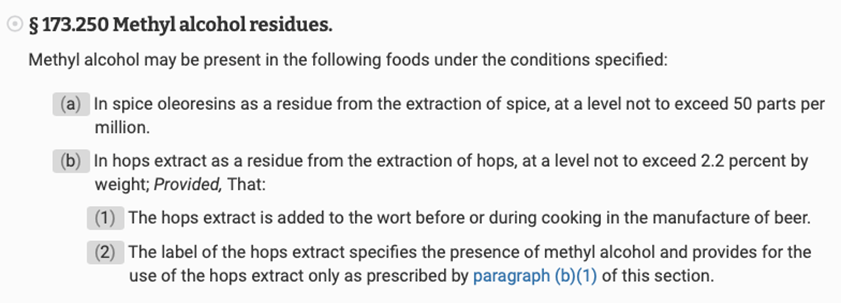
- Spice oleoresins (50 ppb) and hops extract (2.2% by weight) [1]
- Cocoa butter substitute (5 ppm) [2]

- N-Acetyl-L-methionine (10ppm) [3]

2. Methanol Limit in Coffee Beans After Torrefaction
There is no methanol limit in coffee beans before or after torrefaction in the US legislation nor are there guidelines established by the FDA on this criterion.
However, the general principles of food safety apply: according to the Food & Drug Act, sec. 301(a), it is illegal for any person to introduce into interstate commerce an “adulterated” food. Adulteration means a violation of the Federal Food, Drug, and Cosmetic Act which includes products that are defective, unsafe, not shown to be safe, filthy, or produced under insanitary conditions. It also includes products that are manufactured under procedures and controls that do not comply with Current Good Manufacturing Practice regulations [4].
Notes:
- The full definition of adulterated food can be found at 21 USC 342
- Interstate commerce means commerce between any State or Territory and any place outside thereof, it applies to all steps in a product's manufacture, packaging, and distribution.
Finally, while the National Coffee Association* has developed model safety plans and a guideline on how to avoid moldy coffee beans to prevent Ochratoxin A contamination, there is no recommendation on methanol levels in coffee beans pre or post-torrefaction.
*The National Coffee Association is a non-profit organization whose mission is to grow the U.S. coffee community through education, advocacy, and connection.
Conclusion
- In the US, there are no legal limits for naturally present methanol in food nor in coffee beans before or after torrefaction. Limits for methanol have only been set for certain foods (not coffee) where it might be present as a consequence of its use as a solvent.
- The food business operator (FBO) is responsible for placing safe food on the market. As a result, if the FBO is aware of the potentially toxic components due to the making process (e.g., methanol in coffee beans due to yeast), the FBO is expected to limit as possible its content and monitor it to ensure safety.
3. References
1. Code of Federal Regulations, §173.250 Methyl alcohol residues. 21 CFR 173.250
https://www.ecfr.gov/current/title-21/section-173.250
2. Code of Federal Regulations § 184.1259 Cocoa butter substitute. 21 CFR 184.1259(b)(7)
https://www.ecfr.gov/current/title-21/part-184/section-184.1259#p-184.1259(b)(7)
3. Code of Federal Regulations § 172.372 N-Acetyl-L-methionine. 21 CFR 172.372(b)(4)
https://www.ecfr.gov/current/title-21/part-172/section-172.372#p-172.372(b)(4)
4. Food and Drug Act, Section 301 on page 12 (abbreviated as “FD&C Act, sec. 301(a)”)
https://www.govinfo.gov/content/pkg/COMPS-973/pdf/COMPS-973.pdf
Was this article helpful?