
Labeling Regulation Assessment about the Use of Genetic Modification Technology
- 7 Mins to read
- DarkLight
Labeling Regulation Assessment about the Use of Genetic Modification Technology
- 7 Mins to read
- DarkLight
Article summary
Did you find this summary helpful?
Thank you for your feedback
Labeling Regulation Assessment about the Use of Genetic Modification Technology
Taiwan

The below version control table serves to document all updates made to the report. The purpose is to ensure the information is always accurate and up-to-date.
| Version Number | Content Creation Date | Publishing Date | Section(s) Updated & Reason(s) for Update |
|---|---|---|---|
| V0 | 12 Sep 2023 | 17 Sep 2024 | N/A (new report) |
Disclaimers
A) At RegASK, we are committed to providing our clients with the most up-to-date and accurate information on regulatory requirements and compliance. To ensure the highest level of accuracy and relevance, we regularly review and update our e-guidebooks at least twice per year to reflect the latest regulatory developments in the market. (Please contact us if you wish to activate this feature.) In the meantime, our RegAlerts service is designed to keep our clients notified of any regulatory updates that may impact their business.
B) The contents on this platform are exclusively intended for the use of RegASK and its authorized representatives. All materials herein are confidential and the sole property of RegASK. Any reproduction, distribution, or display of this content to others is strictly prohibited without the express written consent of RegASK.
1. Is submission/evaluation necessary for a GM production microorganism for purified ingredients/substances?
According to Chapter I – General Principles under Article 3, Clause 11 of the Act Governing Food Safety and Sanitation [1], the term “genetic modification” is defined as in Figure 1:
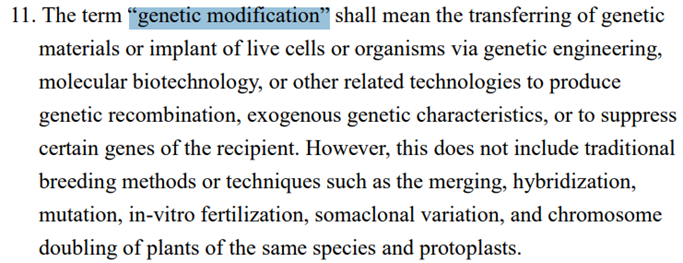
Figure 1: Snapshot of Article 3 of Chapter I – 11 [1]. Definition of genetic modification.
Genetic Modified Foods (GM Food) is also defined in Chapter One of Section III under the Guideline for food safety assessment of genetically modified foods derived from recombinant-DNA organisms [2] per Figure 2.

Figure 2: Snapshot of Chapter One of Section III: Definitions – 2 [2]. Definition of genetically modified foods.
Based on the above definitions, the scope of the GMO regulations in Taiwan covers not only the GMO but also the products from the GMO.
According to Chapter IV – Food Sanitation Control under Article 21 of the Act Governing Food Safety and Sanitation [1] as seen in Figure 3, genetically modified food material can only be used after reviewed and approved by Taiwan Food and Drug Administration (FDA).
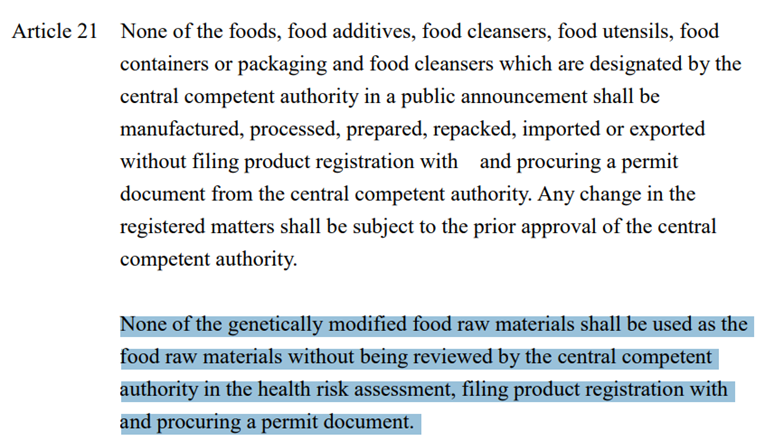
Figure 3: Snapshot of Article 21 of Chapter IV [1]. Food Sanitation Control for GM food materials.
There is no positive listing system for GM Food materials in Taiwan. All GM food materials, whether they are locally produced or imported are required to be reviewed, registered, and to obtain an approval permit. Once registered and approved, it will be published in the list of GM events [3] that have already been evaluated and approved specific to the company. The application or its use will only be restricted to the company.
The approval permit will be valid for 1 to 5 years depending on the decision of the authority. Application for an extension of the permit should be done at least 3 months before the expiry. The extension of the permit will also be at a maximum of 5 years.
The application forms for registration and extension of permit documents for GM food can be found at this link: https://www.fda.gov.tw/TC/siteList.aspx?sid=1752.
The English version of the same form is also available: https://www.fda.gov.tw/ENG/siteList.aspx?sid=10550.
The general process for inspection and registration involves submission of the above application form with the necessary supporting materials to the Taiwan FDA and samples for testing and inspection. These application materials will then be assessed by a review group which will then convey the results to the Taiwan FDA for approval thus issuance of the permit document.
The cost of inspection and registration of genetically modified food ingredients is NT$250,000 per item and the cost for registration changes or extensions of licenses for genetically modified food ingredients is NT$6,000 per item [4]. The timeline is not specified, and it will vary depending on factors such as the completeness of the dossier, the complexity of the GM material, and the availability of the evaluation committee.
Companies can refer to the Guideline for Food Safety Assessment of Genetically Modified Foods Derived from Recombinant-DNA Organisms [2] for preparation of the safety substantiation to support the registration. Chapter 4 and Annex II of the guideline provide details on the requirements for the safety assessment of GM Food derived from Recombinant DNA microorganisms. These include toxicity, allergenicity, and risks related to environmental release of recombinant DNA. It also addresses the safety of the substances produced by the microorganisms that are used as additives or processing aids including enzymes.
2. Is a GM label required for products?
Pre-packaged food products containing GM food ingredients, regardless of B2B or B2C products, should comply with the same requirement in Labeling Requirements for Prepackaged Food Containing Ingredients of Genetically Modified Organisms (GMOs) [5]. This labeling requirement specified the wording required for the use of GMO and its products in different scenarios. For example:
- Pre-packaged food with GMO should be labeled “genetically-modified” or “with genetic modification”.
- Pre-packaged food that uses GMO but does not contain transgenic DNA fragments or transgenic proteins in the final product should be labeled either of the following:
- "genetically-modified", "with genetic modification" or "use genetically modified ________(organisms)".
- "This product is made of genetically modified _________(organisms), but do not contain any transgenic DNA fragment or transgenic proteins " or "this product's raw materials contain genetically modified _________(organisms), but do not contain any transgenic DNA fragment or transgenic proteins".
- "This product does not contain any transgenic DNA fragment or transgenic proteins, but is made of genetically modified _________(organisms)", or "this product does not contain any transgenic DNA fragment or transgenic protein, but with genetically modified _________(organisms)”.
The length and width of the font for GMO labeling should be displayed in Chinese characters of at least 2mm and placed after the name of the product and the ingredients in principle or at a prominent part of the label. Foreign languages like English are optional.
GMO labeling can be exempted for products with less than 3% of the genetically modified material in the individual ingredient or single food per Figure 4 [5].
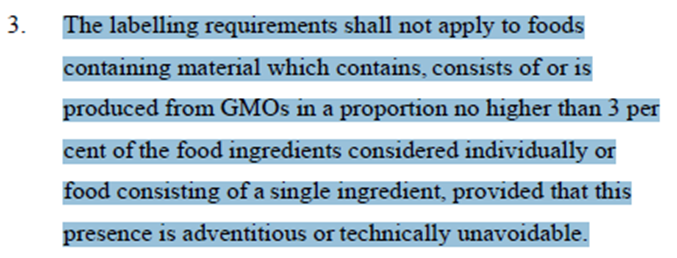
Figure 4: Snapshot of Clause 3 of Labeling requirements for prepackaged food containing ingredients of Genetically Modified Organisms (GMOs) [5].
3. Summary of GM Labeling
Scenarios | GM Label Required (Y/N) | Remarks |
| Ingredient sold B2B: If fermented with GM source using GM production microorganisms. | Y | Required if the final ingredient contains more than 3% of GMO (regardless of the presence of transgenic DNA fragment or protein). |
| Ingredient sold B2B: If fermented with non-GM sources using GM-production microorganisms. | Y | Required if the final ingredient contains more than 3% of GMO (regardless of the presence of transgenic DNA fragment or protein). |
| Ingredient sold B2B: If fermented with GM sources using non-GM production microorganisms. | Y | Required if the final ingredient contains more than 3% of GMO (regardless of the presence of transgenic DNA fragment or protein). |
| Ingredient sold B2B: If fermented with a non-GM source using non-GM production microorganisms. | N | |
| Final product sold B2C: If the purified ingredients are: Fermented with GM source using GM production microorganisms. | Y | Required if the purified ingredient in the final product contains more than 3% of GMO (regardless of the presence of transgenic DNA fragment or protein). |
| Final product sold B2C: If the purified ingredients are: Fermented with non-GM sources using GM-production microorganisms. | Y | Required if the purified ingredient in the final product contains more than 3% of GMO (regardless of the presence of transgenic DNA fragment or protein). |
| Final product sold B2C: If the purified ingredients are: Fermented with GM source using non-GM production microorganisms. | Y | Required if the purified ingredient in the final product contains more than 3% of GMO (regardless of the presence of transgenic DNA fragment or protein). |
| Final product sold B2C: If the purified ingredients are: Fermented with a non-GM source using non-GM production microorganisms. | N |
Conclusion
- In Taiwan, GM food raw material requires registration prior to importation or use locally in food manufacturing. The cost of registration is NTS250,000. The timeline is not noted, and it will largely depend on the completeness of the dossier submitted to the Taiwan FDA.
- Hence, an evaluation and registration submission are necessary for a GM production micro-organism for purified ingredients and companies should submit safety substantiation data according to the requirements in the Guideline for Food Safety Assessment of Genetically Modified Foods Derived from Recombinant-DNA Organisms.
- The permit for the GM food material is valid between 1 to 5 years and can be renewed 3 months before the expiry date.
- Prepackaged food, regardless of B2B or B2C, that contains more than 3% of GMO material requires GM labeling. The label should follow the prescribed wordings and formats stated in Labeling Requirements for Prepackaged Food Containing Ingredients of Genetically Modified Organisms (GMOs).
4. References
1. Act Governing Food Safety and Sanitation
https://www.fda.gov.tw/ENG/lawContent.aspx?cid=16&id=1361
2. Guideline for Food Safety Assessment of Genetically Modified Foods Derived from Recombinant-DNA Organisms
https://www.fda.gov.tw/tc/includes/GetFile.ashx?id=f636719791739565500
3. Current Approvals of Genetically Modified foods in Taiwan
https://consumer.fda.gov.tw/Food/GmoInfoEn.aspx?nodeID=300
4. Standards for examination fees and certificate fees related to food and food additive inspection and registration
https://consumer.fda.gov.tw/Law/Detail.aspx?nodeID=518&lawid=634
5. Labeling Requirements for Prepackaged Food Containing Ingredients of Genetically Modified Organisms (GMOs)
https://www.fda.gov.tw/ENG/lawContent.aspx?cid=16&id=3136
Was this article helpful?