
Regulatory Requirements for Fat in Ice Cream and Chocolate - Thailand
- 7 Mins to read
- DarkLight
Regulatory Requirements for Fat in Ice Cream and Chocolate - Thailand
- 7 Mins to read
- DarkLight
Article summary
Did you find this summary helpful?
Thank you for your feedback
Regulatory Requirements for Fat in Ice Cream and Chocolate
Thailand

The below version control table serves to document all updates made to the report. The purpose is to ensure the information is always accurate and up-to-date.
| Version Number | Content Creation Date | Publishing Date | Section(s) Updated & Reason(s) for Update |
|---|---|---|---|
| V0 | 06 Dec 2023 | 11 Nov 2024 | N/A (new report) |
Disclaimers
A) At RegASK, we are committed to providing our clients with the most up-to-date and accurate information on regulatory requirements and compliance. To ensure the highest level of accuracy and relevance, we regularly review and update our e-guidebooks at least twice per year to reflect the latest regulatory developments in the market. (Please contact us if you wish to activate this feature.) In the meantime, our RegAlerts service is designed to keep our clients notified of any regulatory updates that may impact their business.
B) The contents on this platform are exclusively intended for the use of RegASK and its authorized representatives. All materials herein are confidential and the sole property of RegASK. Any reproduction, distribution, or display of this content to others is strictly prohibited without the express written consent of RegASK.
1. ICE CREAM
1.1 Regulatory background ice cream category
According to Notification of the Ministry of Public Health (No. 354), Ice cream is a prescribed food classified into 5 types [1] :
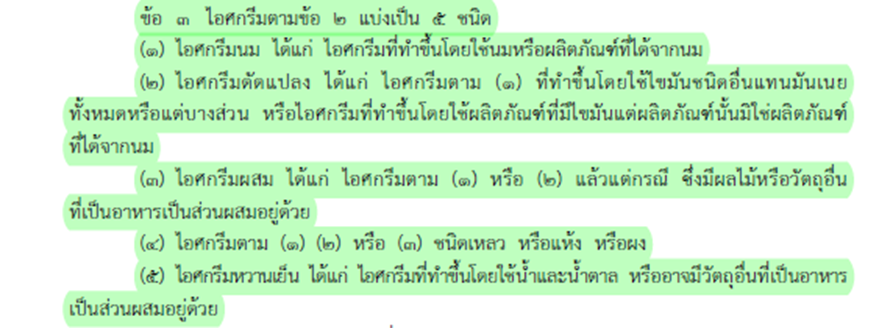
Translation:
(1) Milk ice cream shall be ice cream made from milk or milk products.
(2) Modified ice cream shall be ice cream, as stipulated in (1), made from all or in parts of other substituted fat to milk fat or ice cream which is made from other fat products which are not products from milk.
(3) Mixed ice cream shall be ice cream as stipulated in (1) or (2), as the case may be, which have fruits or other kind of foods content.
(4) Ice cream as stipulated in (1), (2), or (3) which are in liquid, dry, or powder forms
(5) Edible ice shall be ice cream which is made from water and sugar or other kind of foods content.
1.2 Composition criteria – fat and milk fat requirement
Ice cream must comply with the following criteria (only relevant extract reproduced below) [1]:
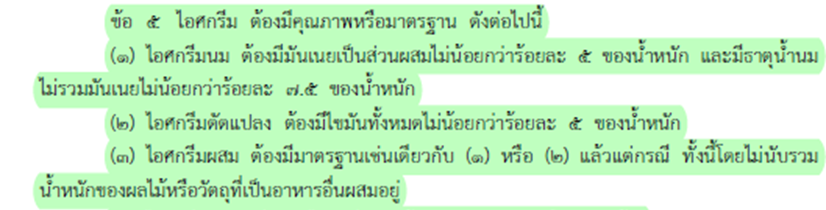
Translation:
(1) Milk ice cream is prescribed to have milk fat content of not less than 5% by weight and contain milk solid non fat not less than 7.5% by weight.
(2) Modified ice cream is prescribed to have total fat of not less than 5% by weight.
(3) Mixed ice cream is prescribed to have standards as stipulated in (1) or (2), as the case may be, excluding total weight of fruits or other kind of ingredients.
1.3 Can the milk fat be replaced by vegetable fat in ice cream?
By definition, milk fat in milk ice cream can not be replaced by vegetable fat.
Modified ice cream can contain vegetable fat with a minimum total fat of not less than 5% by weight as described above [1].
2. CHOCOLATE
2.1 Regulatory background chocolate category
Chocolate is a prescribed food defined as follows [2]:
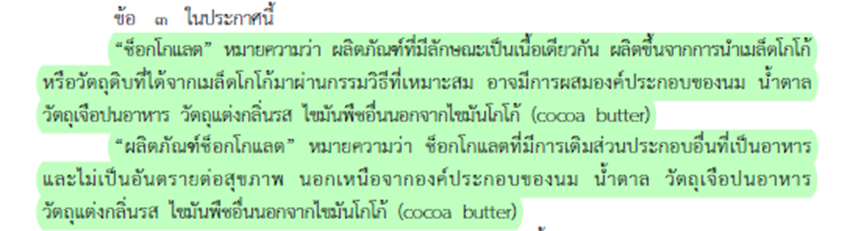
Translation:
“Chocolate” means the homogenous product obtained by an adequate manufacturing process from cocoa beans or cocoa materials which may be combined with milk products, sugars, food additives, flavouring agents, vegetable fats other than cocoa butter [2].
“Chocolate products” means “chocolate” which added with other edible foodstuffs that shall not be hazardous to health; other than milk ingredients, sugars, food additives, flavouring agents, vegetable fats other than cocoa butter [2].
2.2 Composition criteria –fat and milk fat requirement
The following chocolates and chocolate products must comply with the qualities and standards as specified in Annex of the notification [2]:
(1) Chocolate;
(2) Sweet Chocolate;
(3) Chocolate a la taza;
(4) Chocolate familiar a la taza;
(5) Couverture Chocolate;
(6) Milk Chocolate;
(7) Family Milk Chocolate;
(8) Milk Chocolate Couverture;
(9) White Chocolate;
(10) Gianduja Chocolate, the product may be added whole or broken nut varieties (ex. almonds, hazelnuts), in such quantities that, together with the ground hazelnuts content as specified in Annex of this notification, do not exceed 60% of the total weight of the product;
(11) Gianduja Milk Chocolate, the product may be added whole or broken nut varieties (ex. almonds, hazelnuts), in such quantities that, together with the ground hazelnuts content as specified in Annex of this notification, do not exceed 60% of the total weight of the product;
(12) Chocolate para mesa, which contains the grain size of sugars larger than 70 microns;
(13) Semi-bitter chocolate para mesa, which contains the grain size of sugars larger than 70 microns;
(14) Bitter chocolate para mesa, which contains the grain size of sugars larger than 70 microns;
(15) Chocolate Vermicelli / Chocolate Flakes, which obtained by a mixing, extrusion and hardening technique which gives unique, crisp textural properties to the products. Vermicelli are presented in the form of short, cylindrical grains and flakes in the form of small flat pieces;
(16) Milk Chocolate Vermicelli / Milk Chocolate Flakes, which obtained by a mixing, extrusion and hardening technique which gives unique, crisp textural properties to the products. Vermicelli are presented in the form of short, cylindrical grains and flakes in the form of small flat pieces;
(17) Filled Chocolate, the product covered by a coating of a single or combination of the Chocolates as defined in Clause (1)(2)(5)(6)(7)(8)(9)(10) or (11), the centre of which is clearly distinct, through its composition, from the external coating. The chocolate part of the coating shall not be less than 2 5 % of the total weight of the product. The centre filling(s) shall be of quality and standard according to the relevant notification of the Ministry of Public Health exists, or as approved by Thai Food and Drug Administration. Filled Chocolate does not include Flour Confectionery, Pastry, Biscuit or Ice Cream products;
(18) Praline, the product in a single mouthful size, where the amount of the chocolate;
(19) component shall not be less than 25% of the total weight of the product. The product shall consist of either filled chocolate or a single or combination of the chocolates as defined in Clause (1)(2)(5)(6)(7)(8)(9)(10)(11) or (17).
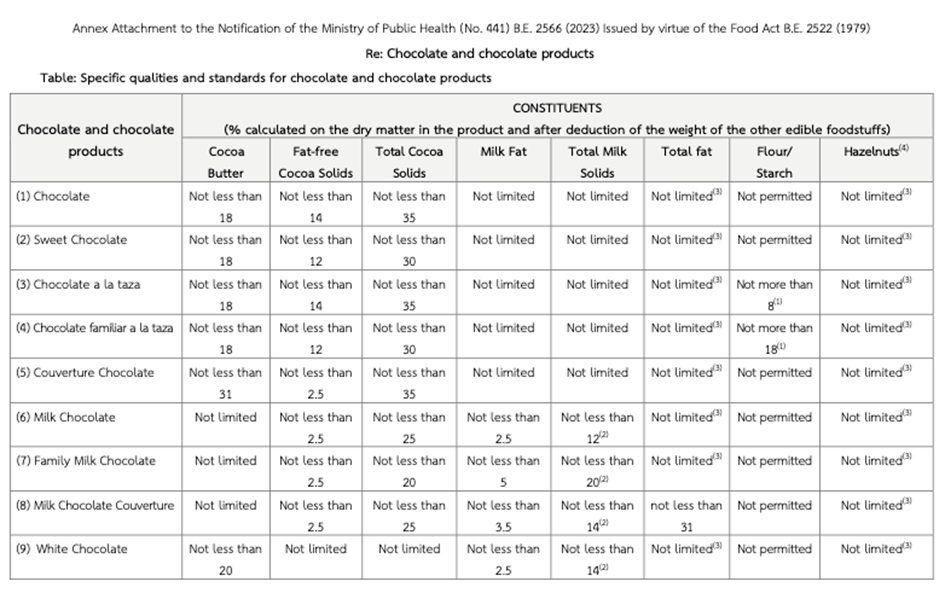
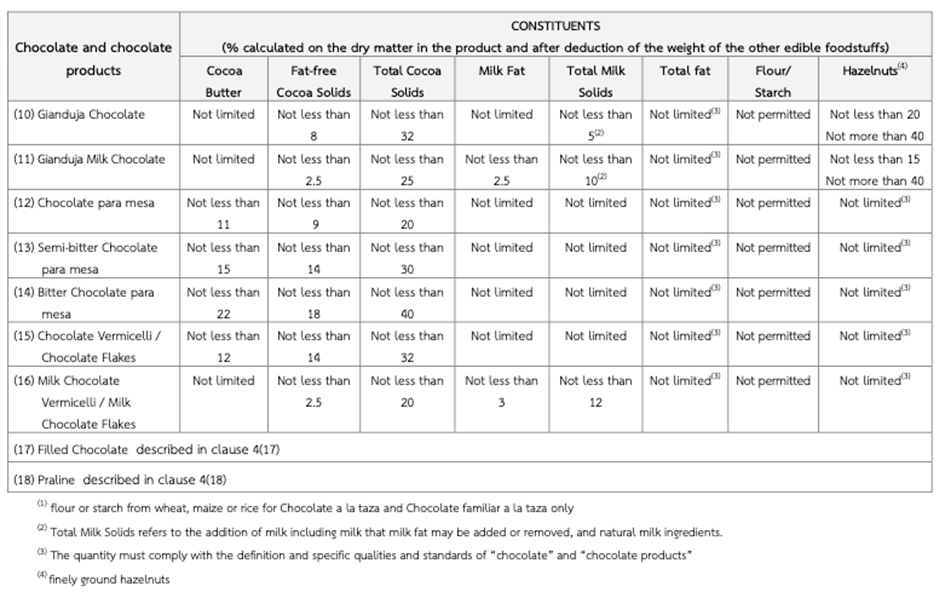
Specific limits for milk fat depending on the type of chocolate are described in the Annex to the Notification on chocolate and are reproduced at the end of this report. Minimum milk fat content is set for a number of chocolate types and range from “not limited” to minimum 2.5 to 5%.
2.3 Can the milk fat be replaced by vegetable fat in chocolate?
Yes, according to Clause 5 of the Chocolate and chocolate product notification [2], the addition of vegetable fats other than cocoa butter shall not exceed 5% of the chocolate:
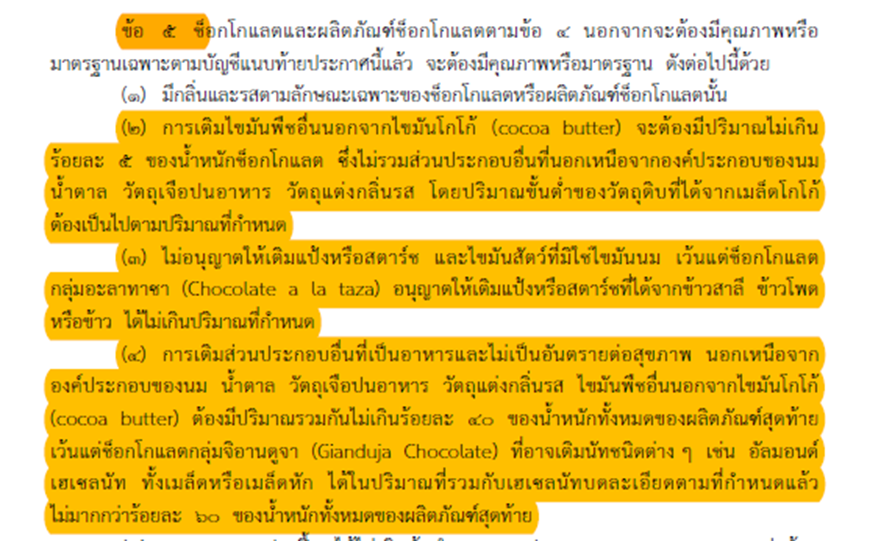
Translation:
(2) The addition of vegetable fats other than cocoa butter shall not exceed 5% of the chocolate, after deduction of the total weight of any other added edible foodstuffs excluding milk ingredients, sugars, food additives and flavouring agents, without reducing the minimum contents of cocoa materials as specified in Annex of this notification;
(3) The addition of flour or starch and animal fats other than milk fat shall be prohibited, except chocolate a la taza and chocolate familiar a la taza which the addition of flour or starch from wheat, maize or rice is permitted but not exceeding the level as specified in Annex of this notification [2];
(4) The addition of edible foodstuffs which not harmful to health; other than milk ingredients, sugars, food additives, flavouring agents, vegetable fats which not cocoa butter; shall not exceed 40% of total weight of finished product, except Gianduja chocolate and Gianduja milk chocolate may be added whole or broken nut varieties (ex. almonds, hazelnuts), in such quantities, together with the ground hazelnuts content as specified in Annex of this notification, but shall not exceed 60% of the total weight of the finished product [2].
In addition, according to clause 10.2, the type and content of all vegetable fats other than cocoa butter and total cocoa solid shall be indicated on area of main ingredients of the label [2].
Conclusion
- In Thailand, Standards for ice cream and chocolate are laid down in legislation.
- By definition, milk fat in milk ice cream can not be replaced by vegetable fat.
- Modified ice cream can contain vegetable fat with a minimum total fat of not less than 5% by weight.
- In chocolate, the addition of vegetable fats other than cocoa butter is possible and shall not exceed 5% of the chocolate.
3. References
1. Notification of the Ministry of Public Health (No. 354) B.E. 2556 (2013) Re: Ice Cream
https://en.fda.moph.go.th/media.php?id=517782059540946944&name=P354_E.pdf
2. Notification of the Ministry of Public Health (no. 441) b.e. 2566 (2023) issued by virtue of the food act, b.e. 2522 (1979) re: chocolate and chocolate products.
https://en.fda.moph.go.th/media.php?id=517782074036461568&name=P441_E.pdf
4. Annex: Notification of the Ministry of Public Health (no. 441) b.e. 2566 (2023) issued by virtue of the food act, b.e. 2522 (1979) re: chocolate and chocolate products.
Was this article helpful?