
Regulatory Requirements for Fat in Ice Cream and Chocolate - Philippines
- 5 Mins to read
- DarkLight
Regulatory Requirements for Fat in Ice Cream and Chocolate - Philippines
- 5 Mins to read
- DarkLight
Article summary
Did you find this summary helpful?
Thank you for your feedback
Regulatory Requirements for Fat in Ice Cream and Chocolate
Philippines

The below version control table serves to document all updates made to the report. The purpose is to ensure the information is always accurate and up-to-date.
| Version Number | Content Creation Date | Publishing Date | Section(s) Updated & Reason(s) for Update |
|---|---|---|---|
| V0 | 06 Dec 2023 | 11 Nov 2024 | N/A (new report) |
Disclaimers
A) At RegASK, we are committed to providing our clients with the most up-to-date and accurate information on regulatory requirements and compliance. To ensure the highest level of accuracy and relevance, we regularly review and update our e-guidebooks at least twice per year to reflect the latest regulatory developments in the market. (Please contact us if you wish to activate this feature.) In the meantime, our RegAlerts service is designed to keep our clients notified of any regulatory updates that may impact their business.
B) The contents on this platform are exclusively intended for the use of RegASK and its authorized representatives. All materials herein are confidential and the sole property of RegASK. Any reproduction, distribution, or display of this content to others is strictly prohibited without the express written consent of RegASK.
1. Regulatory Background
On November 20, 2023, the Philippines FDA issued a draft of the Philippine National Standards (PNS) and its Recommended Code of Practices (RCP) for processed food products as technical regulation. All concerned stakeholders may submit by December 5. There is no Standard for ice cream or chocolate foreseen [1].
Philippines has adopted the Codex Food category System and Descriptor [2], and based on experience*, Philippine FDA generally follow the recommendations of the three international standard-setting bodies Codex, US and EU and the legislation of the exporting country.
* based on experience managing product application processes for CPR (Certificate of Product Registration) in the Philippines. The opinion released by the FDA assessor during pre-assessment (the stage where the assessor provides high level evaluation opinion about the product and the cost of registration with an invoice) is accompanied with sets of regulations for the applicant FBO to observe. The FBO should submit comprehensive information to avoid further requirements or letters of denial. The FBO’s must be able to show to the Philippine FDA that the product is produced in the country of origin and that the product development process in view of product regulatory/safety/import compliance was based on applicable regulations in that country. Additionally, a free sales certificate proving approval for marketing and sales of the product in the country of origin is very useful.
2. ICE CREAM
2.1 Regulatory background ice cream category
There is no specific standard for ice cream in Philippines but it is categorized under Dairy Based Frozen Products - categorized as a High Risk Product in FDA Philippines under FDA Circular #2020-033 [3].
In absence of Codex and EU standard for ice cream, the requirements for ice cream laid down in US legislation can be used [4].
2.2 Composition criteria – fat and milk fat requirement
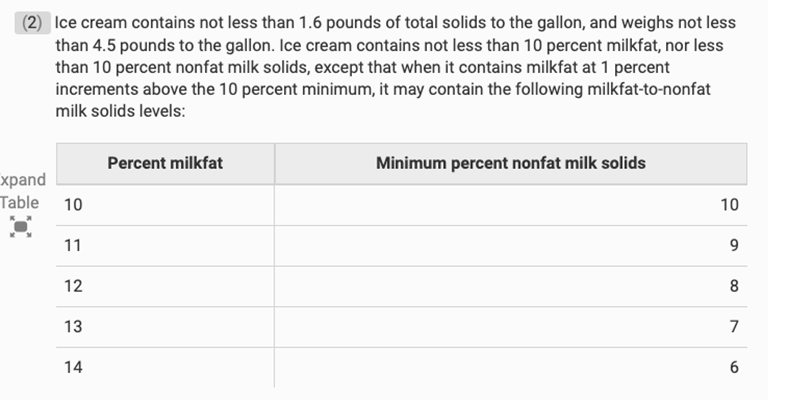
For information, in the US, according to 21 CFR 135.110 Ice cream and frozen custard [4], ice cream must contain not less than 10 % milk fat:
2.3 Can the milk fat be replaced by vegetable fat in ice cream?
This will depend on the country of origin. For information, in the US, ice cream can contain vegetable fat as long as the milk fat content is not less than 10%.
If all the milk fat is replaced by vegetable fat, the product can not longer be called “ice cream” but instead should be called “non-dairy frozen dessert”.
3. CHOCOLATE
3.1 Regulatory background chocolate category
Chocolate is categorized under Confectionary - Medium Risk Product classification as per FDA Circular #2020-033.
3.2 Composition criteria – fat and milk fat requirement
In absence of specific Philippine legislation on chocolate, the Codex Alimentarius - Standard for Chocolates and Chocolate Products [5] is described for information. In the Codex Standard, the milk Fat limit is the following:
- Milk chocolate: Minimum 2.5% to 3.5%
- Family chocolate: Minimum 5%
- Milk chocolate couverture: Minimum 3.5%
- White chocolate: Minimum 2.5% to 3.5%
- Milk chocolate vermicelli/milk chocolate flake: Minimum 3%
Other requirements are set in US:
- Milk chocolate [6] and white chocolate [7]: Minimum 3.39% by weight of milkfat
- Buttermilk chocolate [8] and Skim milk chocolate [9]: less than 3.39% by weight of milkfat
- Finally, EU legislation has also laid down criteria for chocolate and milk fat content [10].
3.3 Can the milk fat be replaced by vegetable fat in chocolate?
According to codex Standard and EU directive on Chocolate, it is possible to use vegetable fat other than cocoa butter as long as it is not more than 5% of Vegetable fat:
Extract from Codex Standard on Chocolate – Section 2 [5]:

Extract from Article 2 of EU Directive on chocolate [10]:

Conclusion
- In Philippines, there is no Standard for ice cream or chocolate foreseen.
- Philippines FDA generally follow the recommendations of the three international standard-setting bodies Codex, US and EU. Philippines has even adopted the Codex Food category System and Descriptor.
- In absence of Philippine standard for ice cream, the US legislation is described. In the US, ice cream must contain not less than 10 % milk fat. If all the milk fat is replaced by vegetable fat, the product can not longer be called “ice cream” but instead should be called “non-dairy frozen dessert".
- In Codex, US and EU texts, different types of chocolate have different limits for milk fat.
- In Codex and EU texts, it is possible to use vegetable fat other than cocoa butter as long as it is not more than 5% of Vegetable fat.
4. References
1. Draft for Comments || Adoption of the Philippine National Standards (PNS) and its Recommended Code of Practices (RCP) for Processed Food Products as Technical Regulation
2. Department Circular No. 2019-0319
https://www.fda.gov.ph/wp-content/uploads/2020/01/Department-Circular-No.-2019-0319.pdf
3. FDA Circular 2020-033 Procedure for the use of the Modified Electronic Registration System of Raw Materials and Prepackaged Processed Food Products.
https://www.fda.gov.ph/wp-content/uploads/2021/03/FDA-Circular-No.2020-033-1-128.pdf
4. US Code of Federal Regulations 21 CFR 135.110 - Ice cream and frozen custard
https://www.ecfr.gov/current/title-21/section-135.110
5. CODEX STANDARD FOR CHOCOLATE AND CHOCOLATE PRODUCTS CXS 87-1981
6. US Code of Federal Regulations – 21CFR 163.155 Milk chocolate
https://www.ecfr.gov/current/title-21/chapter-I/subchapter-B/part-163/subpart-B/section-163.130
7. US Code of Federal Regulations - 21 CFR 163.124 White chocolate
https://www.ecfr.gov/current/title-21/section-163.124
8. US Code of Federal Regulations – 21 CFR 163.135 Buttermilk chocolate
https://www.ecfr.gov/current/title-21/chapter-I/subchapter-B/part-163/subpart-B/section-163.135#p-163.135(a)(1)
9. US Code of Federal Regulations 21 CFR 163.140 Skim milk chocolate
https://www.ecfr.gov/current/title-21/section-163.140
10. Directive 2000/36/EC of the European Parliament and of the Council of 23 June 2000 relating to cocoa and chocolate products intended for human consumption
https://eur-lex.europa.eu/legal-content/EN/TXT/?uri=CELEX%3A02000L0036-20131118
Was this article helpful?