
2. Product Categories
- 3 Mins to read
- DarkLight
2. Product Categories
- 3 Mins to read
- DarkLight
Article summary
Did you find this summary helpful?
Thank you for your feedback
Infant, Follow-up, Young Child, and Maternal Milk Formula
Japan

This section provides the regulatory definition of the food category in scope, or the appropriate food category for the product in scope. Additionally, it provides the food products that belong to this food category along with the definition and specific information on each of these types of food products.
Figure 2.0-1 below illustrates the relationship between food categories and regulations applying to the products in scope in this report.
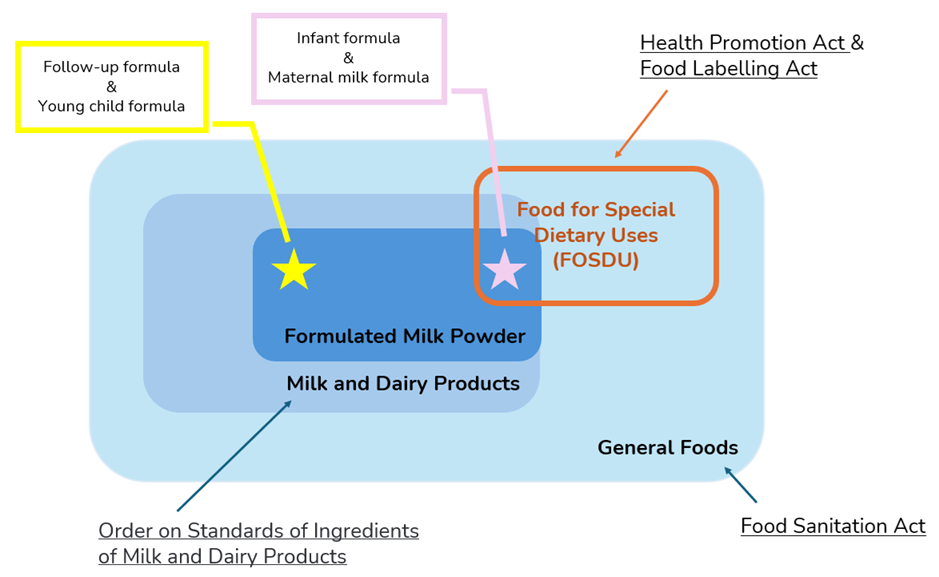 Figure 2.0-1. Diagram of the relationship between food categories and regulations
The products covered in this report are:
- Stage 1 Infant formula (from birth)
- Stage 2 Follow-up formula (from 6 months)
- Stage 3 Toddler milk drink (from 1 year)
- Stage 4 Junior milk drink (from 3 years)
- Maternal milk formula (for pre-conception, pregnancy and breastfeeding)
While all of the above products are classified under the category ‘formulated milk powder’, products (a) and (e) are specifically regulated as Food for Special Dietary Uses (FOSDU), which is defined by Article 43 (1) of the Health Promotion Act (Act No. 103 of 2002) [1] as follows :
“販売に供する食品につき、乳児用、幼児用、妊産婦用、病者用その他内閣府令で定める特別の用途に適する旨の表示(をした食品 (foods offered for sale that are labeled as suitable for infants, young children, pregnant and nursing women, the sick and other special uses specified by the Cabinet Office Ordinance)”
2.1 Category Name & Definition
Category Name
Formulated milk powder (“調製粉乳” in Japanese)
Definition
The "formulated milk powder" is defined by Article 2 (38) of the Order on Standards of Ingredients of Milk and Dairy Products etc. (Ordinance of the Ministry of Health and Welfare No. 52 of 1951) [2] as follows:
“生乳、牛乳、特別牛乳若しくは生水牛乳又はこれらを原料として製造した食品を加工し、又は主要原料とし、これに乳幼児に必要な栄養素を加え粉末状にしたもの (a product derived from raw milk, cow's milk, special milk, or raw water milk. It is a powdered foodstuff, comprising nutrients essential for infants and young children, which has been processed or manufactured from these ingredients)”
Specifications [2]
- Milk solids: 50.0% or more
- Moisture: 5.0% or less
- Bacterial count (per gram by standard plate culture method): 50, 000 or less
- Coliforms: Negative
2.2 Product & Definition
1) Infant Formula (FOSDU)
Definition
"Infant formula" is defined by Article 43 (1) of the Health Promotion Act (Act No. 103 of 2002) [1] as follows:
“販売に供する食品につき、乳児用[・・・]の用途に適する旨の表示[・・・]をしようとする者は、内閣総理大臣の許可を受けなければならない (Foods for which the Prime Minister has granted permission to indicate that they are suitable for infants)”
Specifications/Target Age
Specifications: CAA Notification (Shou-Shoku-Hyou No.296 of 9 September 2019) [3] specifies the compositional and nutritional requirements for infant formula.
Target age: “Infant” is defined by Article 6 (2) of the Maternal and Child Health Act (Act No. 141 of 1965) [4] as follows:
“「乳児」とは、一歳に満たない者をいう (the term ‘infant’ means a person under one year of age.)”
Additional Information
None.
2) Follow-up Formula
Definition
There is no legal definition.
The Japan Dairy Industry Association, an industry association formed by Japanese dairy manufacturers, provides a general definition for “follow-up milk” as the “milk powder formulated to provide a well-balanced intake of nutrients that are essential for growth during the crucial period from infancy to toddlerhood, which designed to meet the nutritional needs of infants from weaning at 9 months to around 3 years of age” [5].
Specifications/Target Age
Specifications: Not legally defined.
Target age: Not legally defined but generally considered between 9 months to 3 years of age.
Additional Information
None.
3) Young Child Formula
Definition
There is no legal definition at the time of this work.
Specifications/Target Age
Specifications: Not legally defined.
Target age: Not legally defined.
Additional Information
None.
4) Maternal Milk Formula (FOSDU)
Definition
“Maternal milk formula” is defined by Article 43 (1) of the Health Promotion Act (Act No. 103 of 2002) [1] as follows:
“販売に供する食品につき、妊産婦用[・・・]の用途に適する旨の表示[・・・]をしようとする者は、内閣総理大臣の許可を受けなければならない (Foods for which the Prime Minister has granted permission to indicate that they are suitable for pregnant and nursing women)”
Specifications/Target Age
Specifications: CAA Notification (Shou-Shoku-Hyou No.296 of 9 September 2019) [3] specifies the compositional and nutritional requirements for maternal milk formula.
Target age: Not legally defined.
Additional Information
None.
2.3 References
1. Health Promotion Act (Act No. 103 of 2002) (in English)
https://www.japaneselawtranslation.go.jp/en/laws/view/3727
2. Order on Standards of Ingredients of Milk and Dairy Products etc. (Ordinance of the Ministry of Health and Welfare No. 52 of 1951) (in Japanese)
https://laws.e-gov.go.jp/law/326M50000100052/
3. Appendix 1 of Full Revision of the ‘Permission for the Labelling of FOSDU’ (Shou-Shoku-Hyou No.296 of 9 September 2019)” (in Japanese)
https://www.caa.go.jp/policies/policy/food_labeling/foods_for_special_dietary_uses/notice/assets/food_labeling_cms206_20240401_12.pdf
4. Maternal and Child Health Act (Act No. 141 of 1965) (in Japanese)
https://laws.e-gov.go.jp/law/340AC0000000141
5. Q&A for Milk and Dairy Products “What are the Differences between Infant Formula and Follow-Up Milk” on the website of the Japan Dairy Industry Association (in Japanese)
https://nyukyou.jp/dairyqa/2107_113_322/
Was this article helpful?