
Novel/Not Novel Determination of a Bacterial Lysate
- 14 Mins to read
- DarkLight
Novel/Not Novel Determination of a Bacterial Lysate
- 14 Mins to read
- DarkLight
Article summary
Did you find this summary helpful?
Thank you for your feedback
Novel/not novel determination of a Bactery lysate
EU & UK

The below version control table serves to document all updates made to the report. The purpose is to ensure the information is always accurate and up-to-date.
| Version Number | Content Creation Date | Publishing Date | Section(s) Updated & Reason(s) for Update |
|---|---|---|---|
| V0 | 03 Nov 2023 | 08 Oct 2024 | N/A (new report) |
Disclaimers
A) At RegASK, we are committed to providing our clients with the most up-to-date and accurate information on regulatory requirements and compliance. To ensure the highest level of accuracy and relevance, we regularly review and update our e-guidebooks at least twice per year to reflect the latest regulatory developments in the market. (Please contact us if you wish to activate this feature.) In the meantime, our RegAlerts service is designed to keep our clients notified of any regulatory updates that may impact their business.
B) The contents on this platform are exclusively intended for the use of RegASK and its authorized representatives. All materials herein are confidential and the sole property of RegASK. Any reproduction, distribution, or display of this content to others is strictly prohibited without the express written consent of RegASK.
1. Novel/not novel food status of bacterial lysate made from L. fermentum
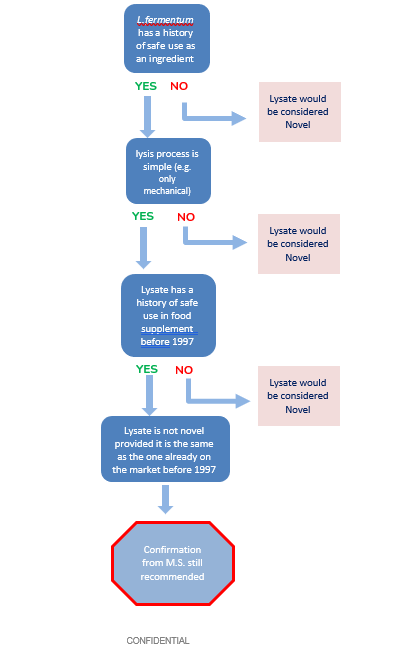
The following diagram can summarize the findings of the report:
1.1 Status for source material Lactobacillus fermentum
Production strain: Lactobacillus fermentum (no further strain identity or culture collection registration information).
Synonym(s): Lactobacillus fermentum is a recognized synonym of Limosilactobacillus fermentum.
Safety of Production Strain: L. fermentum is included in the most recent update (December 2022) of the EFSA QPS List [1]. The QPS approach was developed by the EFSA Scientific Committee to provide a harmonized generic pre-evaluation to support safety risk assessments of biological agents intentionally introduced into the food and feed chain.
Table 1 Entry for “Lactobacillus fermentum” from EFSA’s list of QPS organisms [1]
| Micro sub-group | Genus | Species | Synonyms commonly used in the food/feed industry | Qualification | Comment |
| Gram-positive non-sporulating bacteria | Limosilactobacillus | Limosilactobacillus fermentum | Lactobacillus fermentum | The strains should not harbor any acquired antimicrobial resistance genes to clinically relevant antimicrobials. |
L. fermentum is considered safe, both when used as an ingredient and used as a processing aid in foods since no particular restrictions are set in the above column “Comment”. This means that for any further application of lysate, the safety assessment aspects of the source as L. fermentum can be “fast-tracked”.
"Case history” in the EU when QPS status is restricted
Article 4(2) of the EU Novel Food Regulation (Regulation (EU) 2015/2283) allows for applications to be submitted to a Member State competent authority for a consultation to determine the novel food status of a food.
In 2021 the Spanish Agency for Food Safety and Nutrition (AESAN) received such an application for an opinion on the novel food status of a product named iBalance, which is described as a “combination of 13 dead heat-treated microorganisms” [2]: “IBalance consists of a mixture of lysates from probiotic bacteria and yeasts, which are either purchased from specific suppliers or grown individually in fermenters. Each strain is processed individually and subsequently, the lysates are mixed in the corresponding amount. The food ingredient iBalance is obtained from a particular combination of microorganisms, lysed, sonicated, heat treated, and mixed in specific proportions. The product is intended to be used as an ingredient”.
The AESAN opinion provided their view on the product:
Some of the microorganisms that are part of the composition of iBalance have already been used in the field of human nutrition but only as part of the production process in products for the general population (baked and dairy products for example) and not as ingredients. On this basis, AESAN concluded that the product was novel.
As noted above, in the case of L. fermentum, no such distinction exists between the bacteria being used as an ingredient or in the production process only
Additionally, some manufacturers have filed applications regarding L. fermentum: there are five entries for Lactobacillus fermentum/Limosilactobacillus fermentum in the latest iteration of the list of microorganisms notified to EFSA (as of March 2023) [3] (see Table 2 below). Of these, four are related to feed additive applications and one has been notified as the strain for which a health claim is proposed (EFSA-Q-2016-00318).
Table 2: Entries for Lactobacillus fermentum from EFSA’s list of notified microorganisms Micro group. Micro Subgroup: Gram-positive non-sporulating bacteria [1]
| Genus | Species | Strain/ subsp. (ssp.)/ var./ subtype | EFSA risk assessment area | Category Regulated product | Intended usage | EFSA Question No of Application | Evaluated for a QPS status for 1st time/ reevaluated |
Lacto- bacillus | Lacto- bacillus fermentum | 48/72 | Feed additives | Enzyme production | Production of food enzyme urease | EFSA-Q-2016-00102 | EFSA, 2007, 2008; EFSA BIOHAZ Panel, 2009, 2010, 2011, 2012, 2013, 2017, 2020 |
| Lacto- bacillus | Lacto- bacillus fermentum | CECT5716 | Health Claim | Health claims | Food targeted for health claims* | EFSA-Q-2016-00318 | Safety assessment not foreseen |
| Lacto- bacillus | Lacto- bacillus fermentum | NCIMB 30169 | Feed additives | Technological additives | Feed additive | EFSA-Q-2012-00085 | EFSA, 2007, 2008; EFSA BIOHAZ Panel, 2009, 2010, 2011, 2012, 2013, 2017, 2020 |
| Lacto- bacillus | Lacto- bacillus fermentum | NCIMB 41636 | Feed additives | Technological additives | Technological additive | EFSA-Q-2014-00588 | EFSA, 2007, 2008; EFSA BIOHAZ Panel, 2009, 2010, 2011, 2012, 2013, 2017, 2020 |
| Limosilacto- bacillus | Limosilacto- bacillus fermentum | K9-2 | Feed additives | Zootechnical additives | Gut flora stabilisers. Consisting of four viable bacterial strains. Not GMM | EFSA-Q-2021-00383 | EFSA, 2007, 2008; EFSA BIOHAZ Panel, 2009, 2010, 2011, 2012, 2013, 2017, 2020 |
*Claim effect was “natural defense/immune system”. In 2010, EFSA assessed this claim and concluded: “In weighing the evidence, the Panel took into account that the only human study provided did not show an effect of Lactobacillus fermentum CECT5716 consumption on the maintenance of the upper respiratory tract defense against pathogens by maintaining immune defenses.” [4]
The IDF-EFFCA** Inventory of microbial food cultures with safety demonstration in fermented food products (Bulletin of the International Dairy Federation) [5] includes Lactobacillus fermentum. Furthermore, L. fermentum specifically is documented as used in ancient Egypt in fermented milk, and today as naturally present or as a starter culture in fermented milk products [6]. More precisely, L. fermentum is a member of the Non-Starter Lactic Acid Bacteria (NSLAB) population in some cheese varieties (e.g., Comté, Ragusano). It is one of the most abundant species found in natural whey cultures for Caciocavallo Silano, a hard ‘pasta filata’ cheese, and Parmigiano Reggiano cheese [7]. In Parmesan cheese varieties, Parmigiano Reggiano and Grana Padano, the starter culture often consists of 10–20% of L. fermentum [8].
**IDF: International Dairy Federation; EFFCA: European Food and Feed Culture Association.
1.2 Application for L. fermentum as novel food
- Approved novel food
A list of novel foods authorized in the European Union is published within the Implementing Regulation (EU) 2017/2470 as amended [9], some of which are derived from microorganisms. For example, UV-treated baker’s yeast (Saccharomyces cerevisiae) and Selenium-containing yeast (Yarrowia lipolytica) biomass.
There is no mention in this list of existing authorized novel foods with Lactobacillus fermentum (or Limosilactobacillus fermentum) or extracts from this microorganism or any lysate of any microorganism for that matter.
The presence on this list would have strongly hinted that an L. fermentum lysate would be novel, but the absence of the list does not automatically prove it is novel.
- Foods that have been the object of a novel/not novel food consultation
The list of foods that have been the object of novel/not novel consultation is available along with the conclusion of the Member State who has been consulted [10]. There is no entry for L. fermentum lysate on this list. The closest food that has been assessed is iBalance which consists of a mixture of lysates from probiotic bacteria and yeasts and which has been considered novel (see details in section 1).
- Decisions terminating the procedure for novel food authorization
L. fermentum is not on the List of Decisions terminating the procedure for novel food authorization [11]. This means there was never at any point an application submitted for an L. fermentum lysate to be authorized as a novel food.
1.3 Consumption of an L. fermentum lysate in Europe
A high-level search of the internet and Pubmed did not lead to the identification of any L. fermentum lysate product (whether extracted/purified or unpurified) consumed as food before (or even after) 1997.
Any L. fermentum lysate would therefore be considered “novel”.
1.4 Lysate production process
The flow diagram of the production process for the lysate product indicates that the fermentation culture biomass is collected by centrifugation at the end of the fermentation process. The resulting biomass is washed to remove residual culture components (details of the wash process are not provided). The washed biomass is then subject to alkaline lysis using a “patented process”. Some information on the lysis conditions is provided in the patent application PCT/EP2020/056742, although this specifically addresses the production of alkaline-lysis products from pathogenic microorganisms that are intended for medicinal use.
In addition, the lysis takes place in the alkaline pH range, and this is then followed by tangential flow filtration, involving microfiltration and ultrafiltration, followed by neutralization. The liquid concentrate obtained from this step is then stored at 5°C until it is used to make the final product, which involves the addition of excipients and then lyophilization. The more detailed description of the production process for medicinal lysis products provided in the patent application document indicates purification and selective extraction of the soluble fraction of the lysis product takes place.
Brief details of the composition of the product are provided and this indicates that the liquid concentrate contains a dry residue of 5.61 mg/kg and of this protein (by Lowry determination) represents 1.11 mg/kg (i.e. approx. 20%). The remainder is noted in the production process description as consisting of “peptides and lipids originating from Lacto F”. It is anticipated that if the water is removed by lyophilization then the ratios of proteinaceous material to other constituents will remain constant in the final product placed on the market. The information on the product composition indicates that the liquid concentrate has activity against certain cell lines, namely THP-1 cells and HEK-blue cells. The nature of the activity against the cells is not described further, although the patent application mentioned above provides an indication that the lysis products intended for medicinal purposes display potent biological activity. The recommended dosage, etc. of the product is yet to be determined.
The details of the production process and composition of the end product provided for review are somewhat limited. However, the process information provided does describe the application of a series of filtrations “to remove large molecules/debris and concentrate the solution followed by a final filtration”. As such this would indicate the final product could be considered to be an extract of the biomass of L. fermentum, in which certain constituents are concentrated in relation to others and it does not represent the totality of the cellular material present in the centrifuged biomass at the end of the fermentation process.
Based on this, it is likely that a competent authority in an EU member state (or the UK Food Standards Agency as the body responsible for the novel food regulation in the UK) would consider that the isolate/extract produced from this specific patented process is a novel food since it has not previously been manufactured as such in the EU (or UK) for food.
2. Could a different lysate process lead to a non-novel status?
For the sake of the analysis, one could argue that if the totality of the cell biomass following “simple” lysis was presented as the novel food (i.e., no purification/extract takes place), it is similar to a “microbial biomass (of deactivated organisms”) being ingested as part of the food that the microorganism helped produce (cheese or drinks in the case or L. fermentum).
However, the safety of an L. fermentum microbial biomass is demonstrated through a history of safe use within a given food matrix, in a given food consumption pattern different than that of a food supplement.
Furthermore, if in-depth research was conducted and found that one (or several) products containing a bacterial lysate of L. fermentum had been consumed in the EU as food or food supplement before 1997, in order not to fall under the scope of the Novel food regulation, OM Pharma would need to use the same process leading to the same final components/substances. This seems a difficult technological pathway (the process may not be readily available, characterization of the final components from the competitive process, …).
3. Impact of IP highlighting “biological“ immunological on Food supplement status
As seen earlier, a claim application linking L. fermentum CECT5716 and the natural defense/immune system was assessed in 2010 by EFSA [4]. The EFSA panel concluded that the only human study submitted as justification did show an effect of Lactobacillus fermentum CECT5716 consumption on the maintenance of the upper respiratory tract defense against pathogens by maintaining immune defenses. However, it is worth noting that the panel found that :
“From the clarifications provided by the Member States, the Panel assumes that the claimed effect refers to the maintenance of the upper respiratory tract defense against pathogens by maintaining immune defenses. The Panel considers that maintenance of the upper respiratory tract defense against pathogens by maintaining immune defenses is a beneficial physiological effect.”
The EFSA panel rejected the claim because of a lack of substantiation of the effect, not because of the claimed effect itself (here maintaining immune defenses), thus, implicitly recognizing that a food constituent can have an immunological effect without making it fall under the definition of a drug.
4. Suggested next steps
It is possible under the terms of Article 4 of the Novel Food Regulation, to request a formal view on the novel / not novel status of a food from a competent authority in a Member State (a similar process exists in Great Britain via the Food Standards Agency). Requesting such an opinion on the novel status of a food is not compulsory under the Novel Food Regulation, however, it would be considered worthwhile to have the status confirmed.
It is a process that is faster than a full application and the data collected for an Article 4 request can be used as part of any subsequent full application.
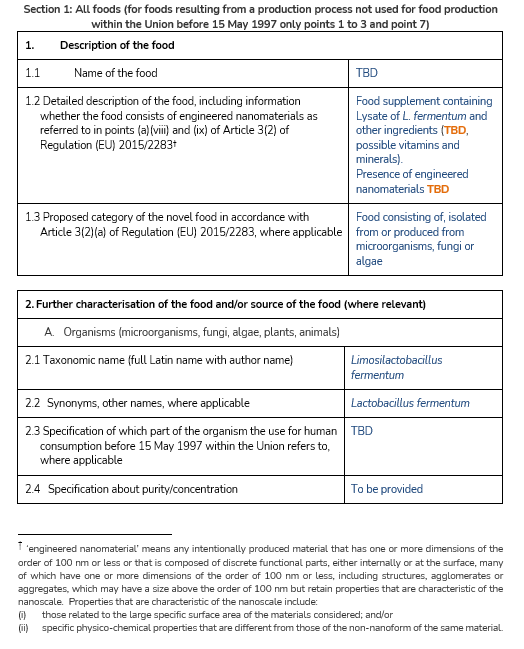
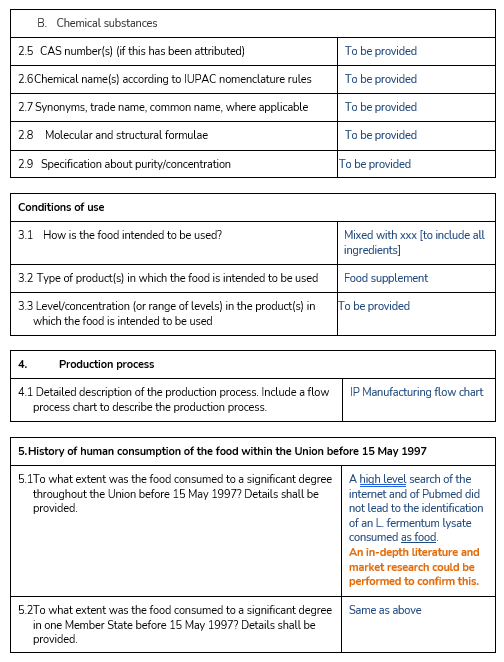
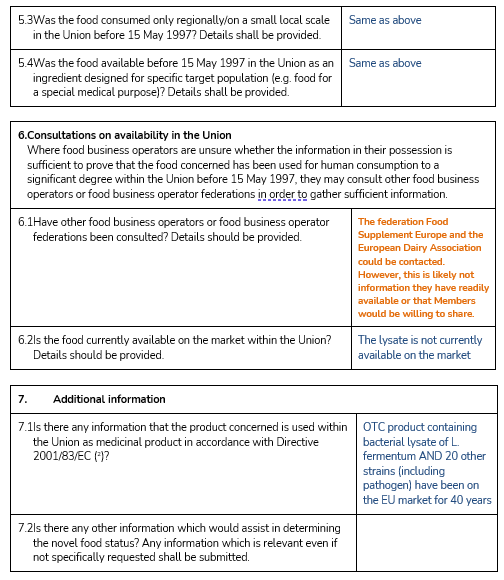
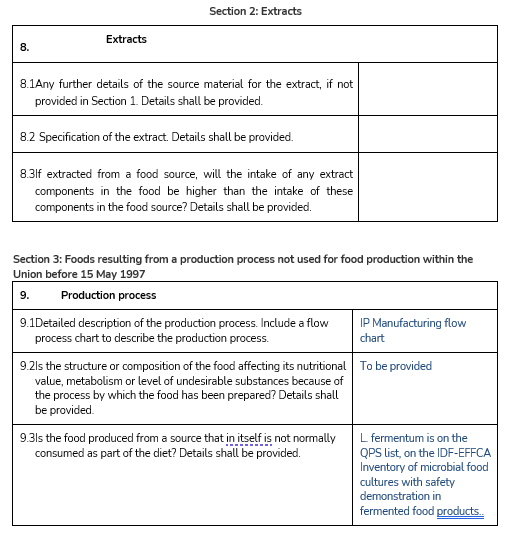
Such an application for an opinion on the status of the product would be the most logical next step, however, a great deal more detail would be required for the compilation of the dossier required to support such a request than has been provided for this assessment: Table 3 below is extracted from Annex II of EU Regulation 2018/456 [12] on the procedural steps of the consultation process for determination of novel food. It describes the content of the technical dossier to be submitted to a Member State as part of a consultation request on the novel food status of a food. Elements of answer applicable to the L. fermentum lysate have been included.
Notes: an applicant is not required to provide all the elements of the table provided it has submitted verifiable justification for the absence of each missing element.
Table 3: Technical dossier for Novel/not novel consultation. Annex II of EU Regulation 2018/456 [12].
Section 1: All foods (for foods resulting from a production process not used for food production within the Union before 15 May 1997 only points 1 to 3 and point 7)
Conclusion
- The bacterial lysate under consideration would appear to be an extract of the biomass of L. fermentum, in which certain constituents are concentrated in relation to others. It does not represent the totality of the cellular material present in the centrifuged biomass at the end of the fermentation process.
- There is no obvious evidence to suggest that such a lysis product (whether extracted/purified or unpurified) has been consumed as a food previously in the EU or GB prior to May 1997.
- Based on this, the lysis product of L. fermentum would likely be considered novel by regulatory authorities in EU member states and also in the UK.
- Even if the totality of the cell biomass following lysis was presented as the food (i.e., no purification/extract takes place) then it is highly probable that it could still be considered novel.
Next steps
- It is possible (not compulsory) under the terms of Article 4 of the Novel Food Regulation, to request a formal view on the novel / not novel status of a food from a competent authority in a Member State (a similar process exists in the UK via the Food Standards Agency).
- It is a process that is faster than a full application and will provide a definitive assessment. Details would be required for compilation of the dossier required to support such a request however the data collected would be used as part of any subsequent application.
5. References
1. Updated list of QPS-recommended microorganisms for safety risk assessments carried out by EFSA
https://zenodo.org/records/7554079
2. Application for consultation to determinate the status of a novel food, pursuant to Article 4(2) of the Regulation (EU) 2015/2283 of the European Parliament and of the Council of 25 November 2015 on novel foods. REF ARES(2022) 2258765 – 28/03/2022
https://food.ec.europa.eu/system/files/2022-03/novel-food_consult-status_ibalance-aesan_2258765.pdf
3. Microorganisms as notified to EFSA (received until March 2023)
https://zenodo.org/records/7554134
4. Scientific Opinion on the substantiation of health claims related to Lactobacillus fermentum CECT5716 and maintenance of the upper respiratory tract defence against pathogens by maintaining immune defences (ID 916) pursuant to Article 13(1) of Regulation (EC) No 1924/2006 https://www.efsa.europa.eu/en/efsajournal/pub/1802
5. Bulletin of the IDF N° 514/2022: Inventory of microbial food cultures with safety demonstration in fermented food products
6. Bernardeau, M., Guguen, M., Vernoux, J.P. 2006. Beneficial Lactobacilli in food and feed: Long-term use, biodiversity and proposals for specific and realistic safety assessments. FEMS Microbiology Reviews 30(4):487-513
https://onlinelibrary.wiley.com/doi/abs/10.1111/j.1574-6976.2006.00020.x?sid=nlm%3Apubmed
7. Lactic Acid Bacteria: Lactobacillus spp.: Other Species. Salam A. Ibrahim, in Reference Module in Food Science, 2016
https://www.sciencedirect.com/science/article/abs/pii/B978008100596500857X?via%3Dihub
8. LACTOBACILLUS spp. | Other Species. V. Crow, B. Curry, in Encyclopedia of Dairy Sciences, 2002
https://www.sciencedirect.com/science/article/abs/pii/B0122272358002455
9. Commission Implementing Regulation (EU) 2017/2470 of 20 December 2017 establishing the Union list of novel foods in accordance with Regulation (EU) 2015/2283 of the European Parliament and of the Council on novel foods
https://eur-lex.europa.eu/legal-content/EN/TXT/?uri=CELEX%3A02017R2470-20230822
10. Consultation process on novel food status
https://food.ec.europa.eu/safety/novel-food/consultation-process-novel-food-status_en
11. Decisions terminating the procedure for novel food authorization
https://food.ec.europa.eu/safety/novel-food/decisions-terminating-procedure_en
12. Commission Implementing Regulation (EU) 2018/456 of 19 March 2018 on the procedural steps of the consultation process for determination of novel food status in accordance with Regulation (EU) 2015/2283 of the European Parliament and of the Council on novel foods
https://eur-lex.europa.eu/legal-content/EN/ALL/?uri=CELEX%3A32018R0456
Was this article helpful?