
8. Safety Parameters
- 6 Mins to read
- DarkLight
8. Safety Parameters
- 6 Mins to read
- DarkLight
Article summary
Did you find this summary helpful?
Thank you for your feedback
Beers, RTDs, Whisky
Mongolia

This section provides the safety parameters (microbiological, contaminants, heavy metals, pesticides, veterinary residues, and food contact materials).
8.1 Microbiological Standards
Provision, Limits, Testing Methods | ||||||||||||||||
Foodstuff/General Food | The regulation of microbial safety and hygiene criteria can be found in MNS 6308:2012, which specifies the permissible levels of microbial safety and hygiene criteria in food products. This standard applies to the establishment of microbiological criteria for consumer food and baby food products [1]. | |||||||||||||||
Category Alcohol | Apply the criteria set for group "Various drinks" specified in MNS 6308:2012 [1]
n: The number of samples or units analyzed c: The maximum number of samples that can yield marginal results, which are results between m and M m: Lower limit M: Upper limit | |||||||||||||||
| Product Beer, 4-7% Alcohol | Same as “Category – Alcohol” above. | |||||||||||||||
| Product Ready-to-drink beverages (mainly Chuhai), 3- 9% Alcohol | Apply the criteria set for group "Various drinks" the same as “Category – Alcohol” above; and Microbiological criteria as specified in MNS 5253:2003 [11].
| |||||||||||||||
| Product Whisky: around 45% | Apply the criteria set for the group "Various drinks" the same as “Category – Alcohol". |
8.2 Contaminants and Heavy Metals
Provision, Limits, Testing Methods | |
Foodstuff/General Food | Contaminant limits in food are governed by MNS CAC 193:2007, General Standards for Toxic and Contaminant Substances in Food Products. MNS CAC 193:2007 follows the fundamental principles and procedures recommended by the Food Law Commission (FLC) concerning contaminants and toxins in food and animal feed. It establishes maximum permissible levels for contaminants and naturally occurring toxins in food and feed, promoting alignment with international trade standards. This standard is based on the Codex General Standard for Contaminants and Toxins in Food and Feed (CXS 193-1995). |
Category Alcohol | Not specified. There is no general set of criteria for alcoholic beverages. Products will be subject to limits specified by MNS CAC 193:2007 based on their specific ingredients. |
| Product Beer, 4-7% Alcohol | Limits of heavy metals in beer comply with MNS 0181:2017 [2]:
Testing methods [2]
|
Product Ready-to-drink beverages (mainly Chuhai), 3-9% Alcohol, and Whisky: around 45% | Limits of heavy metals in Ready-to-drink beverages and Whisky comply with MNS 5984:2009 and MNS 5253:2003 [4, 11]:
Testing methods [4]
|
8.3 Pesticides
Provision, Limits, Testing Methods | |
Foodstuff/General Food | In Mongolia, the maximum permissible residue levels of veterinary medicines, preparations, and pesticides in food raw materials and products are regulated by Order No. A/31 issued by the Minister of Industry and Agriculture. It also outlines inspection and certification requirements for food products to comply with these established standards [7]. Order No. A/31 establishes the limits for pesticide residues in food products, which must comply with MNS 5868:2008 on the maximum permissible levels of pesticide residues in food products [8]. The scope of MNS 5868:2008 applies to animals such as pigs, chickens, sheep, cattle, rabbits, and their respective animal products [8]. |
Category Alcohol | Not specified. Alcoholic beverages are not within the scope of MNS 5868:2008 on maximum pesticide limits in food. |
Product Beer, Alcoholic ready-to-drink beverages, and Whisky | Same as “Category – Alcohol” above. |
8.4 Veterinary Standards
Provision, Limits, Testing Methods | |
Foodstuff/General Food | Maximum permissible residue levels of veterinary medicines shall conform to the Appendix of Order No. A/31 issued by the Minister of Industry and Agriculture [7]. |
Category Alcohol | Not specified. |
| Product Beer, Alcoholic ready-to-drink beverages, and Whisky | Not specified. |
8.5 Other Notes on Safety Parameters
8.5.1 Beer, 4-7% Alcohol
Other contaminants:
| No. | Indicator | Requirements | Testing method |
| 1 | Mycotoxin, mcg/kg | Meets the requirements of MNS 6361, Maximum Permissible Levels of Mycotoxin Residues in Food and Animal Feed [2, 9]. Apply the limit set for group “2.2.12 Beer with an alcohol content of no more than 6%": Ochratoxin A, max 0.2 mcg/kg [9]. | MNS 6049:2009, Enzyme immunoassay for the determination of ochratoxin A content. |
| 2 | Radiation residue, Bq/kg | MNS 0181:2017 stipulates that the permissible level of radiation contamination in beer must comply with the "Radiation Safety Norms-2015," as approved by Resolution No. 06 of 2015 by the Nuclear Energy Commission [2]. Apply the limit set for "other food products" in Chapter 9 of CZAN 2015: max 100 Bq/kg for cesium-137 and strontium-90 [10]. | Not specified. |
8.5.2 Ready-to-drink beverages (mainly Chuhai)
The standards for Stability, Aflatoxin, and Mescaline in alcoholic soft drinks, as specified by MNS 5253:2003 [11], are as follows:
- Stability: 3 – 12 months
- Aflatoxin B1: Not detectable
- Aflatoxin B2: Not detectable
- Mescaline: Not detectable
8.5.3 Ready-to-drink beverages (mainly Chuhai), 3-9% Alcohol, and Whisky around 45%
According to Chapter 9 of CZAN 2015, the maximum allowable limit for radionuclides in "other food products" is set at 100 Bq/kg for cesium-137 and strontium-90 [10].
However, MNS 5984:2009 establishes stricter limits for liqueurs and liqueur-type alcohol, specifying a maximum of 5 Bq/kg for cesium-137 and 3.0 Bq/kg for strontium-90, which are considered more appropriate due to their heightened stringency [4].
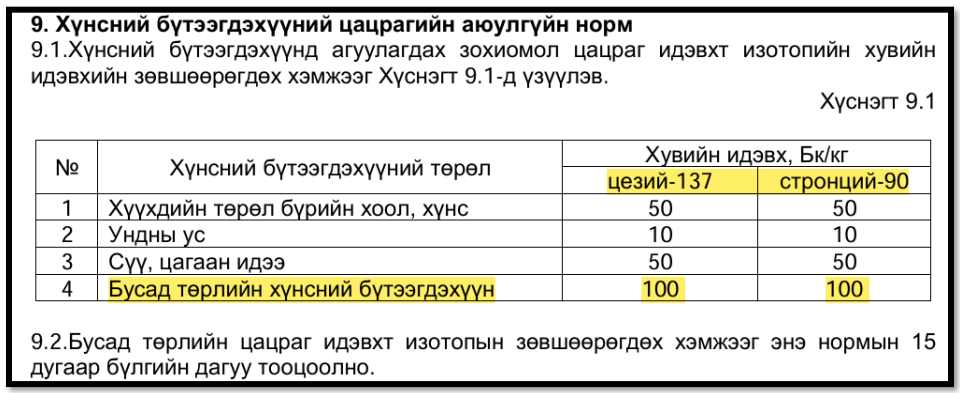
Figure 3. Chapter 9 of the "Radiation Safety Norms-2015," as approved by Resolution No. 06 of 2015 [10].
8.6 Food Contact Materials
Please refer to the other reports on packaging requirements for food contact materials and packaging requirements for food contact materials (hygiene standard) for Mongolia.
8.7 References
1. MNS 6308: 2012 Acceptable levels of microbial safety and hygiene criteria in food products
2. MNS 0181:2017 Various types of beer. General technical requirements
3. MNS 2108:2000 Malt - Technical general requirement
https://old.estandard.gov.mn/standard/v/4680
4. MNS 5984:2009 Alcoholic beverages. Liqueurs and liqueur-type alcohol. General technical requirements
5. MNS CAC 193: 2007 General standards for toxic and contaminant substances in food products
6. Codex General Standard for Contaminants and Toxins in Food and Feed (CXS 193-1995)
7. Order No. A/31 of the Minister of Industry and Agriculture on Maximum Permissible Residues of Veterinary Medicines, Preparations, and Pesticides in Food Raw Materials and Products
https://legalinfo.mn/mn/detail/11914/1/7295
https://legalinfo.mn/uploads/akts/akt%2021tei/akt15/2.pdf
8. MNS 5868: 2008 Maximum permissible levels of pesticide residues in food products
9. MNS 6361: 2012 Maximum permissible levels of mycotoxin residues in food and animal feed
10. Radiation Safety Norms-2015" approved by the Nuclear Energy Commission's Resolution No. 06 of 2015.7
https://legalinfo.mn/mn/detail?lawId=11322
11. MNS 5253:2003 Alcoholic soft drink. Technical general requirements
Was this article helpful?