
8. Safety Parameters
- 4 Mins to read
- DarkLight
8. Safety Parameters
- 4 Mins to read
- DarkLight
Article summary
Did you find this summary helpful?
Thank you for your feedback
Quick-frozen Foodstuffs
EU

This section provides the safety parameters (microbiological, contaminants, heavy metals, pesticides, veterinary residues, and food contact materials).
8.1 Microbiological Standards
Provision, Limits, Testing Methods | |
Category Quick-frozen foodstuffs | Please refer to Section 8.1 - Microbiological Standards - of the "General Foods" guidebook for the EU. |
Product Frozen Potato Products - Deep Fried | Pathogens for testing [1]: Bacillus cereus Spices and spice products often carry a significantly high load of Bacillus species, usually in the spore form. Spices may be added to these products as part of the coating or flavoring, coloring, or seasoning, albeit as a very small proportion of the finished product. However, depending on the nature of the food to which they are added, outgrowth is possible and may then pose a health risk. Levels in spices exceeding 106 cfu/g are therefore regarded as unsatisfactory. |
Product Frozen Cheese Snack Products - Deep Fried | Pathogens for testing [1]: Salmonella Species This organism can survive for long periods of time in high-fat cheese and snacks. Listeria Monocytogens Growth of this bacterium following both post-process contamination of cooked or processed foods or in raw foods probably represents the greatest risk for disease transmission. L. monocytogenes can grow between <0°C to 45°C slowly at refrigeration temperatures. Safety Criteria For soft-ripened cheese, it is recommended that an enrichment method be used, in addition to enumeration, to check that there is an absence of Listeria spp. in 25g of food. Result (cfu/g) Microbiological Risk Category >10² High 10 - <10² Border-line <10 Low Staphylococcus aureus and other coagulase-positive staphylococci Staphylococcal enterotoxins are heat-stable and can survive some normal cooking processes including boiling, hence active toxin can be present in the absence of viable organisms. Most coagulase-positive staphylococci grow between 7°C and 48°C with no growth at refrigeration temperatures. In foods such as ripened cheeses and fermented meat products, S. aureus levels are highest 2–3 days after initial production and may reduce significantly during storage. If levels exceed 105 cfu/g at any time during the life of a food, there is a risk of sufficient enterotoxin to cause illness. Safety Criteria The only food safety criterion for staphylococci in Regulation (EC) No. 2073/2005 (as amended) is for an absence of staphylococcal enterotoxins in cheese, milk powder, and whey powder in products placed on the market during their shelf life. This Regulation has process hygiene criteria with limits of between 10 and 105 coagulase-positive staphylococci/g in cheese, milk, and whey powder during manufacture, and if values of >105 cfu/g are detected, the batch should be tested for staphylococcal enterotoxins.
Escherichia coli Escherichia coli may sometimes be found in soft, mold, ripened, or washed-rind cheese made from raw milk. Safety Criteria Although Regulation (EC) No. 2073/2005 (as amended) has no criteria for E. coli in cheese made from raw milk, it is recommended that these cheese types be routinely tested for E. coli and an investigation undertaken if a change in trend is detected. It is also recommended that a risk assessment is performed to assess the need for periodic monitoring for VTEC O157.
Aerobic Colony Count (ACC) The Aerobic Colony Count (ACC), also known as the Total Viable Count or Standard Plate Count, is an indicator of quality, not safety, and cannot directly contribute towards a safety assessment. |
8.2 Contaminants and Heavy Metals
Provision, Limits, Testing Methods | |
Category Quick-frozen foodstuffs | Please refer to Section 8.2 - Contaminants and Heavy Metals Standards - of the "General Foods" guidebook for the EU. |
Product Frozen Potato Products - Deep Fried | Please refer to Section 8.2 - Contaminants and Heavy Metals Standards - of the "General Foods" guidebook for the EU. In addition, for Deep Fried Potato Snacks, the following apply [2]:
These maximums apply to the raw material “peeled potatoes”. |
Product Frozen Cheese Snack Products - Deep Fried | Please refer to Section 8.2 - Contaminants and Heavy Metals Standards - of the "General Foods" guidebook for the EU.
In addition, for Deep Fried Cheese Snacks (milk), the below applies [2]:
|
8.3 Pesticides
Provision, Limits, Testing Methods | |
Category Quick-frozen foodstuffs | Please refer to Section 8.3 - Pesticides - of the "General Foods" guidebook for the EU. |
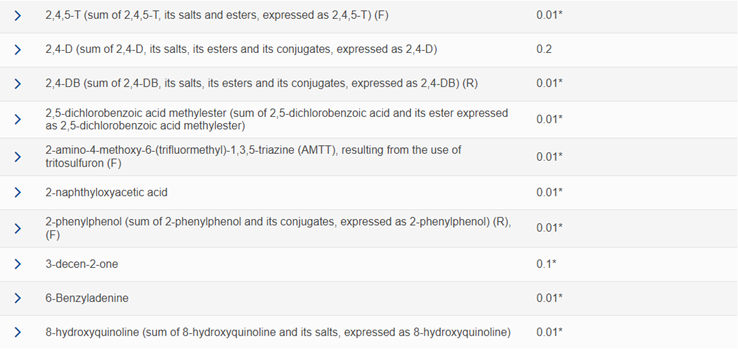
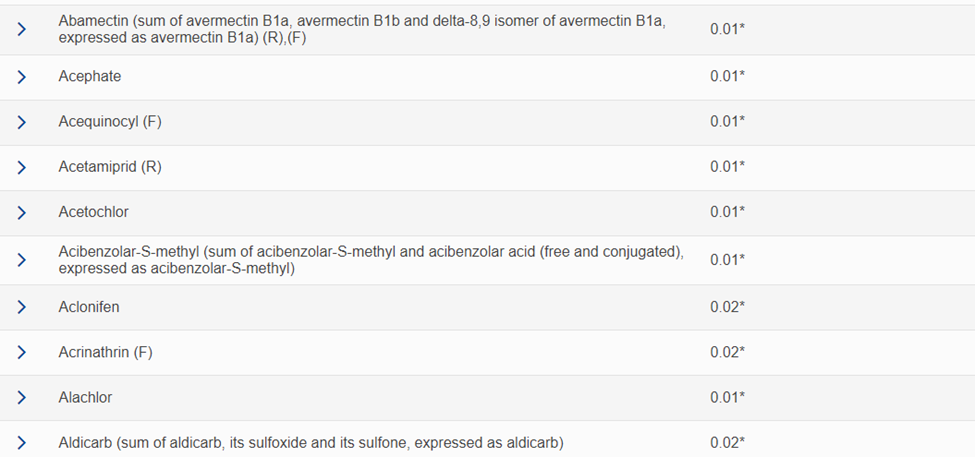
Product Frozen Potato Products - Deep Fried | Please refer to Section 8.3 - Pesticides - of the "General Foods" guidebook for the EU. Specifically for Deep Fried Potato Snacks, the below applies [3]: Raw materials – potatoes – Code number 0211000 Snapshot from the register:
  |
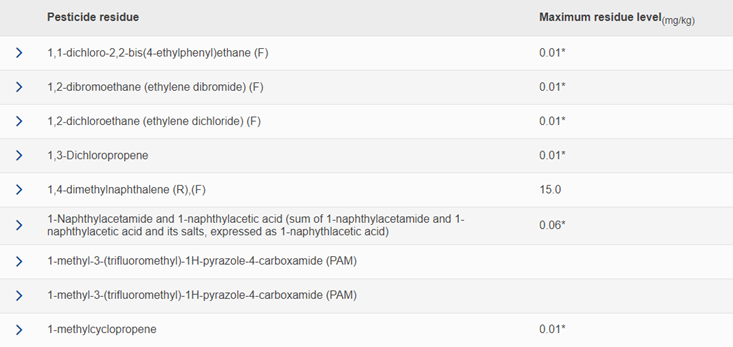
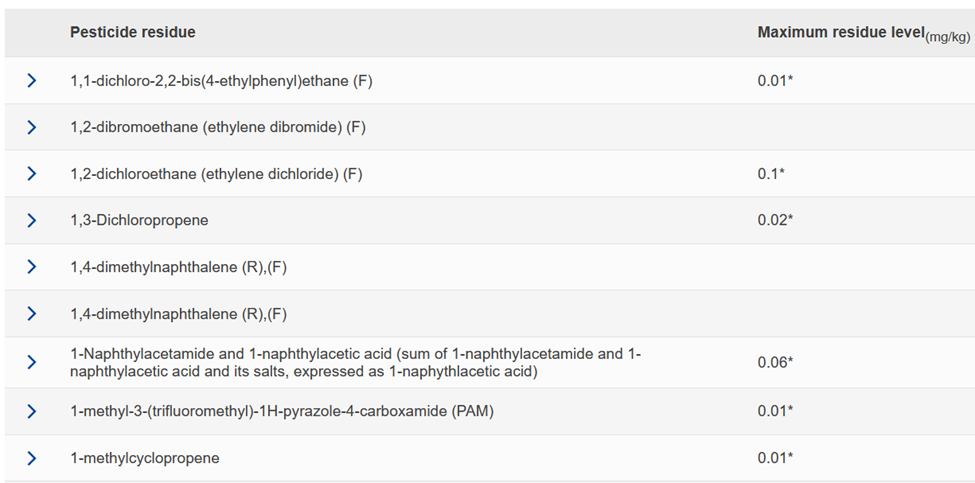
Product Frozen Cheese Snack Products - Deep Fried | Please refer to Section 8.3 - Pesticides - of the "General Foods" guidebook for the EU. Specifically, for Deep Fried Cheese Snacks (milk), the below applies [3]: Raw materials – milk – Code number 1020000 Snapshot from the register:
|
8.4 Veterinary Standards
Provision, Limits, Testing Methods | |
Category Quick-Frozen foodstuffs | Please refer to Section 8.4 - Veterinary Standards - of the "General Foods" guidebook for the EU. |
Product Frozen Potato Products - Deep Fried | Same as "Category" above. |
Product Frozen Cheese Snack Products - Deep Fried | Same as "Category" above. |
8.5 Food Contact Materials
Provision, Limits, Testing Methods | |
Category Quick-frozen foodstuffs | Please refer to Section 8.5 - Food Contact Materials - of the "General Foods" guidebook for the EU. |
Product Frozen Potato Products - Deep Fried | Same as "Category" above. |
Product Frozen Cheese Snack Products - Deep Fried | Same as "Category" above. |
8.6 References
1. Regulation (EC) No. 2073/2005
CL2005R2073EN0090010.0001_cp 1..1 (europa.eu)
3. EU database of pesticides
Was this article helpful?